Platforms Have an LLM Read Your Articles, but Let Your Readers Decide the Ranking
CIKM 2026, the ACM Conference on Information and Knowledge Management, took place in Rome from November 7 to 11. Its applied research track covers systems in production: Google, LinkedIn, Meta and ByteDance describe how they recommend and rank content. We read eight papers, seven from CIKM and one from RecSys 2026, and compared them with our Discover data. This article goes through them platform by platform, then presents our measurement of clickbait headlines, with its full method.
In brief
- The LLM reads, but the ranking learns mostly from readers. Google has a large language model (LLM) compare pairs of articles. Meta has one browse a user's network, ByteDance has one read the title and the speech in videos. The ranking, for its part, is trained on clicks, time spent, likes, shares and dismissals.
- The LLM takes a lot of compute. Google, and LinkedIn for its job search, have a small model imitate it, and that small model runs in production. Meta keeps it for the 5 to 10% most active users.
- LinkedIn tested an LLM ranker for its feed. Online, it never beat the model in place.
- At Baidu, the split depends on the query. LLM labels beat clicks on rare queries. On frequent queries, clicks keep a slight edge: they capture the authority and quality of the page.
- The tie between reader and source comes in separately. LinkedIn adds it to the model as a separate input. Discover keeps a dedicated queue for the sources the reader follows.
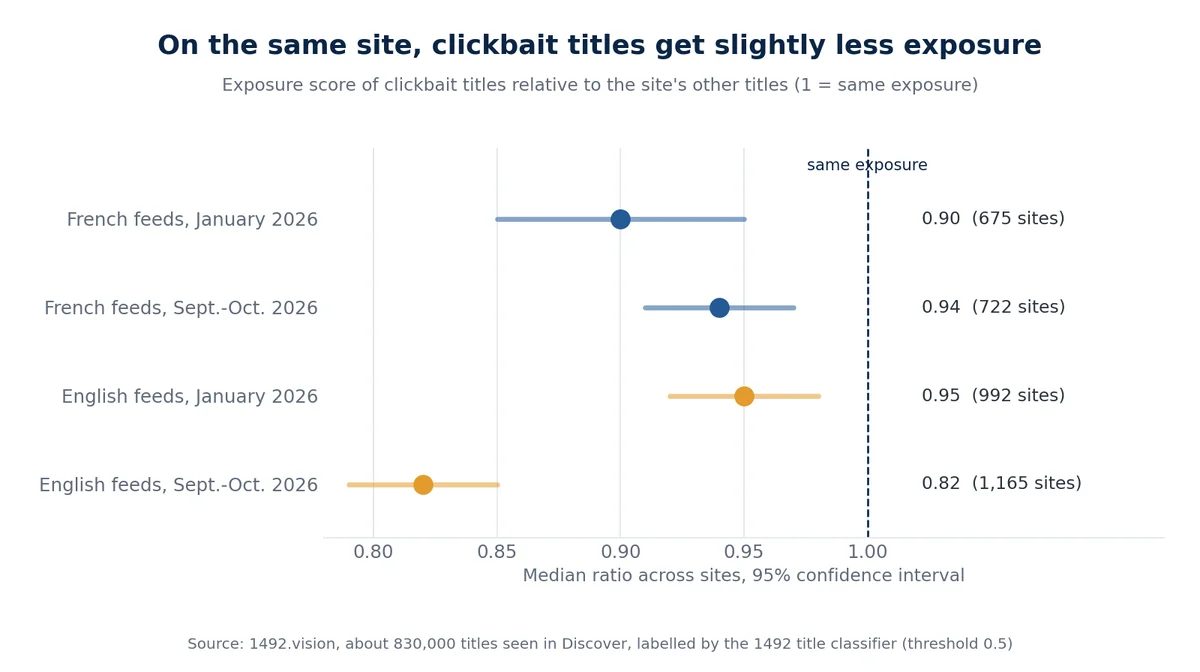
- In our Discover data, on the same site, clickbait headlines get slightly less exposure. The ratio ranges from 0.90 to 0.95, except in English-language feeds in September-October, where it drops to 0.82.
Read, then rank
A recommender system works in stages. It gathers candidates (articles, posts, videos), drops some of them with filters, then ranks the rest for each user. In the CIKM 2026 papers, the LLM steps in before the ranking, or next to it. It reads a piece of content, or a user's network, and turns it into a label or a description. The final ranking is mostly left to a model that predicts the reader's reactions.
Three terms come up in what follows:
- labeling: a large model judges examples, such as two articles on the same topic or a job offer against a query, and its judgments are used to train another model;
- the small model that imitates: trained on those labels, it runs in production, faster and with less compute;
- the A/B test: some users get the new system, the others keep the old one, and the published gains compare the two groups.
This applied research answers a question newsrooms have been asking since LLMs became everywhere: should you write for them? Going by these papers, written by the platforms' own researchers in a track devoted to systems in production, the answer is clear:
The LLM reads your articles, but the rank is decided by your readers' reactions.
Discover: two filters before the ranking
We analyzed Google's SDF paper in our article on staleness in Discover. Before ranking, Discover removes stale articles. Two filters do the job.
The first one spots an article superseded by a newer article on the same topic. Google had a large model, PaLM 2-L, label 1.1 million pairs of articles. It then trained a smaller model, T5 (11 billion parameters), to reproduce those labels. We will find the same recipe at LinkedIn and Meta: the large model labels, the small model serves.
The second filter, called PTR, estimates whether an article has already received most of its audience. It reads the text, the images and the video. But it learns from clicks coming from Google Search. Google does not use page views, which it considers "biased by publisher promotion."
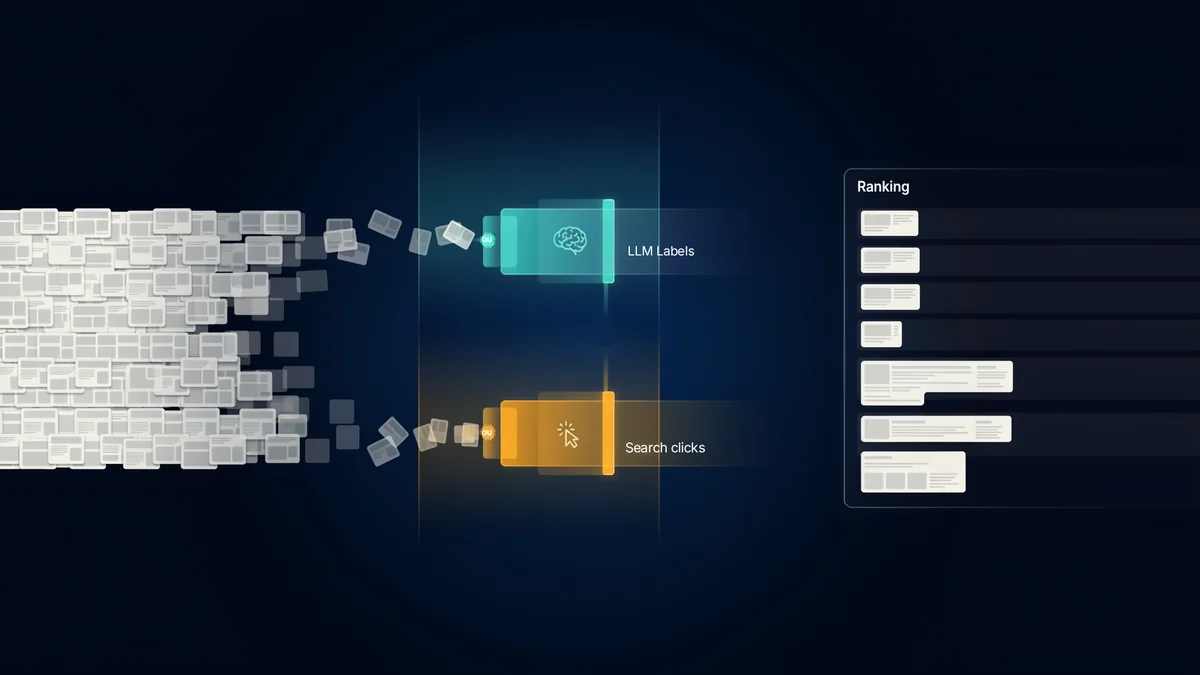
Then comes the ranking. Another paper from the same team, presented at RecSys 2026, describes it. The model predicts 11 reader reactions: positive ones (click, like) and negative ones (dismissing the card, blocking a source). The paper gives neither the full list nor the weight of each.
The authors name a risk: a model tuned mainly on click-through rate "may disproportionately favor low-quality articles (e.g., click-bait) over high-value videos and UGC." In their baseline model, "poor-quality web articles frequently outranked high-quality videos." Further down, we measure where clickbait headlines stand in our feeds.
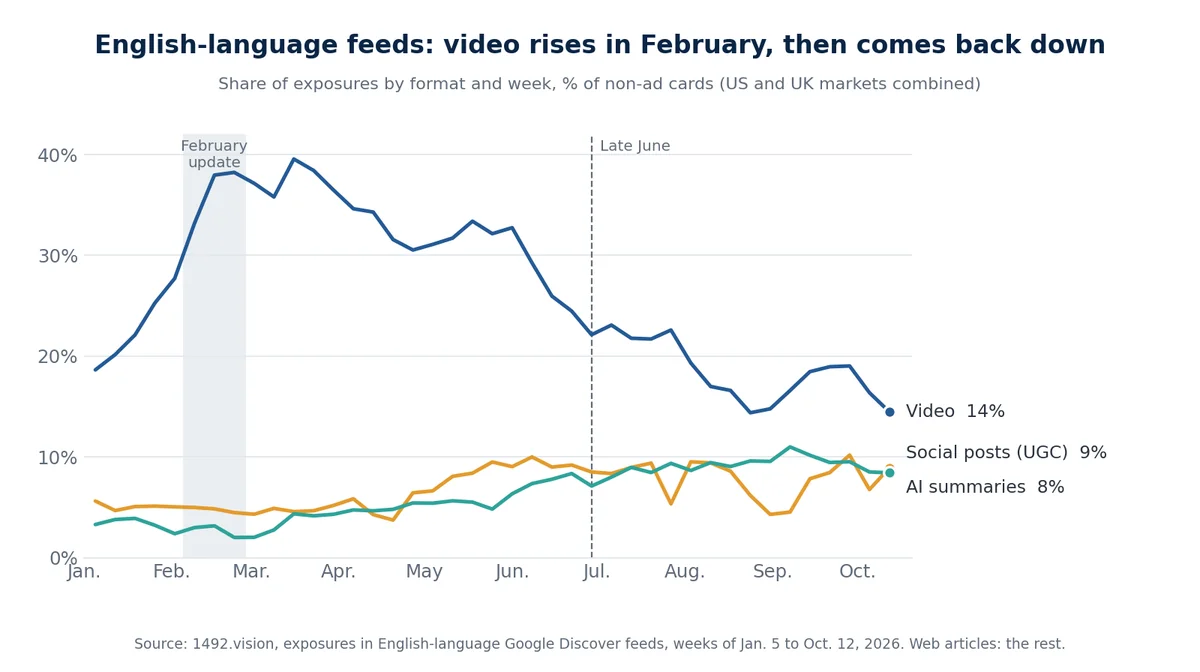
The paper also notes that formats do not draw the same reactions: "articles primarily drive clicks, whereas UGC and sports match cards drive long dwell time." And for new formats, such as AI-generated summaries, the model can rely on the content of the card rather than on a still thin history of reactions, "transitioning away from sparse historical interaction signals to focus on the rich semantics within the card." This is Baidu's rule again: the text matters when reactions are missing. In our feeds, formats other than the web article have not gained ground since June 2026. In English, video is declining, and only AI-generated summaries are growing.
LinkedIn: the LLM ranker failed online
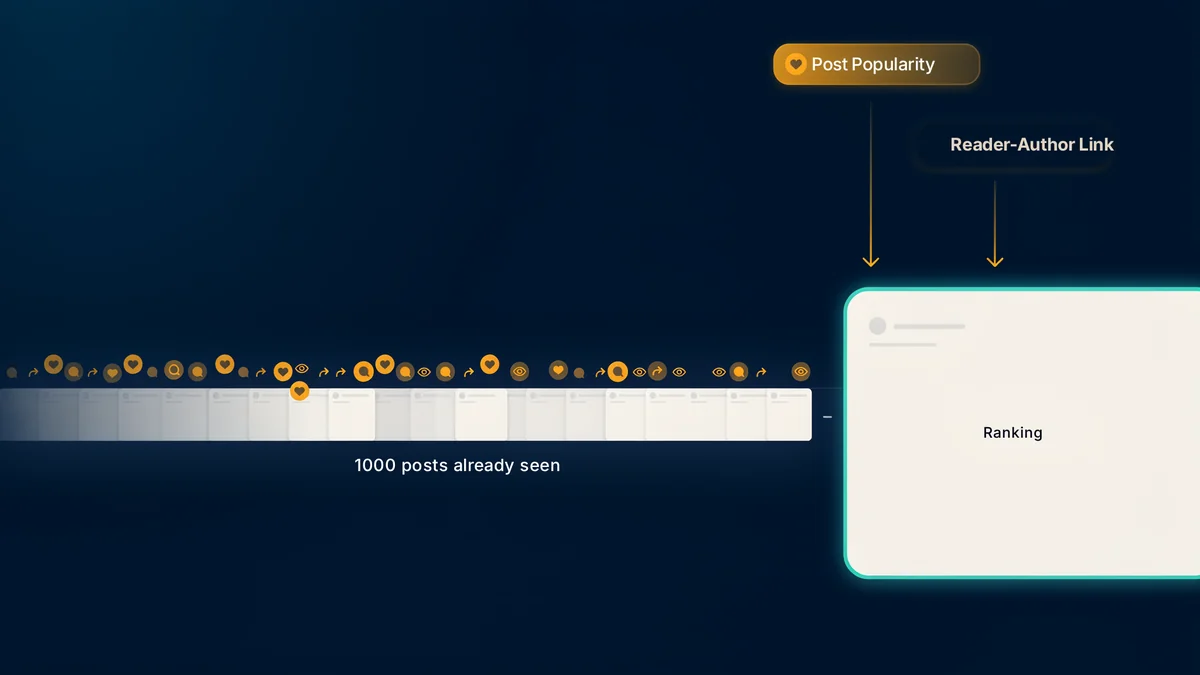
The LinkedIn feed is ranked by a model that predicts, for each post, whether you will read it at length, click, like, comment or share. To do so, it looks at the last 1,000 posts you saw and what you did with each one. In an A/B test, it raised time spent by 2.10% and reactions by 3.52%.
Two pieces of information come in separately: the post's popularity, and the tie between you and its author.
The team also tested a ranker built on an LLM. It did well on posts from people you do not follow. It struggled with posts from your network. And it took a lot of compute. Online, it never beat the model in place: "the LLM-Ranker never achieved superior online performance over the existing production model."
Our reading:
The tie between you and the author is not in the text of the post. A model that reads only the text cannot guess it.
LinkedIn still uses an LLM, in job search. An 8-billion-parameter model judges how relevant job offers are. A 0.6-billion-parameter model learns to imitate it, and that is the one running in production. Same recipe as Google.
Baidu: clicks learn what the text does not say
A team from the Chinese Academy of Sciences, with three Baidu researchers, asks the question head on. Can a search engine learn from labels produced by an LLM, rather than from users' clicks?
Their answer depends on the query:
- on rare queries, the LLM beats clicks;
- on frequent queries, clicks keep a slight edge;
- combining the two signals gives the best result.
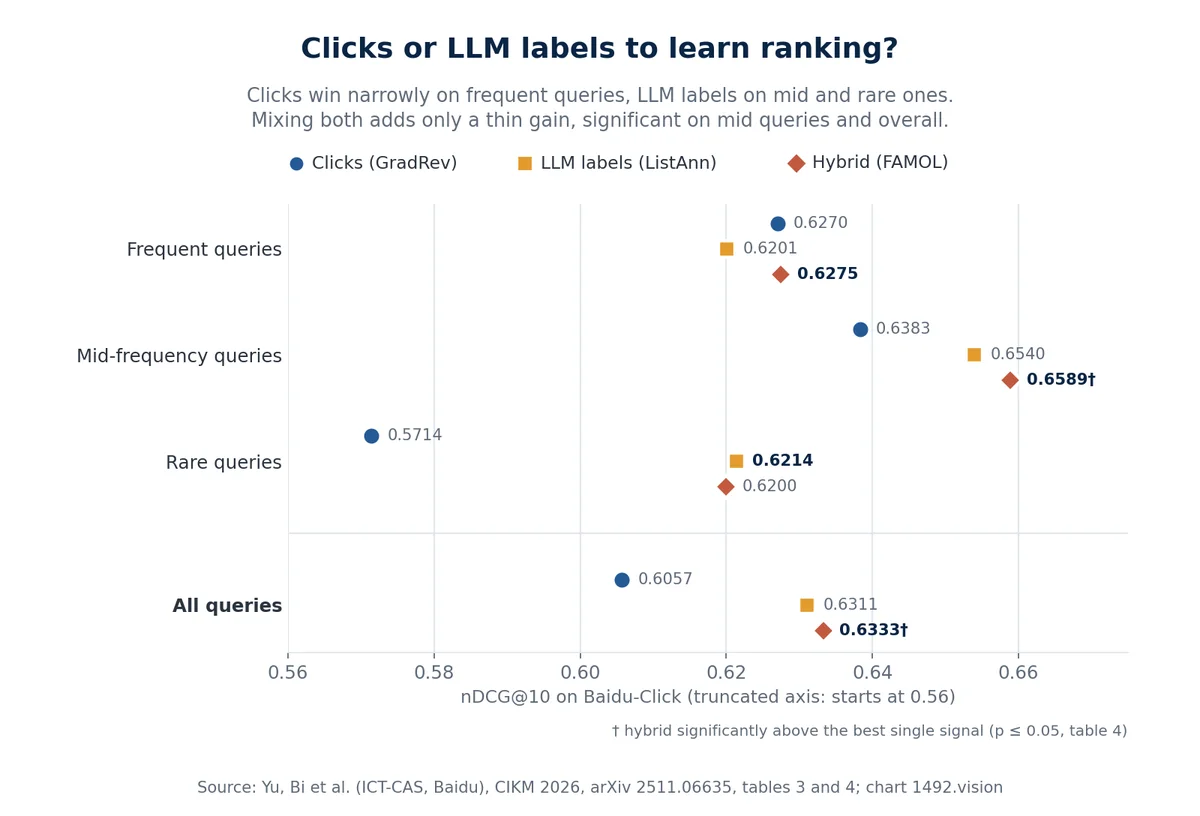
The gap comes from click volume. On a frequent query, many pages answer well. The clicks of thousands of users tell them apart: according to the authors, they capture the authority and quality of the page, which the LLM does not see in the text. On a rare query, in the long tail, clicks are too few or too noisy to learn from ("sparse or unreliable"). The LLM only needs the text: it judges whether the page answers the query, even if few users have seen it.
The researchers tried giving the LLM each page's PageRank, to close its gap on frequent queries. It did not work: the model reads numbers poorly.
SEOs will think of NavBoost. At the U.S. antitrust trial against Google in 2023, Pandu Nayak, who leads Search at Google, described it as a memory of clicks on results over the past 13 months (SE Ranking reproduces the excerpt from his testimony). A former Google engineer, Eric Lehman, summed it up as, essentially, a big table (Abondance, in French). The leak of Google's internal documentation in 2024 detailed the types of clicks it records (Resoneo).
A click memory only works where clicks exist, so mostly on frequent queries. The paper does not mention Google, and the connection is ours. But the reading is the same:
Clicks where there is volume, a language model for the long tail.
Applied to a feed, one can expect readers' reactions, when there are many of them, to teach the system what the text does not say.
Meta and ByteDance: keep the LLM for a few, or train it on usage
At Meta, an LLM browses a user's network (friends, groups, followed pages) to find videos for them. In an A/B test, watch time rises by 0.43%. But the LLM only serves the 5 to 10% most active users. For everyone else, a small model imitates its choices, in about one millisecond.

At ByteDance, the paper is about search in Douyin, the Chinese version of TikTok. A model reads the title, the on-screen text and the speech in videos. It learns at the same time as the ranking, from user behavior. It ranks better than a generic language model used as is. Online, it adds 0.56% of time spent and 1.1 to 1.5% of reactions (videos watched to the end, likes, shares).
These gains are small. ByteDance notes that a 0.1% gain in its offline tests is enough to produce visible gains in an A/B test.
The same split at all four
| Platform | The LLM reads | The ranking learns from |
|---|---|---|
| Google Discover | Pairs of articles, to spot superseded ones | Search clicks (article age); 11 reader reactions (ranking) |
| LinkedIn (feed) | Nothing: the LLM ranker was dropped | Long reads, clicks, likes, comments, shares, over 1,000 posts seen |
| Meta | The network of the 5 to 10% most active users | Watch time |
| ByteDance (Douyin search) | Title, on-screen text and speech in videos | Search behavior |
The LLM takes a lot of compute. So platforms keep it for the most active users, or train a small model to imitate it.
The ranking keeps what the text does not contain: the authority of a source, the tie between a reader and an author, the popularity of a post.
In our Discover data
We track real Discover feeds, in French and in English. Discover attaches internal scores to every card. We have been describing some of them since December 2025 (our first findings), then in our study on attention prediction.
Like the 11 reactions in the RecSys paper, these scores come in families. Some rise with predicted engagement. Others estimate disinterest, for example the risk that the card is scrolled past without a glance.
Our SDF article gave two examples. The score we call "topic potential" depends on the content and hardly at all on the reader. When the same feed sees the same article again, this score does not change with the article's age (about 11,500 cases). And it treats articles whose URL contains a clickbait phrase exactly like the others: 0.187 against 0.183, on about 23,500 articles, in spring 2026.
Discover also keeps a place for the sources a reader follows. Their articles go through a separate recommendation queue, followedcreatorcontent, which works like a reserved slot, with an average weight about twice as high. And when the reader follows a source, the share of the affinity between that reader and that source rises by about 18% in the prediction (our October 2026 newsletter, in French). This is the equivalent of the reader-author tie that LinkedIn handles separately. The RecSys paper describes the same mechanism on Google's side: for a followed creator, the model can move "away from the global popularity priors that heavily influence unfollowed organic ranking, orienting instead toward user-creator affinity."
Clickbait headlines get slightly less exposure
Another CIKM 2026 paper proposes a new method to detect clickbait headlines. Since it says nothing about how they are distributed, we measured it.
We classified about 830,000 headlines seen in Discover, in French and in English, with a 1492 headline classifier trained to measure how clickbait a headline is. The headlines come from two periods: January 2026, then September and October 2026. For each site, we compared the exposure score of its clickbait headlines with that of its other headlines.
On the same site, a clickbait headline gets slightly less exposure.
| January 2026 | September-October 2026 | |
|---|---|---|
| French-language feeds | 0.90 | 0.94 |
| English-language feeds | 0.95 | 0.82 |
Exposure of clickbait headlines relative to the same site's other headlines (1 = same exposure). Median over 675 to 1,165 sites depending on the cell. All 95% confidence intervals stay below 1.
The gap widens when we keep only the most clearly clickbait headlines. In English, it was small in spring and widened markedly in the fall. The details of the measurement are at the end of the article.
At the input stage, topic potential does not penalize clickbait phrasing. The gap would therefore form later, when the ranking learns from readers' reactions, dismissals and ignored cards included.
For publishers
The papers presented at this technical conference give no advice to publishers. The following suggestions are therefore our own conclusions.
- Write for the reader. Models read your text, but the ranking learns from what the reader does with it: reading at length, sharing, dismissing the card.
- Say what the article delivers. Google's judge compares your article with newer ones. ByteDance's encoder reads the title. A headline that carries the information reads better than a vague hook. In our data, on the same site, clickbait headlines also get slightly less exposure.
- Look after the tie with your readers. LinkedIn handles the reader-author tie separately. Meta browses the user's network. Discover keeps a place for followed sources. Asking your readers to follow your source works on a signal the text does not carry.
- Don't count on in-house promotion. PTR learns from search clicks. Your homepage, your notifications and your social accounts do not make an article last longer in its eyes.
- Keep your loyal readers. At LinkedIn, the most active members gain the most from the new model. At Meta, the LLM only serves the 5 to 10% most active users. The systems know regular readers better.
The measurement in detail
The headlines. About 830,000 articles seen in our Discover feeds, in French and in English, over two periods: January 2026, then September and October 2026. We keep sites with at least 20 articles, with at most 200 articles per site, language and period, drawn at random. Social posts and videos are excluded. We also remove headlines that are not headlines: interface text captured in place of the title (3,760 articles) and headlines repeated word for word on the same site, such as a section name or a horse-racing result (1,486 articles). Headlines repeated word for word across several sites stay in: they are real articles.
The label. The 1492 headline classifier gives each headline a probability of being clickbait. It reads only the headline. Above 0.5, the headline counts as clickbait. Above 0.8, it is clearly clickbait. On 600 headlines judged by an LLM, the classifier finds clickbait headlines with an F1 of 0.79 (macro-F1).
The calculation. Within each site, we compare the median exposure score of its clickbait headlines with that of its other headlines, drawn in equal numbers (200 draws). A site counts if it has at least 3 clickbait headlines. The figure reported is the median of these ratios across sites. The 95% interval comes from 2,000 random draws among the sites.
At the strict threshold. The gap widens in all four cells. Headlines classified as clickbait by a narrow margin do not explain the result.
| Threshold 0.5 | Threshold 0.8 | |
|---|---|---|
| French-language feeds, January | 0.90 [0.85; 0.95] | 0.88 [0.78; 0.92] |
| French-language feeds, September-October | 0.94 [0.91; 0.97] | 0.88 [0.79; 0.95] |
| English-language feeds, January | 0.95 [0.92; 0.98] | 0.93 [0.90; 0.97] |
| English-language feeds, September-October | 0.82 [0.79; 0.85] | 0.79 [0.74; 0.82] |
In brackets, the 95% confidence interval. From 675 to 1,165 sites depending on the cell.
A second measure. We also computed, within each site, the probability that a clickbait headline drawn at random gets more exposure than another headline from the same site. With no gap, it would be 0.5. It is below 0.5 in all four cells: 0.47 to 0.49 in January and in French, 0.43 in English in September-October. This measure does not depend on the shape of the score, and it confirms the gap.
Over time, in English. Google announced its February 2026 Discover update as targeting, among other things, sensationalism and clickbait (Google's announcement). It rolled out from February 5 to 27, starting in the United States. We classified two more slices in English and compared the gap with January's, on the same sites:
| Compared with January | Sites | Change in the gap |
|---|---|---|
| February 28 to March 6 | 354 | 1.05 [0.95; 1.12] |
| March 7 to April 30 | 784 | 0.96 [0.93; 1.00] |
| September-October | 653 | 0.83 [0.76; 0.85] |
1 = gap unchanged; below 1, the gap widens to the detriment of clickbait headlines.
Right after the rollout, the gap does not move. It widens a little in spring, over a period that also covers the March core update, then markedly in the fall. In between, Discover went through other changes, in early July in particular. The measurement therefore does not tie the gap to the February update. In French, the update was not announced in February: we did not run this test.
By section. The most consistent gap is in sports and practical life, in both languages. No section clearly favors clickbait headlines. The classifier infers the section from the headline alone: this breakdown is indicative.
Other indicators. The daily peak of exposure separates little-seen articles poorly: the ratio there is often 1. Most articles are seen on a single day only. The share of articles seen on at least two days is lower for English clickbait headlines in September-October (8 points lower), but this indicator is less robust than the score.
The text matters, because models read it. But the reader matters even more, because the ranking learns from them.
The levers are in your hands. Over to you!
Sources
- Di Bai, Feng Han, Zhenwei Tang, Jintao Liu, Luoshu Wang, Jialu Liu. "Decomposing Staleness in Recommender Systems: A Dual-Filter Framework for Supersession and Decay." CIKM 2026. arXiv 2608.15780, DOI 10.1145/3799682.3840082.
- Di Bai, Jintao Liu, Zhenwei Tang, Peifan Wu, Nada Al-Thawr, Luoshu Wang. "Heterogeneous Ranking in Industrial-Scale Recommender Systems: A Case Study." RecSys 2026. arXiv 2607.27577, DOI 10.1145/3773078.3831848.
- Lars Hertel, Gaurav Srivastava et al. "An Industrial-Scale Sequential Recommender for LinkedIn Feed Ranking." CIKM 2026. arXiv 2602.12354, DOI 10.1145/3799682.3840102.
- Fedor Borisyuk et al. "Semantic Search At LinkedIn." CIKM 2026. arXiv 2602.07309, DOI 10.1145/3799682.3840152.
- Lulu Yu, Keping Bi, Jiafeng Guo, Shihao Liu, Shuaiqiang Wang, Dawei Yin, Xueqi Cheng. "Can LLM Annotations Replace User Clicks for Learning to Rank?" CIKM 2026. arXiv 2511.06635, DOI 10.1145/3799682.3841034.
- Haoyu Han, Yuming Liu, Lei Huang, Lizhu Zhang, Jiliang Tang, Xiangjun Fan. "ConnectionMind: Leveraging Social Networks and Large Language Models for Personalized Recommendation at Meta." CIKM 2026. arXiv 2608.10187, DOI 10.1145/3799682.3840157.
- Xintian Han, Honggang Chen, Quan Lin et al. "LEMUR: Large scale End-to-end MUltimodal Recommendation." CIKM 2026. arXiv 2511.10962, DOI 10.1145/3799682.3840084.
- Changrong Min et al. "Two important things you must know! Revisiting Clickbait Detection from Perspectives of Humans' Cognition and Emotion." CIKM 2026. DOI 10.1145/3799682.3840795.
- Google Search Central, Google's February 2026 Discover Core Update, February 5, 2026.
- SE Ranking, NavBoost, with the excerpt from Pandu Nayak's testimony (DOJ v. Google, 2023).
- Resoneo, Google leak part 5: click data, NavBoost, Glue and beyond.
- Abondance, NavBoost, signaux manuels, pogosticking : la face cachée du ranking Google (in French).
- 1492.vision, L'été des Search Profiles, October 2026 newsletter (in French).
- 1492.vision, Google Discover filters out stale content before ranking: the SDF paper against our data.
- 1492.vision, Deep dive: how Discover predicts your attention.
- 1492.vision, Inside Google Discover's New Internal Signals, LinkedIn, December 2025.
Authors
Posted on 2026-11-11
More reliable, sourced reporting on Discover? Add us to your sources!
Add to sources Add to sources