Google Discover cards in 2026 carry one entity per reader, Google's topics and new related-feed signals
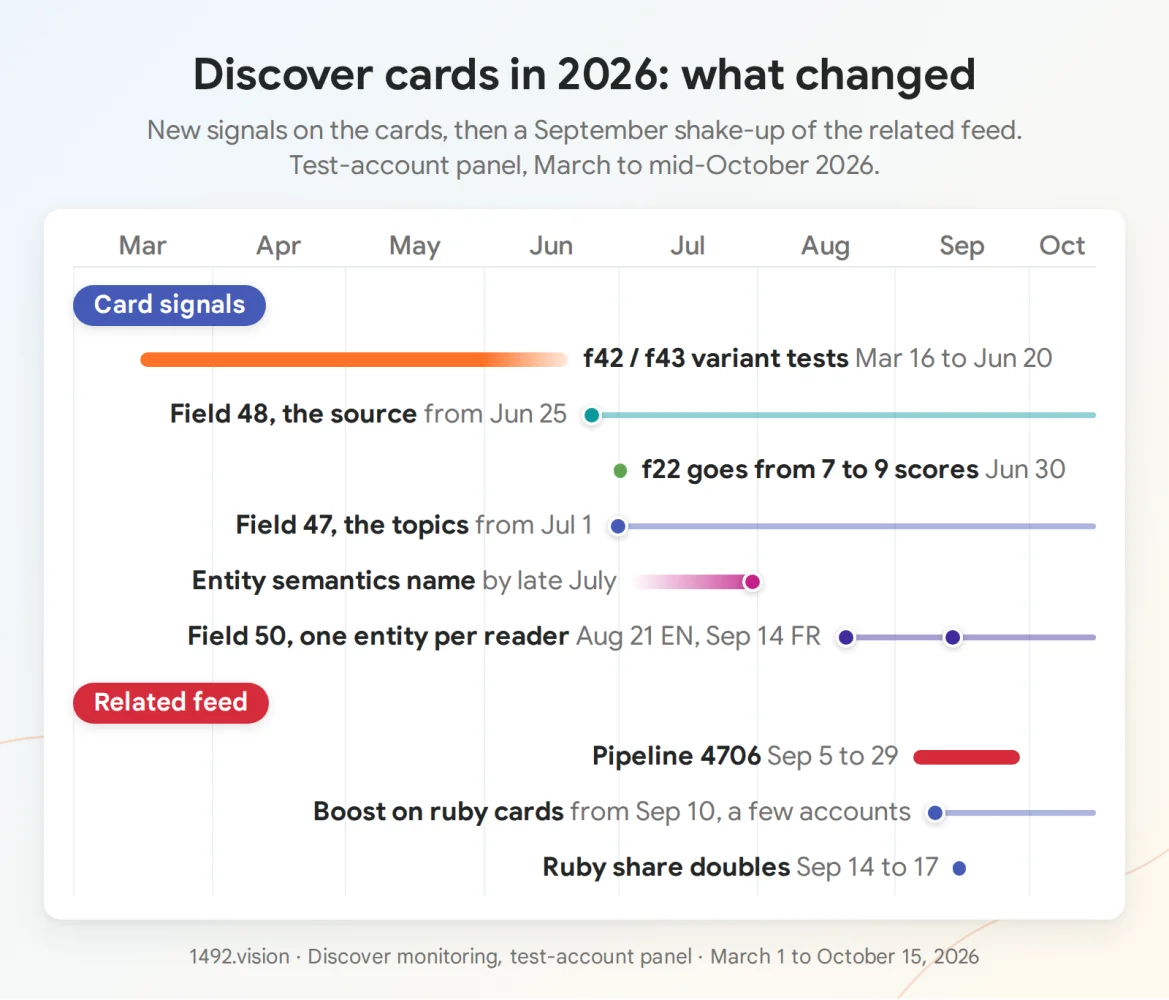
The changes covered in this article, March 1 to October 15, 2026. Faded bars mark dates we cannot pin down.
In December 2025, we described a first set of new internal signals in Google Discover: publisher IDs, "Multi-Objective Scores", generative retrieval. Ten months later, the cards carry more of them. Between March and October 2026, our monitoring saw an entity chosen for each reader appear on cards, Google's public topic taxonomy arrive on every card, test fields come and go, and the related feed go through an unusual September. The field numbers and score indices in this article are our own labels; strings such as relatedcontentruby are Google's internal names.
Key points:
-
Since August 21 in English and September 14 in French, some cards carry one Knowledge Graph entity chosen for each reader (field 50). For the same article on the same day, two readers get a different entity in 65% of cases.
-
This entity follows the reader's reading history far more than their declared interests (63% against 4%), and it sits at the level of detailed entities that Chrome never syncs.
-
A new internal name, DISCOVER_PERSONALIZED_ENTITY_SEMANTICS, was there by the end of July, at least three weeks before field 50. We think the name covers the reader side, and field 50 the card side, of the same matching.
-
From mid-March to mid-June, two fields (f42 and f43) tested ranking variants on a single test account, then disappeared.
-
Since July 1, cards carry up to five topics from Google's public taxonomy (field 47). The first topic is stable, the last ones rotate.
-
In September, the related feed changed in two ways. Ruby, the classic related pipeline, gained ground and a boost on a few accounts. A pipeline we know only by its number, 4706, answered likes and see mores for three weeks, then stopped.
-
Among the f22 prediction scores, f22.8 has become the best click predictor in our panel. f22.2, the score most tied to the boost, went back up without predicting clicks any better.
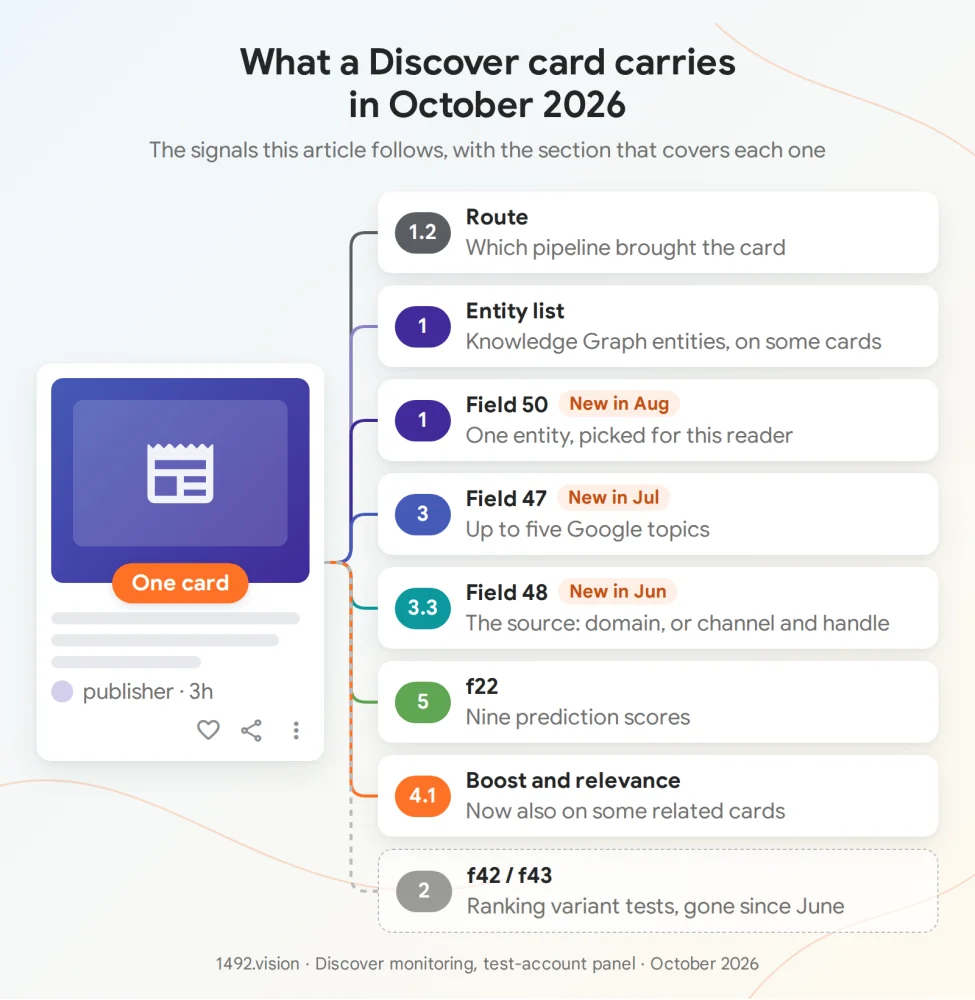
What a card carries in October 2026, with the section of this article that covers each signal.
1) Field 50 gives each reader one entity of the article
Field 50 appeared on August 21, 2026 on English cards, and on September 14 on French cards. It contains a single Knowledge Graph entity, identified by its MID, the Knowledge Graph's machine identifier. Depending on the account, it shows up on 10% to 34% of cards. 79% of these identifiers are classic /m/ MIDs, 21% are more recent /g/ ones.
Field 50 depends on the reader. When the same URL reaches two of our accounts on the same day, field 50 differs in 65% of pairs in English (228 of 350) and 64% in French (60 of 94).
On September 19, two of our readers received the same bleepingcomputer article, "Microsoft fixes bug behind 'Defender Antivirus is turned off' alerts". Reader A got Microsoft (/m/04sv4). Reader B got Microsoft Defender Antivirus (/m/04xd0g). Same day, same five topics, same source. Other pairs show the same split on a shared URL: Google and Gemini, Russia and United States, Airplane and Aircraft, Sports and NFL, Linux and Ubuntu.
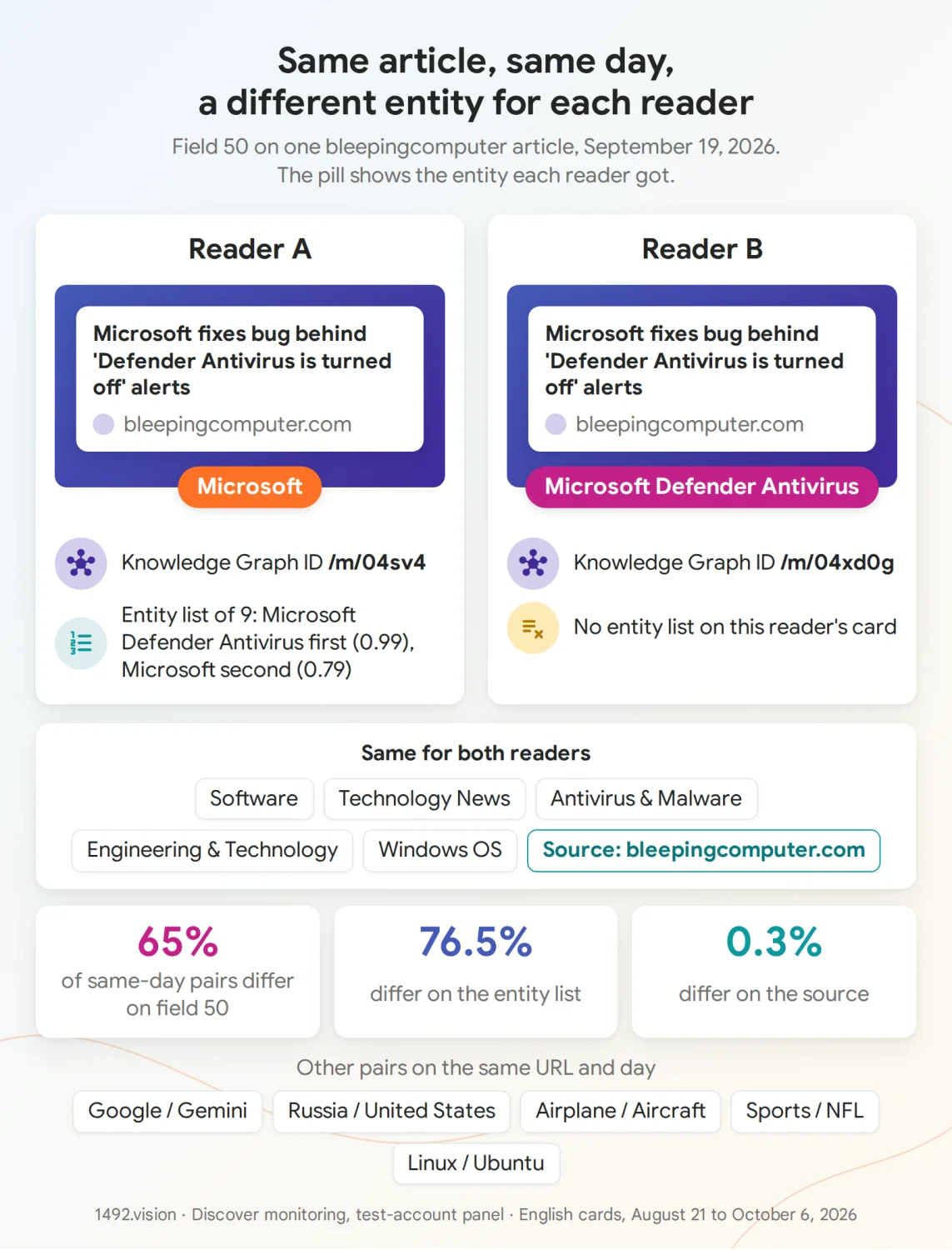
Same article, same day, two readers. The entity changes; the topics and the source stay the same.
Field 50 often differs from the article's main entity. 75% of the cards that carry it have no entity list at all (82% in French). When a list exists, field 50 is in it 91% of the time, but in first position only about half the time (49%). On reader A's card, the list contains nine entities, with Microsoft Defender Antivirus first (0.99) and Microsoft second (0.79). Field 50 kept Microsoft.
We compared field 50 with what each test account did and declared. It matches an entity from the account's reading history in 63% of cases, against 4% for interests the account declared explicitly. Field 50 seems to say which side of the article Google picked for this reader, based on what the reader does.
1.1 Field 50 works at the entity level that Chrome never syncs
Chrome annotates the pages you visit at two levels:
-
detailed entities, an open vocabulary of specific things (Microsoft, OpenAI, Linux, SpaceX, Data center);
-
broad categories, a short list of topics (Software, Security, Movies, Technology).
Only broad categories are kept with the history and synced, and only when they score at least 85 out of 100. Detailed entities are never synced.
Field 50 sits at the detailed level. Of the distinct entities it carried on English cards from August 21 to October 6, 94.5% belong to detailed entities and 7% to synced categories (a few are both).
Google still computes these detailed entities itself, and the visited URL is part of the synced history. Our data cannot show whether Discover reads Chrome data. Field 50 works at the same fine-grained level as the entities Chrome keeps out of sync.
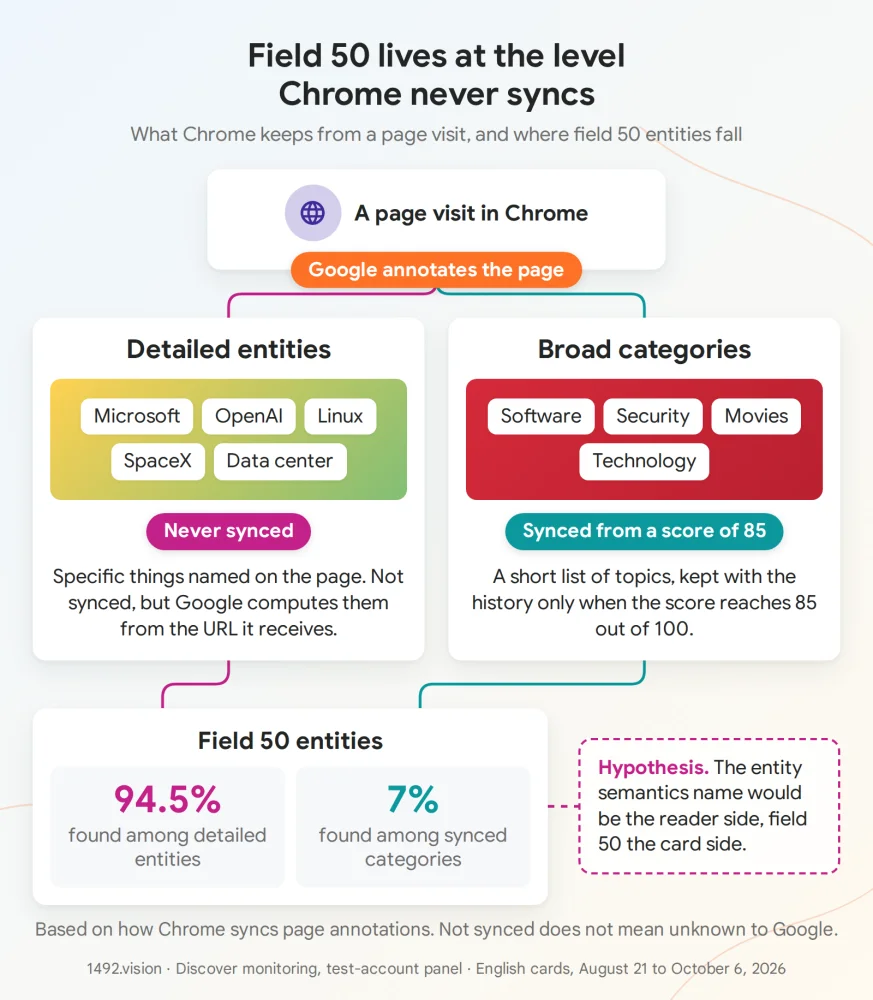
What Chrome keeps from a page visit, and where field 50 entities fall. The dashed box is our hypothesis (section 1.4).
1.2 Only on routes that retrieve by topic
Field 50 appears on some routes only. On English cards from September 13 to 25, it is on all UGC and AIGC cards, 75% of fresh videos, 62% of the YouTube cluster, 35% of the main feed and 11% of aura cards. It never appears on related cards (0 of 1,246 ruby cards, 0 of 567 pipeline 4706 cards), nor on followed creators, star search, trends or collaborative filtering.
Field 50 belongs to the routes that retrieve cards by topic: the entity would be the reason the card was picked for this reader. Routes that start from something else (an article just touched, a followed creator, a trend) do not carry it.
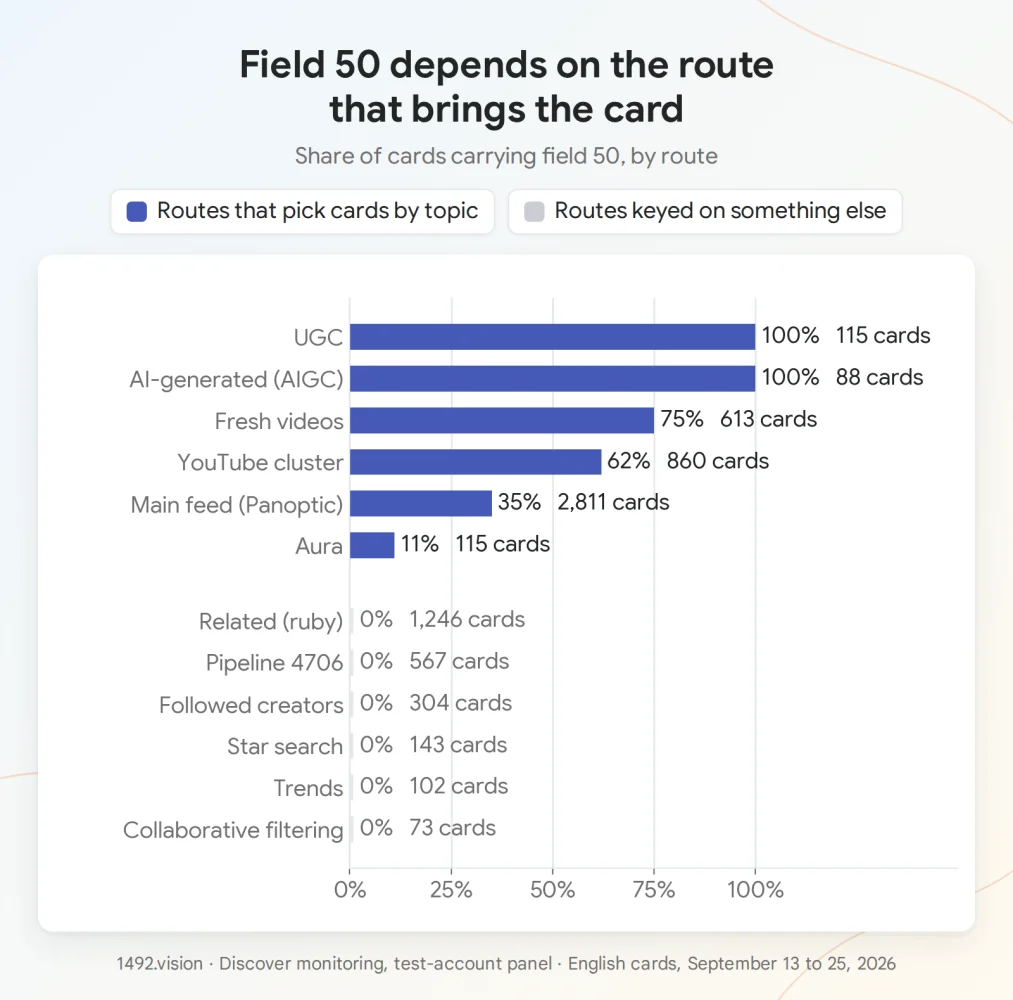
Share of English cards carrying field 50, by route, September 13 to 25, 2026.
1.3 No measurable effect on the boost
We see no measurable effect of field 50 on the boost, the ranking adjustment value attached to some cards. Its exact role, a retrieval key or a label kept on the card, remains unknown.
1.4 A new internal name appeared before field 50
A new internal name was there by the end of July 2026 at the latest: DISCOVER_PERSONALIZED_ENTITY_SEMANTICS. Its exact arrival date is not known. Earlier internal names already covered entities: embeddings of entities of interest, an entity history and entity familiarity. We know the name and roughly when it arrived, but not what it contains.
The name fits what we measure on field 50:
-
DISCOVER: field 50 is a feed signal;
-
PERSONALIZED: the entity changes from one reader to another in 65% of cases;
-
ENTITY: it is a Knowledge Graph identifier;
-
SEMANTICS: what changes between readers is the facet of the article (Google or Gemini, Sports or NFL, Linux or Ubuntu).
The card's entity list changes with the reader too. For the same URL on the same day, it differs between readers in 76.5% of pairs (280 of 366), against 13.0% for field 47 topics and 0.3% for the source. Most of the reader-to-reader difference sits in the entities.
On the calendar, field 50 arrives on August 21 in English and September 14 in French, at least three weeks after the name.
Hypothesis. The internal name would refer to the reader side: a representation, possibly an embedding, of the entities that matter to this reader. Field 50 would be the card side of the same matching: the entity kept for this reader on this article. This rests only on a coincidence of calendar and vocabulary, and the name's exact arrival date is unknown.
2) f42 and f43 tested ranking variants on one account
From March 16, 2026 until a date between June 17 and 20, two ranking-test scores that we call f42 and f43 appeared on Discover cards. Only one of our test accounts carried them, on 82% of its cards, and the two fields always sat on the same cards.
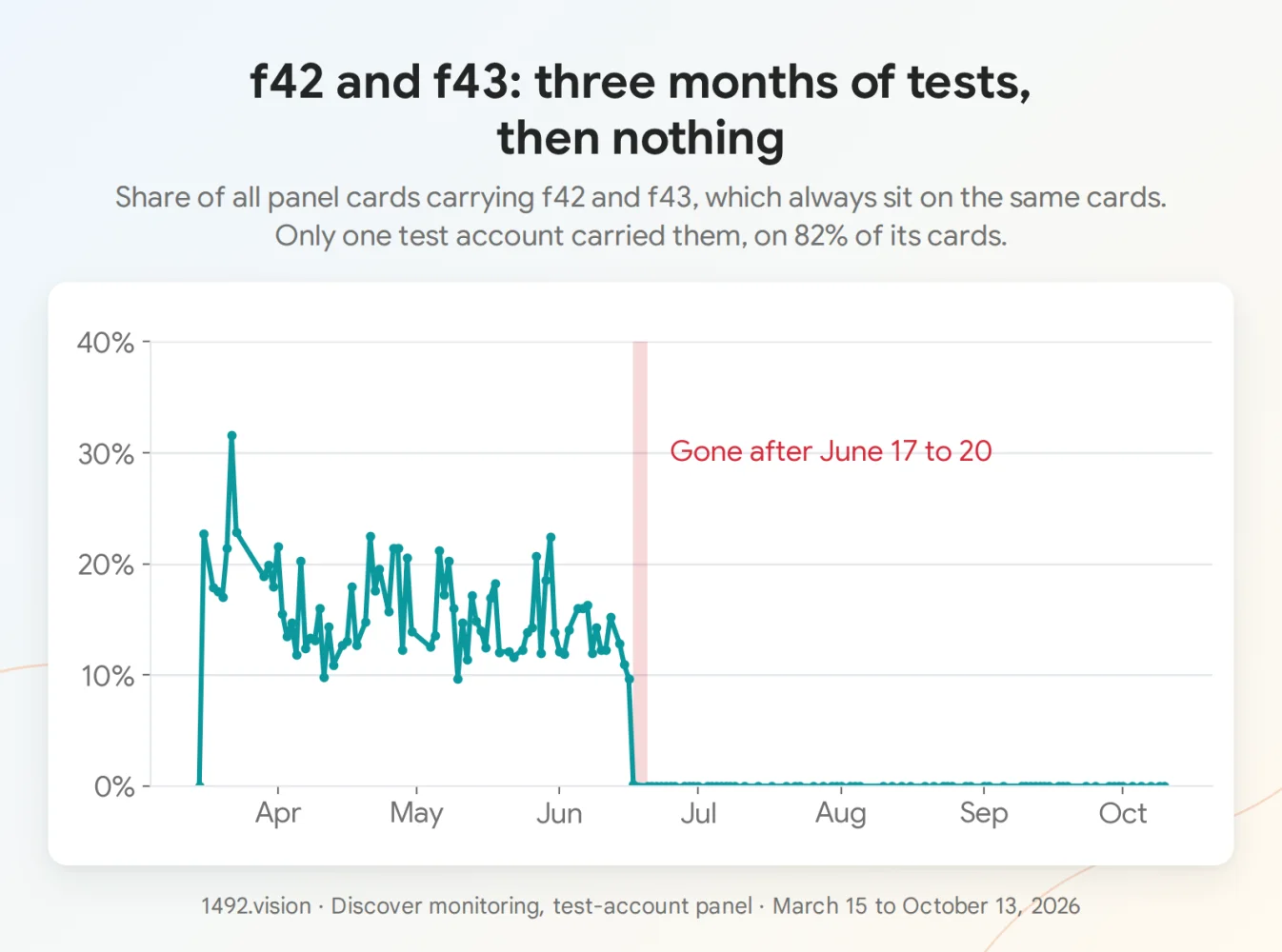
Share of all panel cards carrying f42 and f43. A single test account carried them, so the share stays low across the panel.
Their value changed over time. We saw five values one after the other, which we call A to E, and each came with a different median boost, from 0.761 for A to 1.138 for B. Some lasted a few days (B, March 19 to 23), one lasted two months (E, April 15 to June 17). The most frequent, D (April 1 to 15), covered 2,625 cards with a median boost of 0.835.
This looks like a ranking experiment: the same account placed in successive, sometimes overlapping test arms, each with its own effect on the boost.
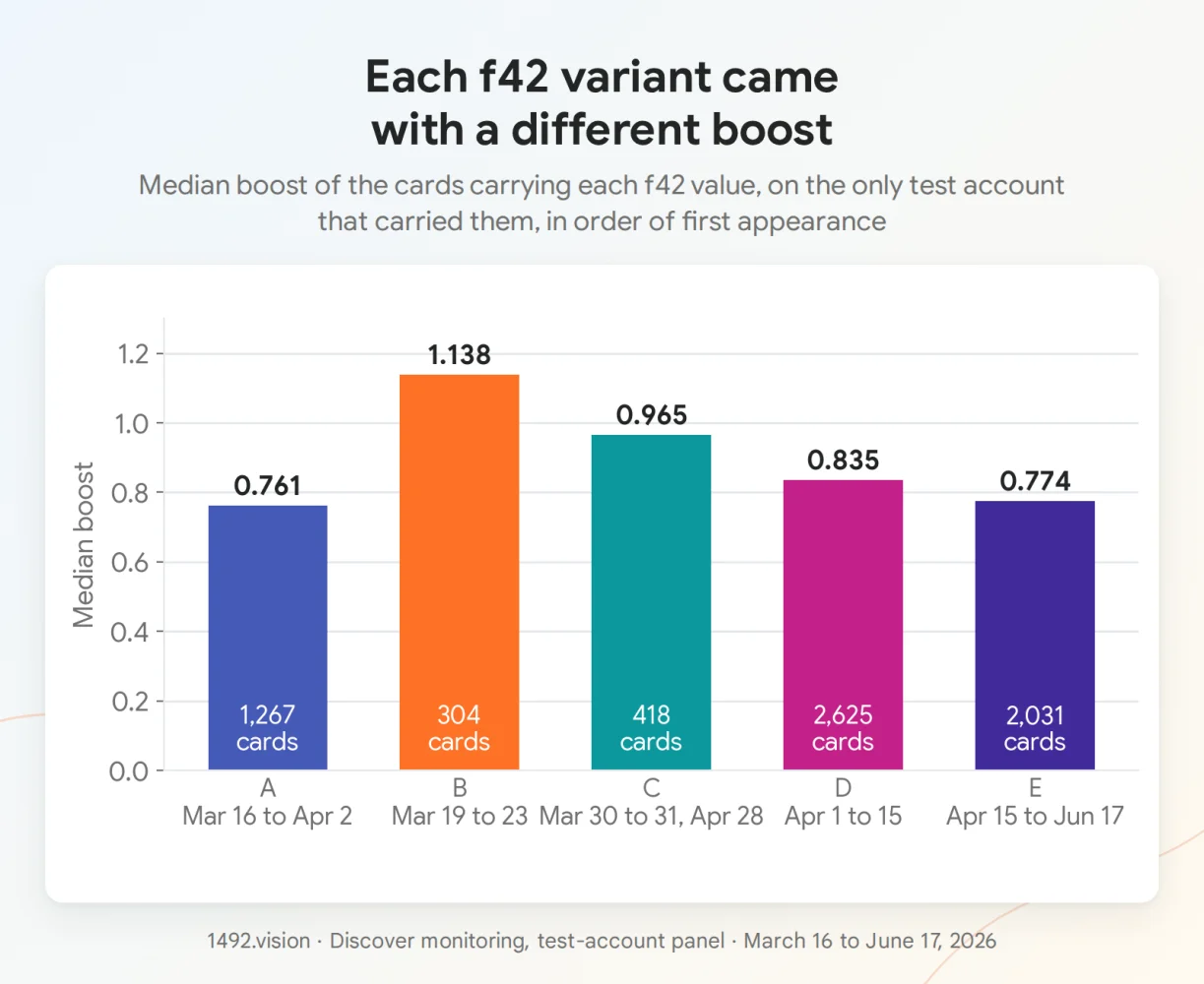
Median boost of the cards carrying each f42 value, on the only account that carried them, March 16 to June 17, 2026.
The fields disappeared between June 17 and 20, about two weeks before field 48 (June 25) and field 47 (July 1) arrived. These dates give an order of events only: f42 and f43 marked tests on one account, while fields 47 and 48 describe the content of every card.
3) Field 47 puts Google's topics on every card
Since July 1, 2026, cards carry up to five topics in a new field, field 47. From July 1 to October 13, we counted 60,030 cards, 1,440 distinct topics across 27 verticals, and 4.86 topics per card on average. A card can carry several verticals at once (multi-label).
The taxonomy is the one Google publishes for Ads, Trends and the Cloud Natural Language API: 97.6% of the topics we see have a name in these public lists. One vertical, 397, is missing from the public Ads and Trends lists. The Natural Language API files the same articles under Sensitive Subjects (War & Conflict, Death & Tragedy, Accidents & Disasters). It is on 6.3% of cards (3,785).
In our panel, News comes first (55.3% of cards), followed by Arts & Entertainment (36.3%), Computers & Electronics (25.3%), Business & Industrial (23.5%), Science (18.5%), Law & Government (15.0%) and Sports (13.0%). This mix reflects the interests of our test accounts.
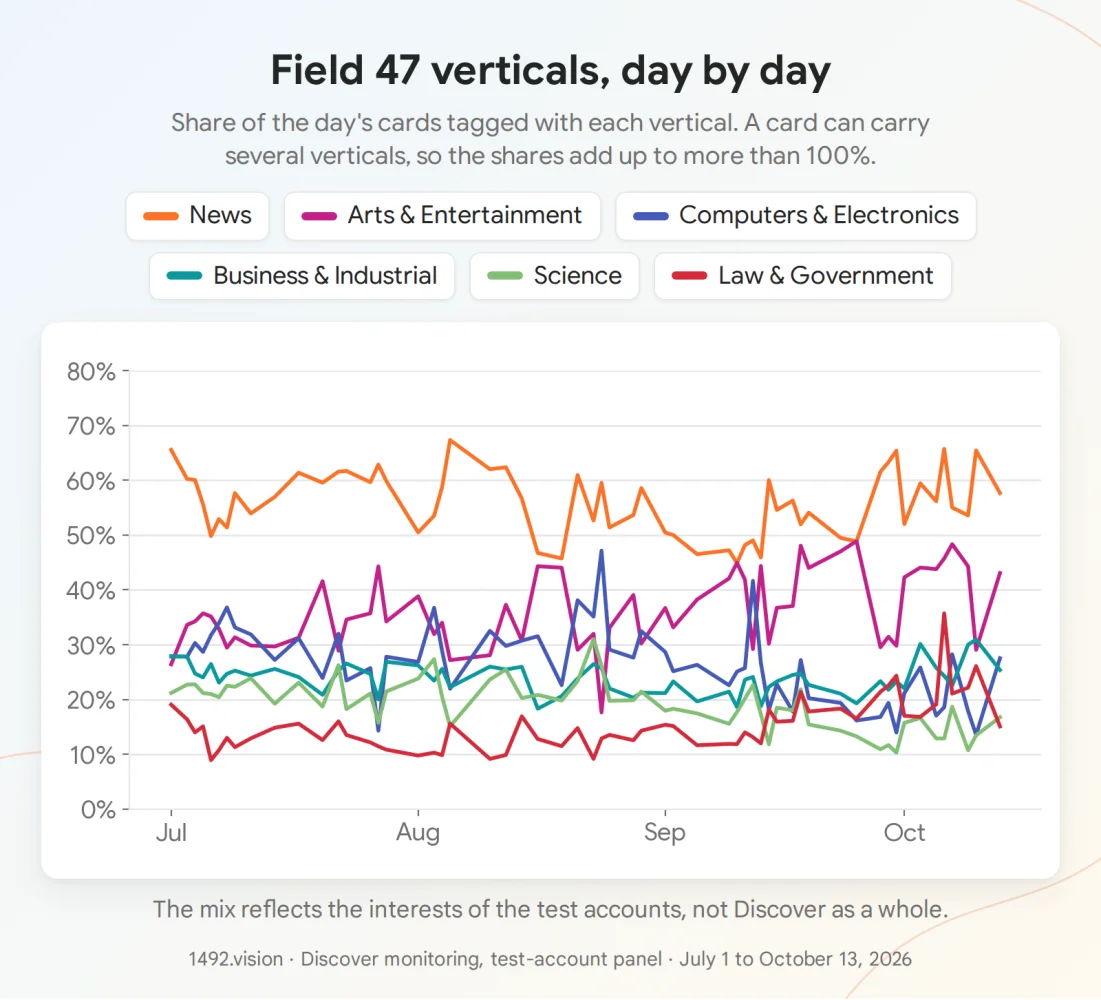
Share of the day's cards tagged with each vertical. A card can carry several, so the shares add up to more than 100%.
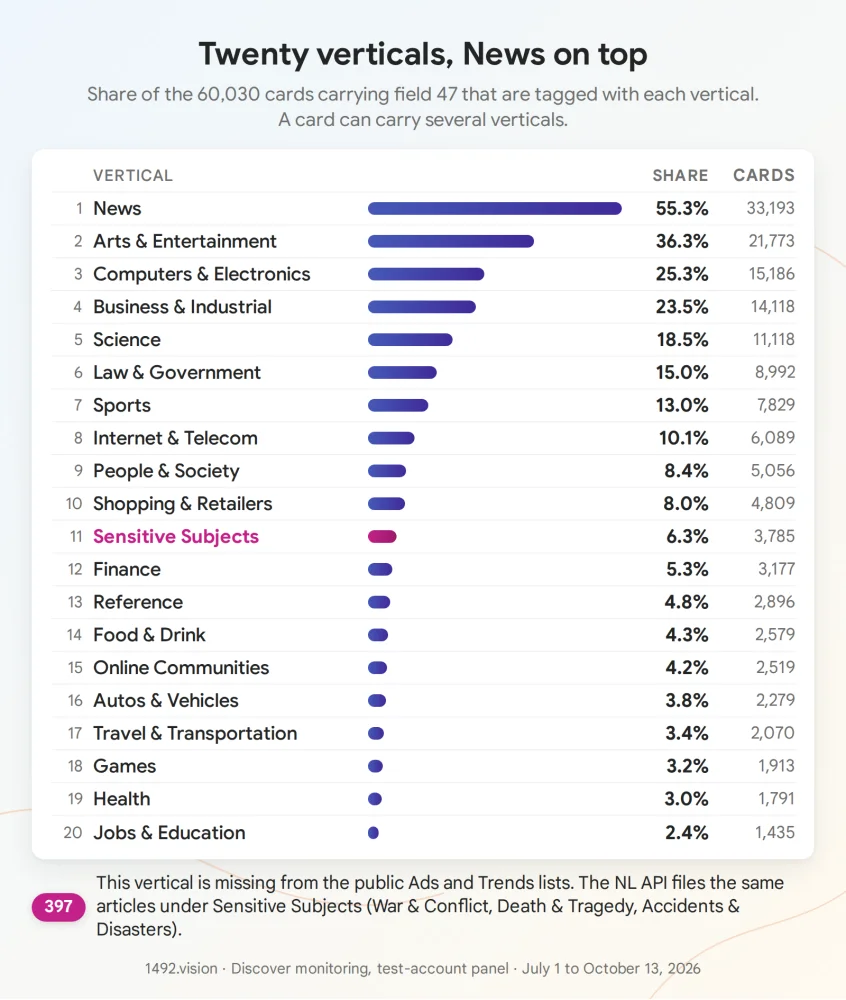
The twenty most frequent verticals, July 1 to October 13, 2026.
3.1 Ranks 4 and 5 rotate over time
For a given URL, the list is mostly stable. Of 14,899 URLs seen at least twice, 92.1% keep the same topic list and 97.0% keep the same first topic.
About 65% of changes swap a single topic, and about 64% of the swapped topics sit at rank 4 or 5. 60.4% of rotating topics stay within one of the URL's stable verticals.
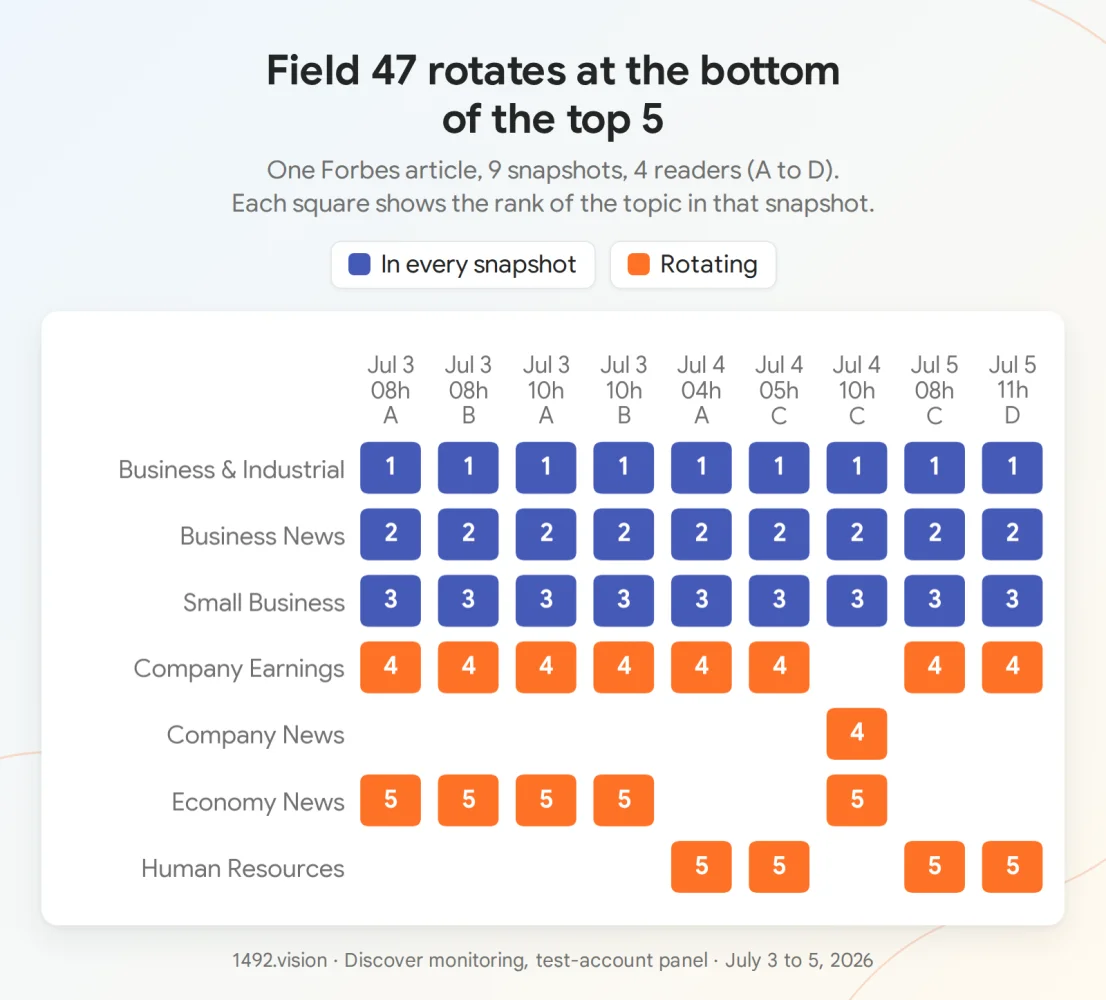
One Forbes article, nine snapshots, four readers. Ranks 1 to 3 stay the same; ranks 4 and 5 rotate. Economy News on July 3, Human Resources in most later snapshots, whatever the reader.
On a few URLs, the list goes through many topics. A Reuters article about Berlin's city government collected 13 different topics over four snapshots and three readers, with no topic present in all of them. Articles from bfmtv, androidpolice and cnbc reach 10 or 11.
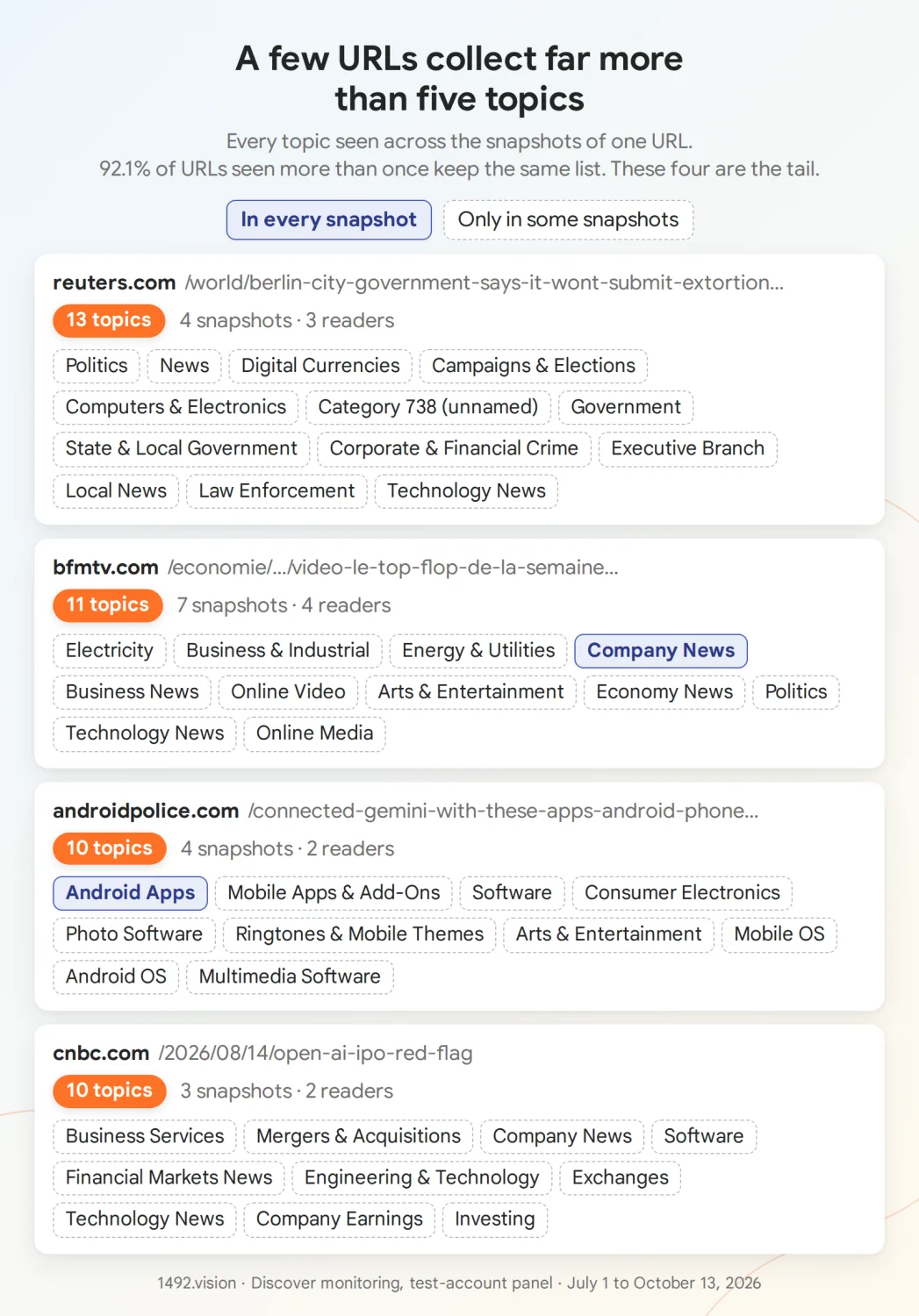
Every topic seen across the snapshots of four URLs. Solid: in every snapshot. Dashed: only in some.
The rotation follows time more than the reader. Share of snapshot pairs of the same URL whose topic list differs:
| Pair of snapshots | Same reader | Two readers |
|---|---|---|
| Same day | 5.1% | 14.2% |
| Within the same hour | 8% | |
| Four hours or more apart | 17% | 22% |
The list seems to drift with time around a cut-off, with at most a small reader effect. On the Forbes article above, readers A and B both have Economy News at rank 5 on July 3, and later snapshots mostly show Human Resources, for readers A, C and D alike.
3.2 Field 47 compared with the Natural Language API
We compared field 47 with what Google's Cloud Natural Language API (V2) returns for the same 218 articles. Both use the same taxonomy, with different classifiers. On verticals:
- Jaccard similarity: 0.59;
- share of field 47's verticals also returned by the API: 78%;
- share of the API's verticals covered by field 47: 70%;
- same first vertical: 38% of cases.
The API leans toward editorial and meta verticals (News, Reference, Shopping), field 47 toward substantive ones (Arts & Entertainment, Science, Business). For a publisher, running an article through the API gives a fair idea of its verticals, much less of the exact topics Discover attaches.
3.3 Field 48 identifies the source
Field 48 arrived on June 25. It identifies the source: the domain for a website, the channel and handle on a platform. It is on 93.8% of cards and almost never changes between readers (0.3% of same-day pairs).
We have not yet measured whether field 47 plays a part in ranking.
4) Two related pipelines changed in September
In February, we wrote that likes no longer seemed to trigger related articles. Our September data let us test this again.
Our September 22 logbook measured the share of relatedcontentruby, the classic related pipeline that we call ruby, among article cards in five languages. Over the summer, it stayed at 13% to 15%. From September 14 it rose, and on September 17 it reached 24% to 28% depending on the language. It gained 8 to 13 points everywhere, taken mostly from the main feed and the aura route. Our test-account panel shows the same rise.
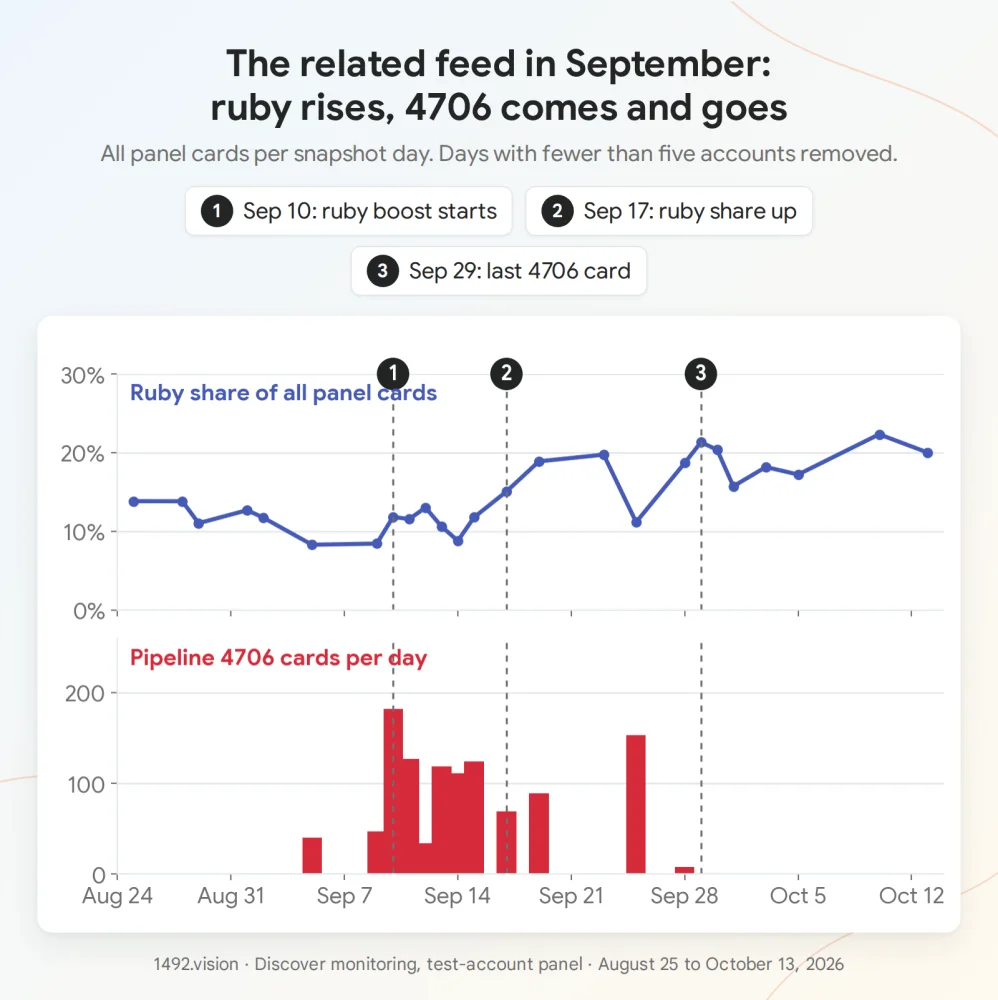
Top: ruby's share of all panel cards, per day. Bottom: pipeline 4706 cards per day, until the last one on September 29.
On September 19, ruby made up 18.9% of all panel cards and pipeline 4706 another 4.7%: 23.6% of the feed came from these two related pipelines.
4.1 Ruby still starts with a click
Ruby only starts after a click. About half of clicks are followed by ruby cards within 10 minutes (51% from September 22 to 29, 55% from September 30 to October 7), with a median delay of about a minute. Likes and see mores alone give none: 0 of 3,026 likes and 0 of 682 see mores from September 22 to 29, then 0 of 2,433 and 0 of 376 from September 30 to October 7. A controlled test on October 7, with one gesture per article, gave the same result.
The September rise made the lists longer: from 1.48 to 1.50 distinct articles per seed before mid-September to 2.27 from September 17 to October 13. Seeds followed by a single card went from more than half (54% to 58%) to 34%.
After a reader opened an article on nuclear power, the related cards came in two groups. Fourteen came from other sites (Le Figaro, BFM TV, Reporterre, La Voix du Nord and more) and carried the seed's own Knowledge Graph entities: Nuclear power plant, Nuclear reactor, Electricity. Twenty-one more came from the seed's own site, on unrelated topics. A related set is built partly from the seed's topic and entities, partly from its source. How much a site recirculates its own articles varies a lot: Le Parisien, for instance, takes only about 3% of the related slots it seeds.
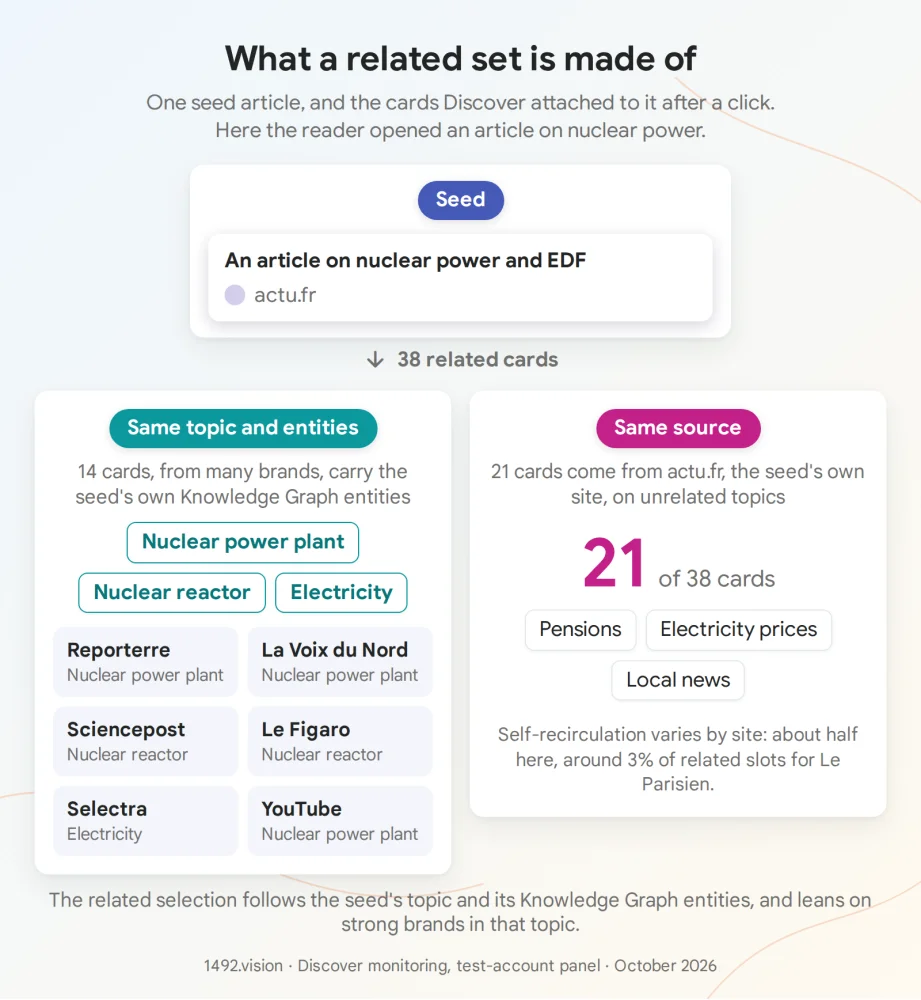
One seed and its related set. The cards either share the seed's topic and Knowledge Graph entities, or come from its own site.
Since September 10, ruby cards also get a boost and a relevance score on a small group of test accounts (four, never more than three on the same day), where 71% to 100% of ruby cards are boosted. We had never seen a boost on ruby from March to August.
The boost ranges from -8.45 to +4.59: it can push a related card up or down. Over the same period, ruby's median boost is 0.45, against 1.06 for every other boosted card. Other routes have negative boosts too (7.2% of their boosted cards, against 12.4% for ruby), so the negative sign is not specific to ruby. The boost was still there in October, with 107 boosted ruby cards on October 10.
Ruby cards also carry fewer entities than before: 79% had an entity list in June, 55% to 57% in September and October.
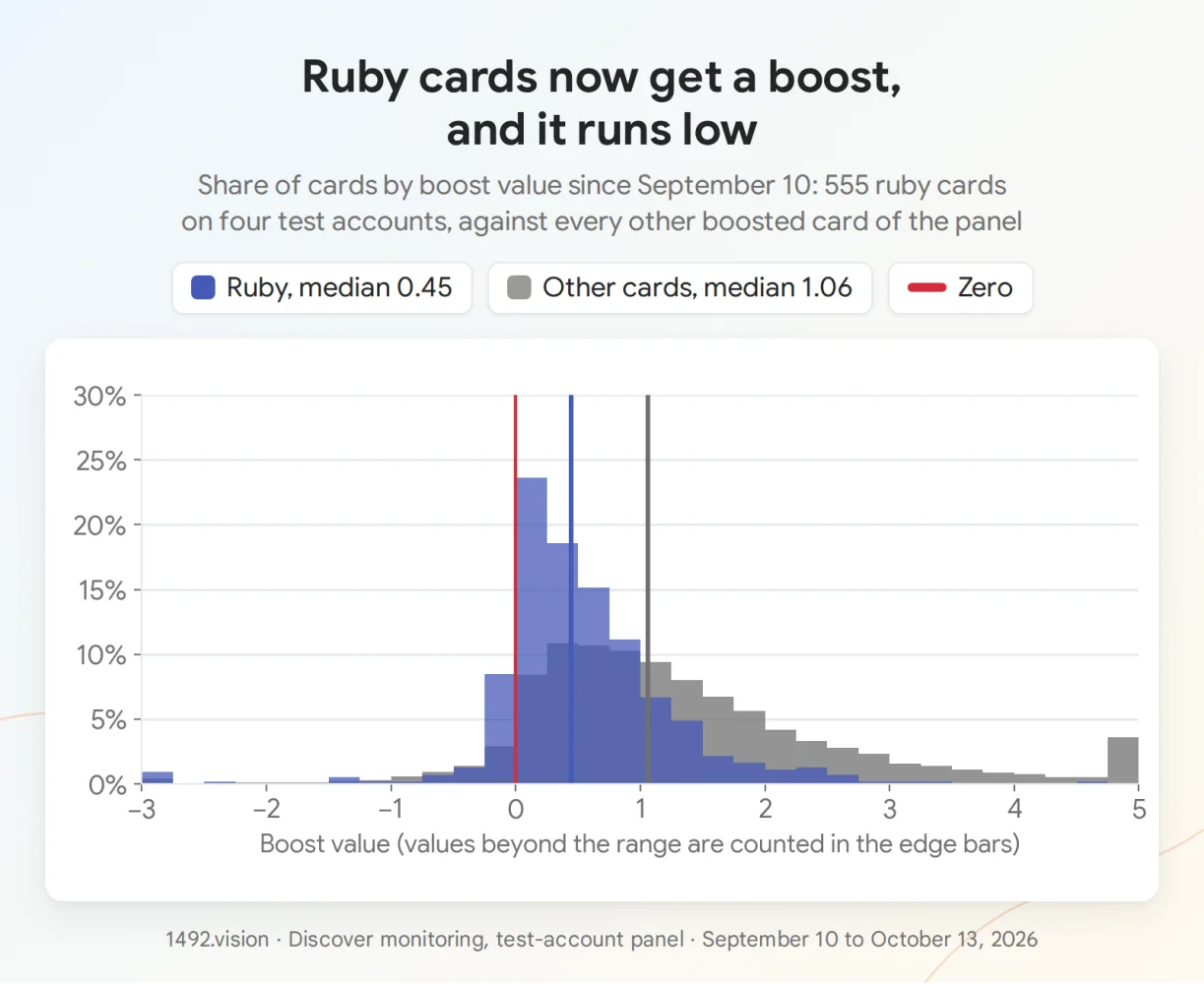
Share of cards by boost value, September 10 to October 13, 2026: ruby cards against every other boosted card in the panel.
4.2 Pipeline 4706 ran from September 5 to 29
From September 5 to 29, a second related pipeline served cards in our panel. We know it only by its number, 4706. Its card category, triggers and format all differ from ruby's.
Over 1,032 cards from September 22 to 29, its trigger was a like for 37% of them, a see more for 36% and a click for 17%. Likes and see mores, which never open ruby, did open 4706 cards.
The card arrives alone, one to two seconds after the gesture, inserted into the feed that is already loaded. Its place varies. After a click on a CNN article, an X post shows up right under that article. After a see more on a Fantastic Fest video, a film trailer appears several cards lower, between two cards that were already there.
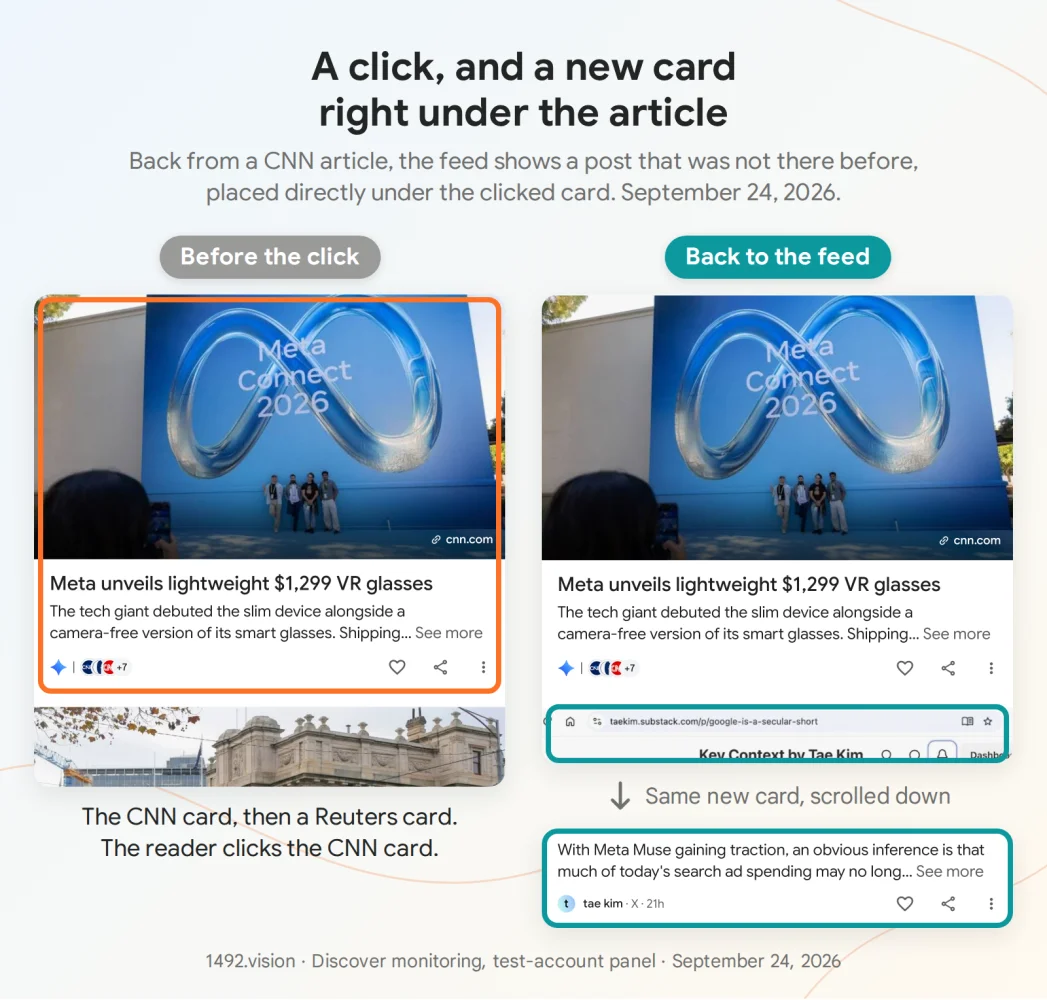
Back from a CNN article, a post that was not there before sits right under the clicked card. September 24, 2026.
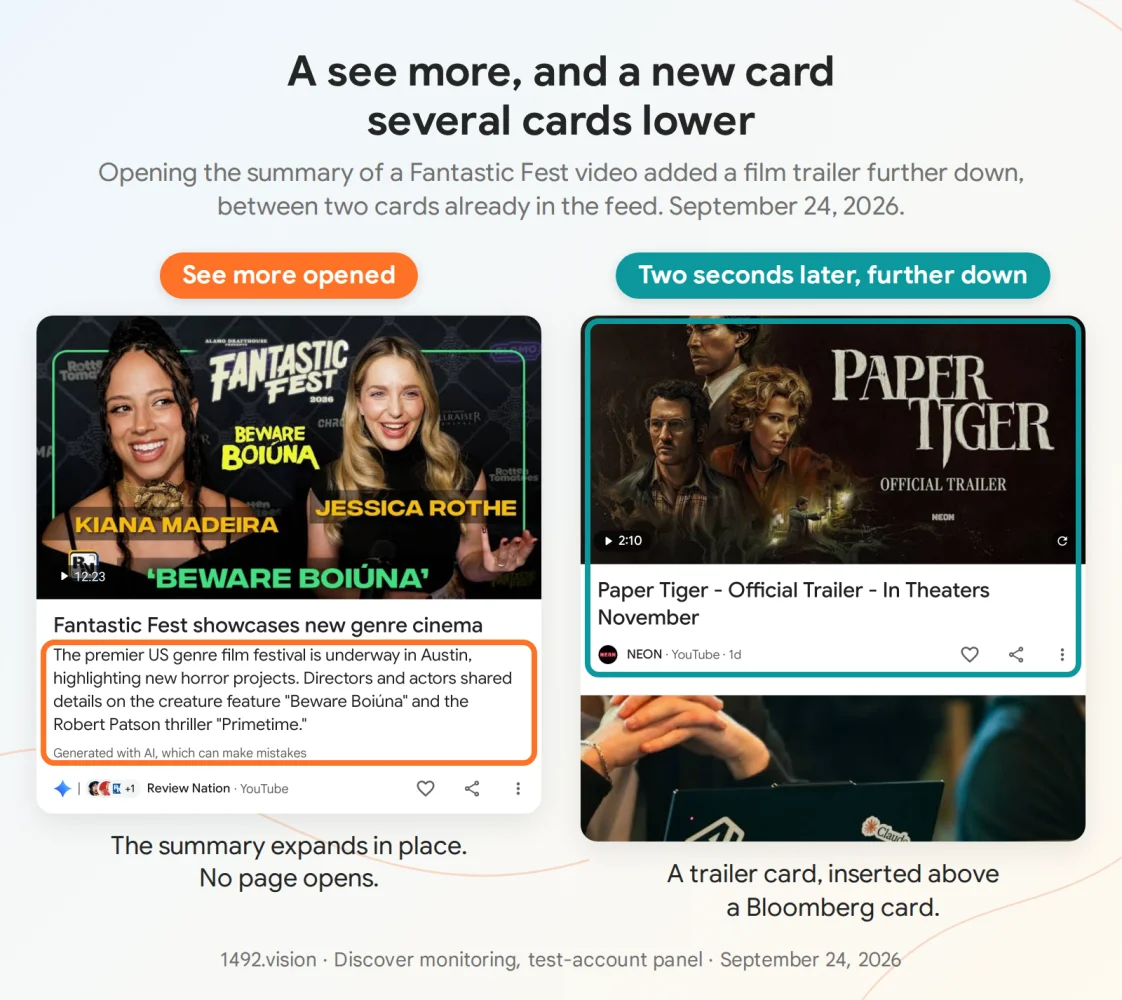
A see more expands the summary in place. Two seconds later, a trailer card appears further down, above a Bloomberg card. September 24, 2026.
A gesture was followed by a 4706 card only part of the time. On September 25, 77% of see mores (118 of 154) were followed by a 4706 card within 30 seconds, along with 57% of clicks (146 of 257) and 34% of likes (390 of 1,145).
It gives one card per seed (for 95% of seeds), against 1.8 for ruby over the same weeks. 34.5% of its cards are X or Threads posts, against 11.5% for ruby, and 83% of these posts follow a press article. The format sometimes follows the touched card (a video, then a trailer) and sometimes does not (an article, then an X post).
The card carries no entities, no boost and no relevance score; it does carry f22 predictions and field 47 topics. On the 37 cards that allow the test, its selection follows the reader's interests at least as much as the rest of the feed. That sample is too small to say more.
The pipeline stopped over five days. The share of see mores followed by a card went from 85% on September 22 to 76% and 77% on September 24 and 25, 37% on September 26 and 1% on September 27. The last card we saw arrived on September 29, and no account received one up to October 15. A stop that hits every account at once points to a decision on Google's side. We do not know the reason.
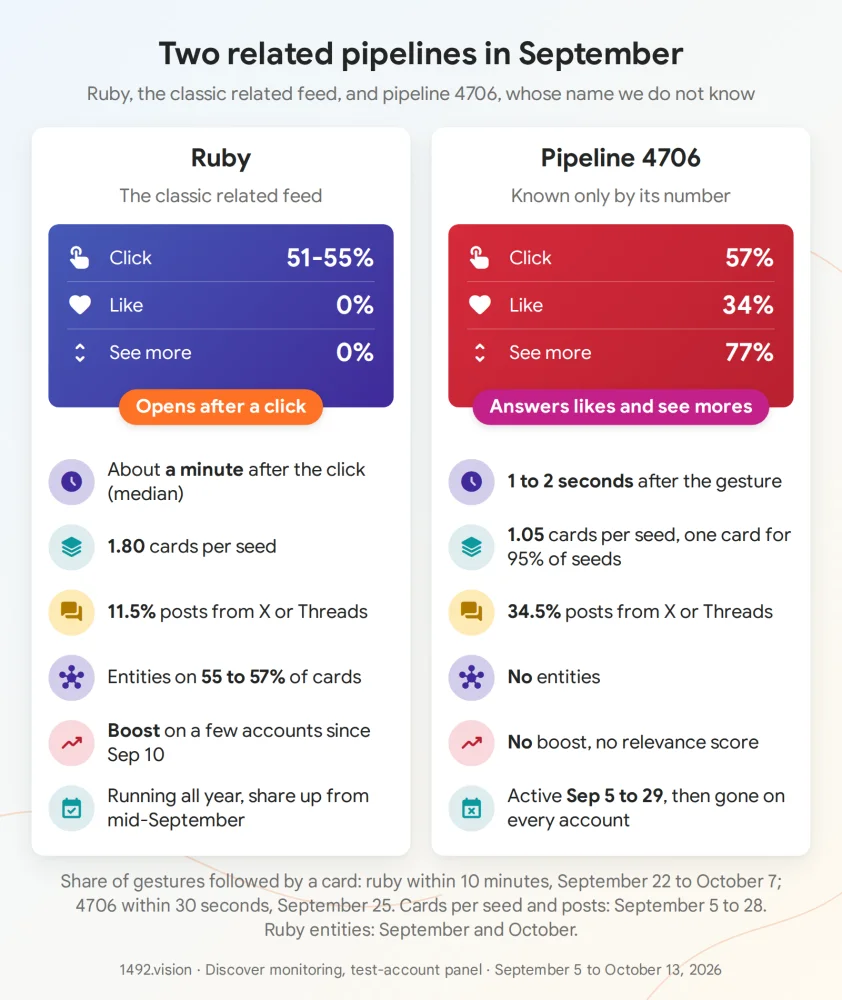
Ruby and pipeline 4706 side by side. Ruby rates are measured within 10 minutes (September 22 to October 7), 4706 rates within 30 seconds (September 25).
4.3 Consequences for publishers in the related feed
-
The click is still what opens ruby. In our panel, a like or a see more does not.
-
For three weeks, Google ran a faster, lighter related pipeline that answered likes and see mores and served more social posts. If it comes back, X and Threads posts could take related places that articles occupy today.
-
Related cards are now re-scored for some readers, and that boost can demote as well as promote.
5) f22.8 now predicts the click best
In December 2025, we described "Multi-Objective Scores": raw probability scores attached to each article, two of which, score 1 and score 7, moved in opposite directions. They are f22.1 and f22.7 (correlation of -0.91). The set has grown since. On June 30, it went from seven to nine scores with f22.9 and f22.11, and f22.8 lost its cap between 0 and 1, with a recalibration window from June 30 to July 3.
A Google paper published in July names Discover. Bai et al., "Heterogeneous Ranking in Industrial-Scale Recommender Systems: A Case Study" (RecSys '26, arXiv 2607.27577), describes a shared backbone with "11 task-specific prediction heads", grouped into positive engagements (pInterest) and negative ones (pDisinterest). f22 looks like such a set of heads, with positive and negative ones.
We measured, month by month, how well each score separates clicked cards from the others (AUC, where 0.5 means chance). Two scores stand out, f22.2 and f22.8, which we read as predictors of deeper engagement.
f22.8 has led since July, going from 0.599 in June to 0.619 in July, 0.651 in August and 0.690 in September. f22.2 was level with it in May (0.614 against 0.619) and slightly ahead in June (0.617), then stayed between 0.58 and 0.63. Early October is weaker for both (0.598 and 0.544, on 749 clicks).
The best predictor also depends on the account. In May and June, f22.2 and f22.8 shared the lead between accounts. In September, f22.8 led on 11 of our 13 accounts.
f22.2 is the f22 score most tied to the boost (Spearman correlation of +0.21). Its median fell from 0.397 in April to 0.087 in August, then rose again to 0.125 in September and 0.146 in October. Its click prediction did not follow (0.544 in early October). The score that best follows clicks and the score most tied to the boost are no longer the same.
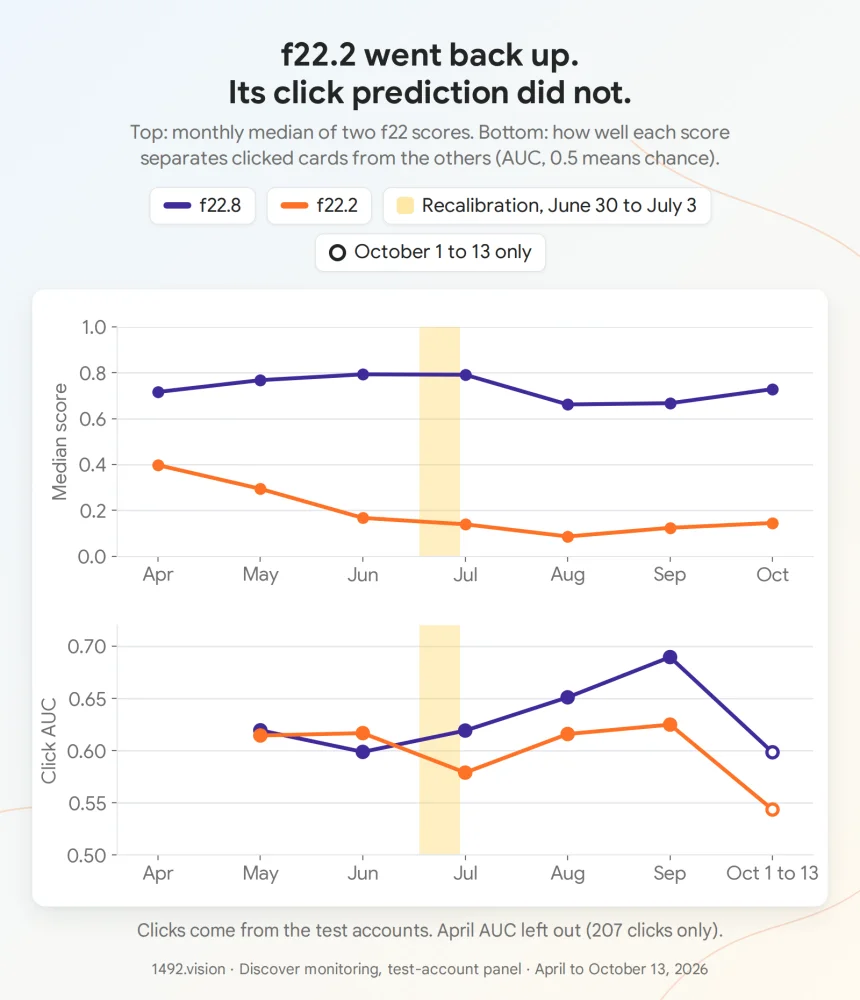
Top: monthly median of f22.2 and f22.8. Bottom: click AUC of each score. April AUC is left out (207 clicks only).
6) Consequences for publishers
Field 50 suggests that Discover picks, for each reader, one entity of an article. An article that clearly names its entities, the product as well as the company, the team as well as the sport, gives the system more facets to match with more readers.
Reading history seems to matter more than declared interests. In our panel, field 50 follows what accounts read (63%) far more than what they follow explicitly (4%). The readers this signal points to are the ones who already read about the topic.
Field 47's first topic is stable and, at the vertical level, close to what the Natural Language API returns. A clear angle helps that first topic be the right one; ranks 4 and 5 move anyway.
In the related feed, the click is still the gesture that opens ruby, and some related cards are now boosted or demoted like the rest of the feed.
On f22, the click follows f22.8 more than f22.2 in our panel. If f22.8 predicts depth of engagement, as we read it, this score seems to favor the articles that keep readers engaged after the click.
Open questions
Does field 50 act in retrieval, or is it a label kept on the card? Will pipeline 4706 come back, and with which triggers? Does field 47 play a part in ranking? Our monitoring continues on these three points.
The article is the same for every reader; the entity Google picks for it changes from one reader to the next.
Method and limits
This article is based on 1492.vision's Discover monitoring: a panel of test accounts, in English and French, followed from March 1 to October 15, 2026. For each card, we look at the signals attached to it, the pipeline that brought it, and what happens after a click, a like or a see more.
-
Names and numbers: Google publishes no numbering for these signals. "Field 50", "field 47", "f22.8" are the labels we gave each one to track it; the number is our index. The f22 scores and the f42/f43 fields are ranking and prediction scores the system computes for each card; fields 47, 48 and 50 are other per-card signals (the topics, the source, the entity). The meaning we read into each is our interpretation. Strings such as relatedcontentruby or DISCOVER_PERSONALIZED_ENTITY_SEMANTICS are Google's own internal names, quoted as such.
-
Panel: clicks, likes and see mores come from our test accounts. The shares and the f22 AUCs describe this panel; real readers at scale may behave differently.
-
Field 50: we see no ranking effect from it, and the internal name does not prove that field 50 is its output. The link is a hypothesis built on vocabulary and calendar.
-
f42 and f43 marked tests on a single account.
-
Field 47 rotation follows time more than the reader.
-
The stop of pipeline 4706 on September 29 does not show whether it will come back.
Notes
-
MID: Knowledge Graph machine identifier. /m/ identifiers come from the former Freebase base, /g/ identifiers are more recent.
-
Route, pipeline: the selection circuit that brought a card into the feed (main feed, fresh videos, related...). Some have internal names, such as relatedcontentruby or paginationpanoptic (the main feed); 4706 is known only by its number.
-
UGC, AIGC: UGC is the route of user-generated content (posts and videos from platforms). AIGC is the route of AI Overview cards.
-
Aura: a broad, general recommendation route, closely tied to the main content feed, that brings back articles already seen by the reader or by readers with a similar profile.
-
Fresh videos: the route that serves recently published videos.
-
Star search: the route that serves cards linked to searches the reader has made or saved.
-
Collaborative filtering: the route that recommends what readers with similar behaviour clicked, rather than what matches the article's topic.
-
Retrieval: the stage that picks candidate cards before they are ranked.
-
Seed: the article or card the reader interacted with, which a related pipeline starts from.
-
See more: the button that expands a card's summary in place, without opening the article.
-
Boost: a ranking adjustment value attached to some cards. Since September 10, some related cards carry one, positive or negative.
-
Vertical: the first level of Google's topic taxonomy (News, Sports, Arts & Entertainment...).
-
Multi-label: a card can belong to several verticals at once.
-
Jaccard similarity: the overlap of two sets, shared items divided by all distinct items.
-
AUC: the probability that a score ranks a clicked card above a non-clicked one. 0.5 is chance, 1 is a perfect predictor.
-
Spearman correlation: a correlation computed on ranks, from -1 to +1.
Source
- Damien Andell, Inside Google Discover's 2026 Card Signals: One Entity per Reader, Rotating Topics and a Related Feed That Answered Likes, LinkedIn, October 15, 2026. First publication of this article.
Authors
Posted on 2026-10-15
More reliable, sourced reporting on Discover? Add us to your sources!
Add to sources Add to sources