Your name on Google: you finally get to pick it (almost)
Until this week, your official name on Google, on your Google search profile, was not yours to choose. An unsophisticated algorithm chose it for you.
A quick recap for anyone coming aboard mid-voyage. For months now, Google has been building creator profiles, or "Search profiles": a profile.google.com/@handle page that pulls together your site, your verified social accounts and your content, and feeds your knowledge panel. We have documented that construction piece by piece since March 2025, well ahead of any official communication: the Follow button, the profile pages, the Subscribe button spotted in the code, the pilot with 54 US publishers, then the official launch of "Search profiles" on 4 June.
And one detail in that machinery bothered us. The handle, the @yourname address that serves as your public identifier, was assigned automatically: Google took the name of your most followed verified account. That was it. Your own preference never entered into it.
We wrote as much in June: the handle "follows the logic of the largest linked social audience, not necessarily your editorial preference".
What just changed
Google has announced a feature in beta to creators: Handle Swapping, the ability to switch your handle to any of your linked verified platforms. A beta is running this week with volunteers (a profile created, several verified accounts linked), and Google says a launch for everyone is coming "very soon".
Put like that, it sounds like a convenience setting. It is in fact a decision about identity architecture.
Why this is far from a detail
Take a real creator from our monitoring.
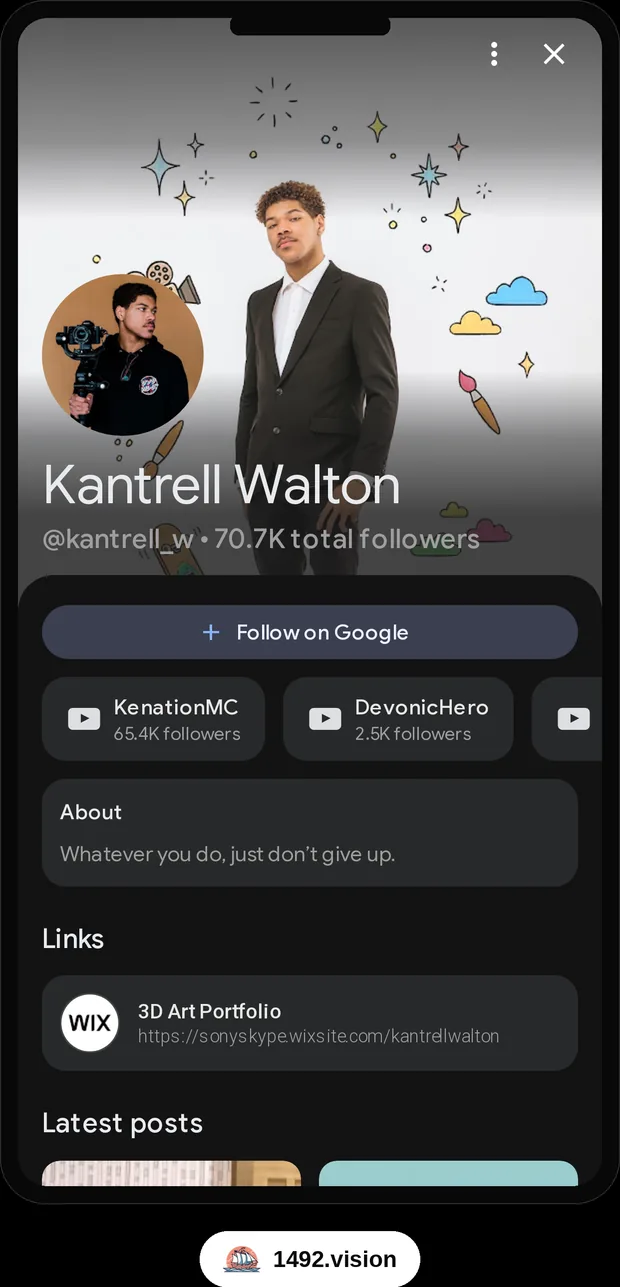
On this one profile, four identifiers coexist for a single person: the display name, the handle, and two verified channels each carrying yet another name. And the handle that stuck, @kantrell_w, is not the one from the most followed channel: KenationMC accounts for 65.4K of the 70.7K followers. Either this creator is one of the beta volunteers and has already picked, or the most-followed rule has exceptions we cannot explain yet. Either way, the screenshot shows what a profile looks like when the name matches the identity rather than the statistics.
His case is unremarkable, and that is exactly the problem. Three very common situations:
- Creators with several names. A YouTube channel name, a legacy X handle, an Instagram account under the brand name. Which one is "the real one"? Until now, whichever had the most subscribers. Not the one the creator considers their identity.
- Fallback names. Everyone who could not get a clean name on the dominant platform and lives with a
brand1245or areal_name_2. The algorithm could turn that stopgap into your canonical identifier on Google. - Audiences that reflect nothing. The most followed network is not always the most active, nor the most strategic, nor the most representative of who you are today. Yesterday's audience was freezing tomorrow's name.
Handle Swapping fixes all three at once. Identity goes back to being a declaration rather than a statistical inference. It is exactly the right call, and the fact that Google is making it says something important: the canonical handle matters enough to be worth choosing.
Our reading: the profile moves from imposed to managed
Put this small setting back into the trajectory our data has been describing for 18 months.
In the beginning, Google profiles were auto-generated: Google built your page, linked your accounts (sometimes the wrong ones), picked your name. You were a spectator to your own identity. Then came claiming, the banner, configurable links, pinned posts. And now the choice of name.
Step by step, the profile shifts from a page you are handed to an identity you manage. It is the same turn Google My Business took local commerce through fifteen years ago: first listings built by the machine, then one day the ability to claim them, and very quickly a professional obligation. Nobody today would leave their business listing unattended. We expect the same norm to settle over creator profiles, and fast.
Under the hood, none of this is cosmetic: the profile is the human interface to the Knowledge Graph. Linked verified accounts, a reciprocal knowledge panel, a consolidated entity. When Google lets you choose your handle, it lets you name your entity. In a system where authority is migrating from the domain to the individual, that is not a lever you leave to the algorithm.
What it changes for SEO and GEO
On the SEO side, the profile consolidates your identity graph: verified accounts linked cleanly, a canonical name you chose, a knowledge panel pointing to the right place. That is disambiguation, structural E-E-A-T, and one more google.com URL you control on your brand SERP.
On the GEO side, it may matter more still. Answer engines do not cite pages, they cite identifiable sources: entities. A clean profile, with a chosen name and accounts that agree across platforms, is the canonical version of "who you are" that grounding systems can use to attribute you, and to cite you. In the citation economy now taking shape, badly managed identity will be paid for in lost attributions.
Due honesty: nothing to date shows that a well-configured profile improves rankings, or that it hurts them. Across the cohort of 54 pilot publishers, feature adoption shows no correlation with visibility trajectory. The profile is an identity and readiness asset, not a ranking lever. That is already a lot.
What to do, concretely
- Check your profile (and your clients'): does an auto-generated one exist? With the right accounts linked?
- Verify your social accounts on every platform: they are the raw material of the profile and of the future handle choice.
- Decide your canonical handle now: the one you will pick when the control reaches you. One name, everywhere, for the long run.
- Make your surfaces agree: same information, same identity, no contradictions. That is what humans will read, and what machines will ground.
Granted, claiming a profile is currently reserved for the "big" players. Officially the United States only; in practice it is open, so ask us. And Google has already said privately that it is considering lowering the thresholds before long. So this will change again, without becoming a free-for-all: E-E-A-T and spam insurance see to that.
The course has been clear for 18 months, and every new piece confirms it: Google is building out the identity registry for creators and brands, beyond what its Knowledge Graph has long been doing. We track close to 47,000 profiles in 7 languages to document each step.
Choosing your flag before putting to sea is basic navigation. The control is coming. You may as well already know which name you will fly.
Posted on 2026-08-02
More reliable, sourced reporting on Discover? Add us to your sources!
Add to sources Add to sources