Google Discover FR vs EN: Two Different Products
Same pipeline names. Same labels. Yet the data tells two structurally distinct stories. Here are the ten divergences our 42 million cards reveal — and what they mean for publishers operating in both markets.
The premise
Most publishers and SEOs think of Google Discover as a global product. One algorithm, one logic, language adjustments. Our data shows something else: the French feed and the English feed are two different products sharing the same infrastructure.
The same 20 pipelines exist in both markets. But their proportions, their sources, and sometimes their very existence diverge radically. A publisher who transposes their Discover strategy from one market to the other without adjustment is making a mistake — and our data explains why.
For detailed per-market analyses: FR reference | EN reference
The ten divergences — overview
Before diving into the detail, the summary table. Each row is a finding in its own right — and each links to its detailed analysis.
| # | Dimension | FR | EN | Gap |
|---|---|---|---|---|
| 1 | Moonstone (reach) | 19.3% | 9.4% | 2x FR advantage |
| 2 | AIO | ~0% | 3.5–29% depending on pipeline | EN-only |
| 3 | Video in the feed | < 5% of volume | 13% (neoncluster alone) | EN = video |
| 4 | Social source | x.com 75% (creatorcontent) | YouTube 72% | Inverted |
| 5 | neoncluster | 36 hits in 3 months | 4.5% of volume, 13% reach | EN-only |
| 6 | feedads (reach) | 24% | 58.4% | 2.4x EN |
| 7 | Shopping lifespan | 3.7 days | 2.5 days | FR lasts longer |
| 8 | Multi-labeling | 58% in 2+ pipelines | 37% in 2+ | FR more multi-pipeline |
| 9 | EPL exclusion | N/A | Active in 7+ pipelines | EN-specific |
| 10 | Pipeline growth | creatorcontent 33x | neoncluster 18x | Different explosions |
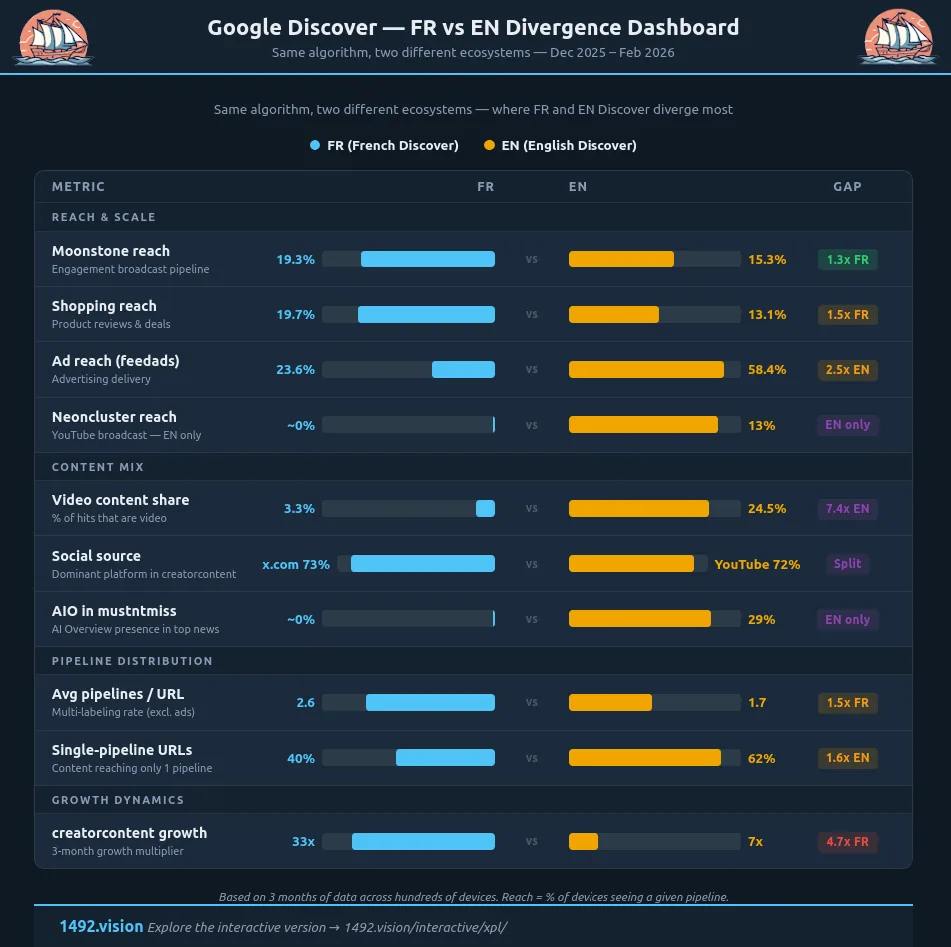 The 10 major divergences between Discover FR and EN. Same infrastructure, two functionally different systems.
This table is not a summary. It's a map. Each divergence is an architectural choice — or a reflection of underlying markets — that changes the optimal strategy for a publisher.
The compared landscape
Before diving into each divergence, let's place the two maps side by side.
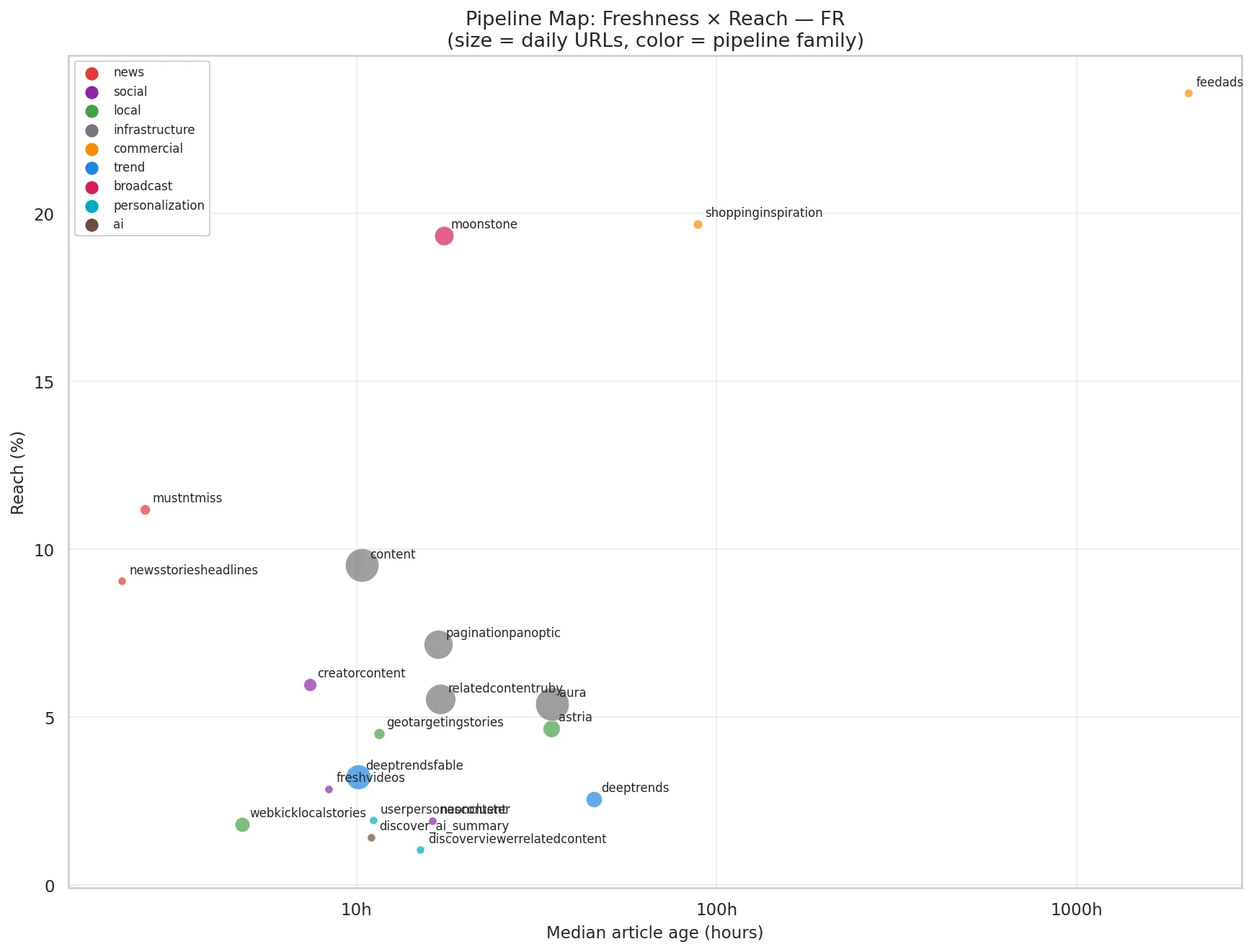 FR: moonstone dominates in reach (19.3%). neoncluster is invisible (36 hits). feedads is present but moderate (24%). The feed is centered on editorial and engagement.
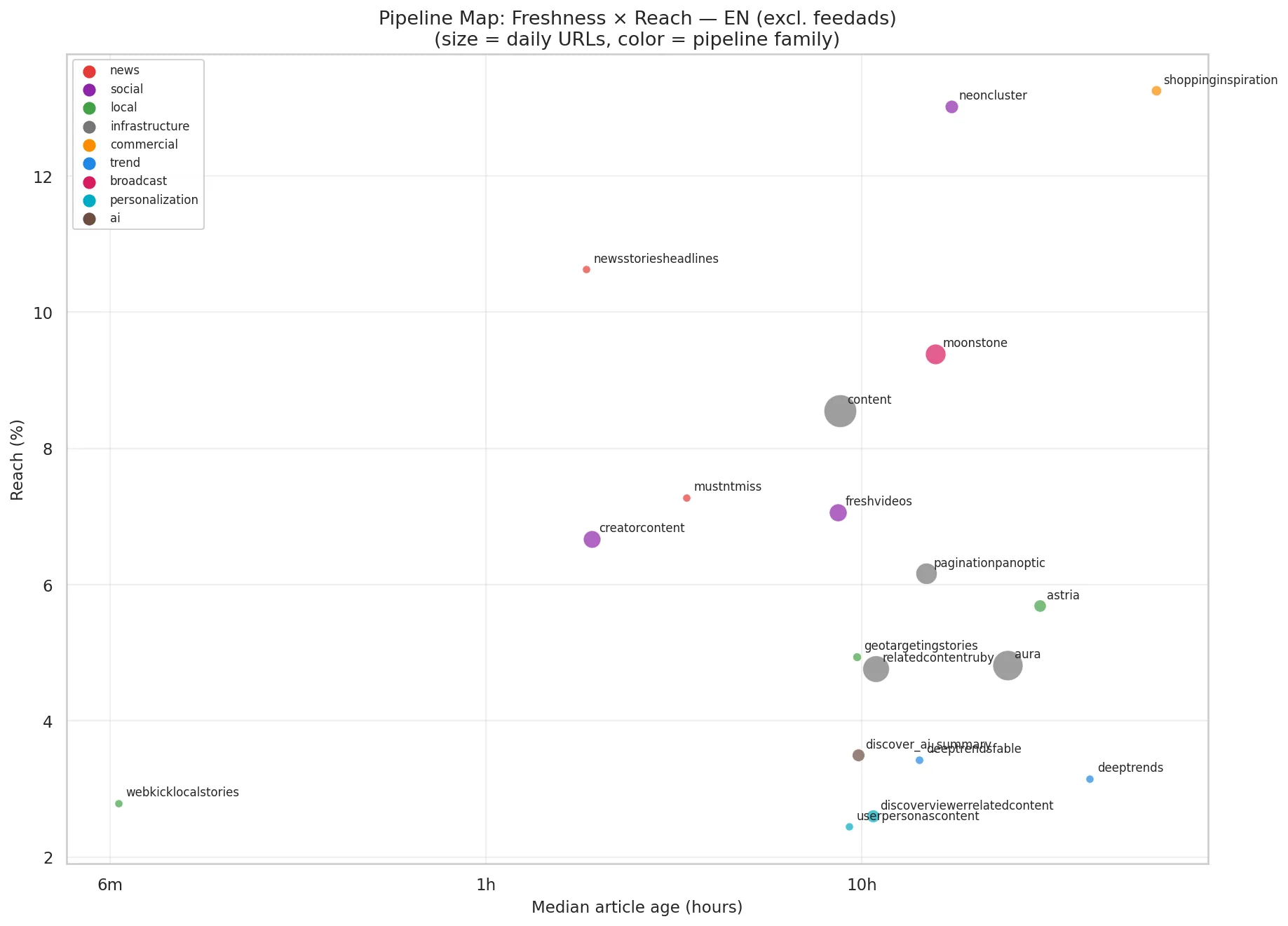 EN: neoncluster appears at 13% reach (absent from FR). feedads explodes at 58.4%. moonstone is halved. The feed is centered on video, advertising, and AIO.
The visual comparison is striking. Two products. The same labels.
Divergence 1 — Moonstone: the French anomaly
FR 19.3% reach — EN 9.4%. A 2x gap.
Moonstone is the engagement broadcast pipeline — it selects articles that generate clicks and shows them to the maximum number of devices. In France, it's the pipeline with the highest editorial reach. In English, its reach is halved.
The gap is not a measurement artifact. It reflects a structural difference in broadcast competition:
- In FR, moonstone is the only high-reach editorial pipeline. It has no competitor.
- In EN, moonstone competes with neoncluster (13% reach), feedads (58.4%), and newsstoriesheadlines (10.6%). Broadcast power is distributed.
Sources change too. In FR, moonstone is dominated by traditional press — Ouest-France (9%), BFM TV (8.8%), Le Figaro (6.8%). In EN, YouTube (23%) and x.com (20.4%) take the top two spots. English moonstone digests social content — French moonstone stays anchored in the press.
What this changes: for an FR publisher, moonstone is THE visibility lever. For an EN publisher, it's one lever among several — and not the most powerful.
Divergence 2 — AIO: the revolution that hasn't (yet) reached France
FR: 72 AIO hits in 3 months. EN: 1.1% of volume in a dedicated pipeline, 29% in mustntmiss.
The AI Overview — the AI-generated summary — has arrived in Discover. But only in English.
- discover_ai_summary EN: 1.1% of volume, 99.997% AIO. Reuters (12.3%), NYT (7.5%), CNBC (7.3%). Finance and space over-represented.
- mustntmiss EN: 29% AIO content — the editorial importance pipeline has become the gateway for AIO into Discover.
- paginationpanoptic EN: 7.8% AIO — AIO infiltrates even the scroll infrastructure.
- FR: effectively zero. 72 hits in 3 months across the entire panel.
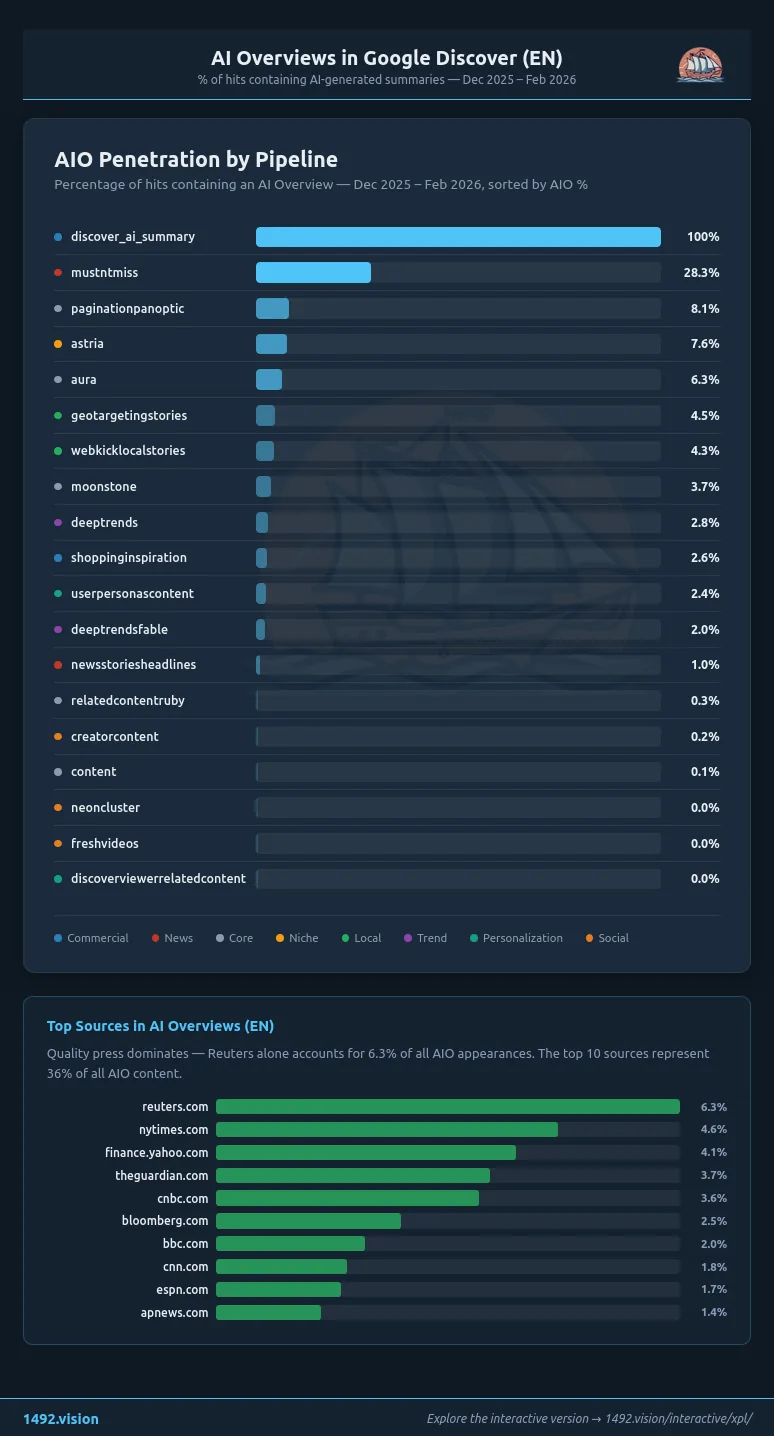 AIO content rate by EN pipeline. discover_ai_summary at 99.997%, mustntmiss at 29%. In FR: effectively zero.
The AIO source club is exclusive: Reuters, NYT, CNBC, Financial Times, Guardian. It's factual, structured, financial press. AIO doesn't democratize visibility — it concentrates it.
What this changes: for an EN publisher, AIO readiness is a real competitive advantage. For an FR publisher, it's not a priority today — but it's a weak signal to watch. What's in English today is often in French tomorrow.
Divergence 3 — Video: two content architectures
FR: < 5% video in the feed. EN: three video pipelines totaling 13% of volume.
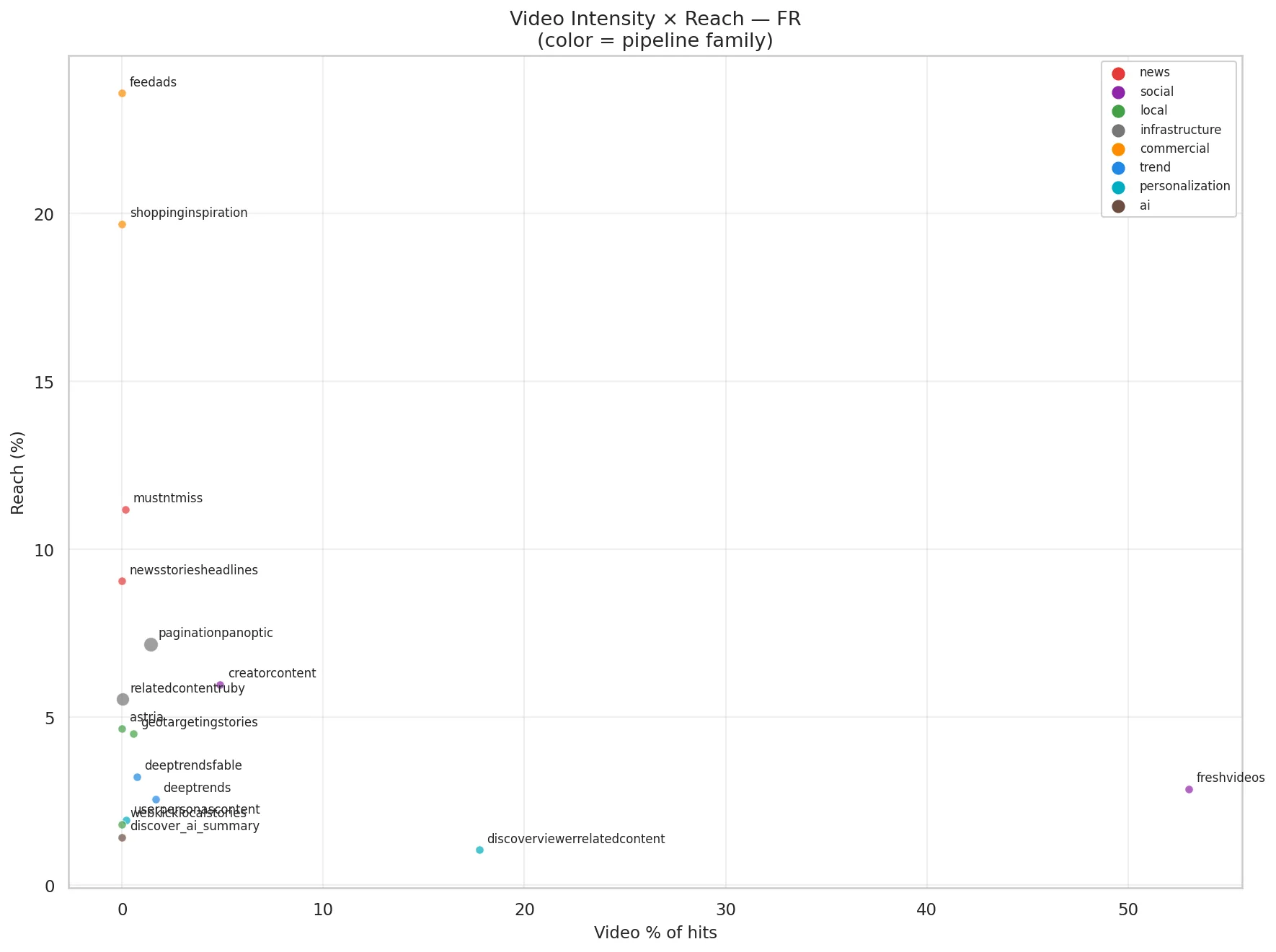 FR: all pipelines cluster near 0% video. The French feed is massively textual. Even freshvideos is only 53% video.
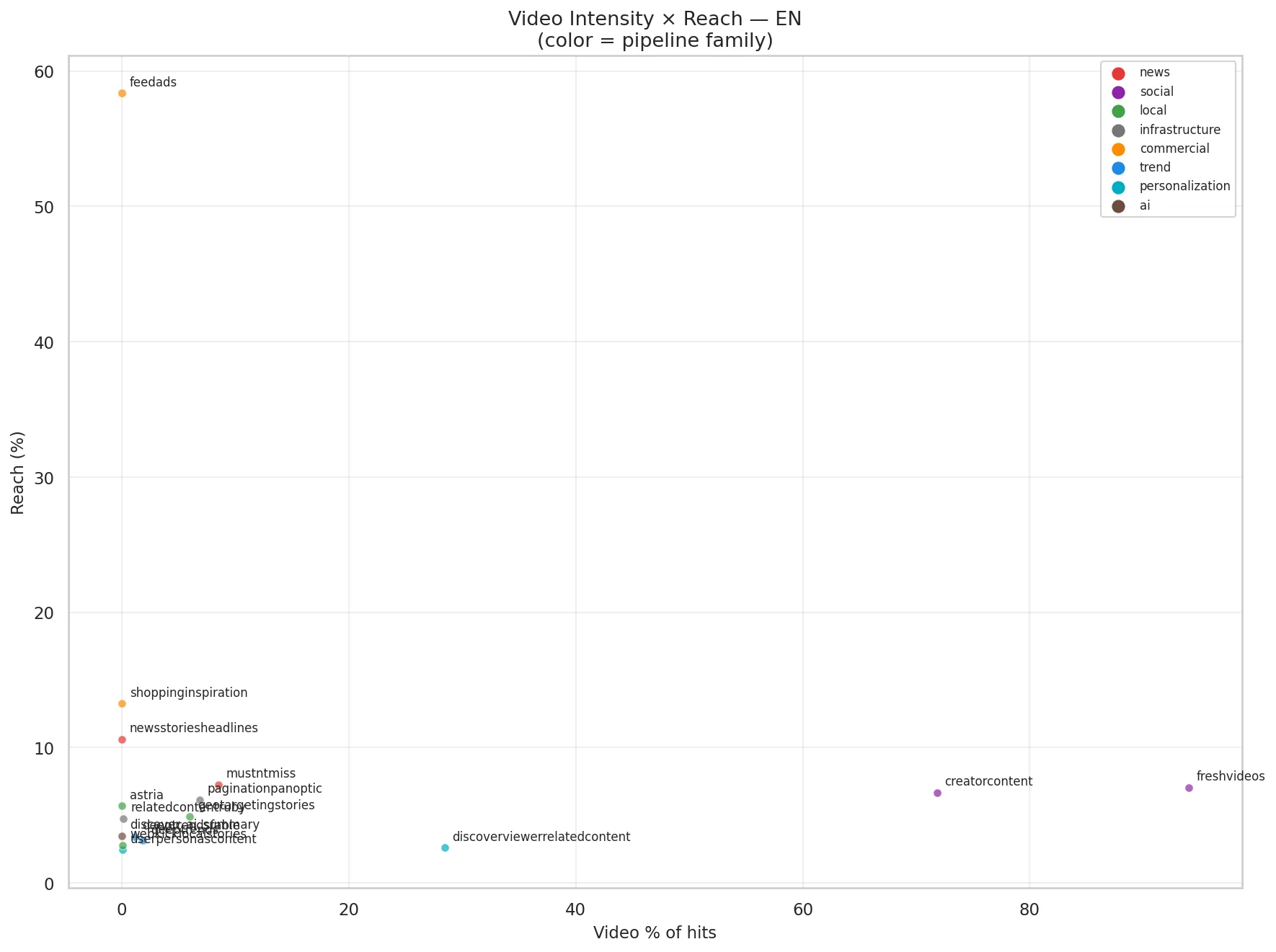 EN: a full spectrum. neoncluster at 100% video / 13% reach. freshvideos at 94%. creatorcontent at 72%. The video cascade is a structural fact.
The divergence is binary: the FR feed is a textual product with video accents. The EN feed is a hybrid text-video product with a three-stage video cascade.
Volume figures confirm it:
- creatorcontent: FR 1.8% → EN 4.0% (2.2x)
- freshvideos: FR 0.3% → EN 4.4% (15x)
- neoncluster: FR 0.0% → EN 4.5% (∞)
What this changes: an EN publisher without a YouTube video strategy is giving up 13% of feed volume. An FR publisher can focus on text without significant penalty.
Divergence 4 — Social sources: x.com vs YouTube
FR creatorcontent: x.com 75%. EN creatorcontent: YouTube 72.4%. The perfect inversion.
The same pipeline — creatorcontent — captures social content for Discover. But the source is completely inverted between the two markets:
| Source | creatorcontent FR | creatorcontent EN |
|---|---|---|
| x.com | 75% | 23.2% |
| YouTube | 5.1% | 72.4% |
The inversion propagates through the cascade: FR freshvideos contains 47% articles (TF1, L'Equipe) and 53% video. EN freshvideos is 94% YouTube. The video cascade works because YouTube feeds the pipeline — in FR, x.com doesn't produce video content that feeds the cascade.
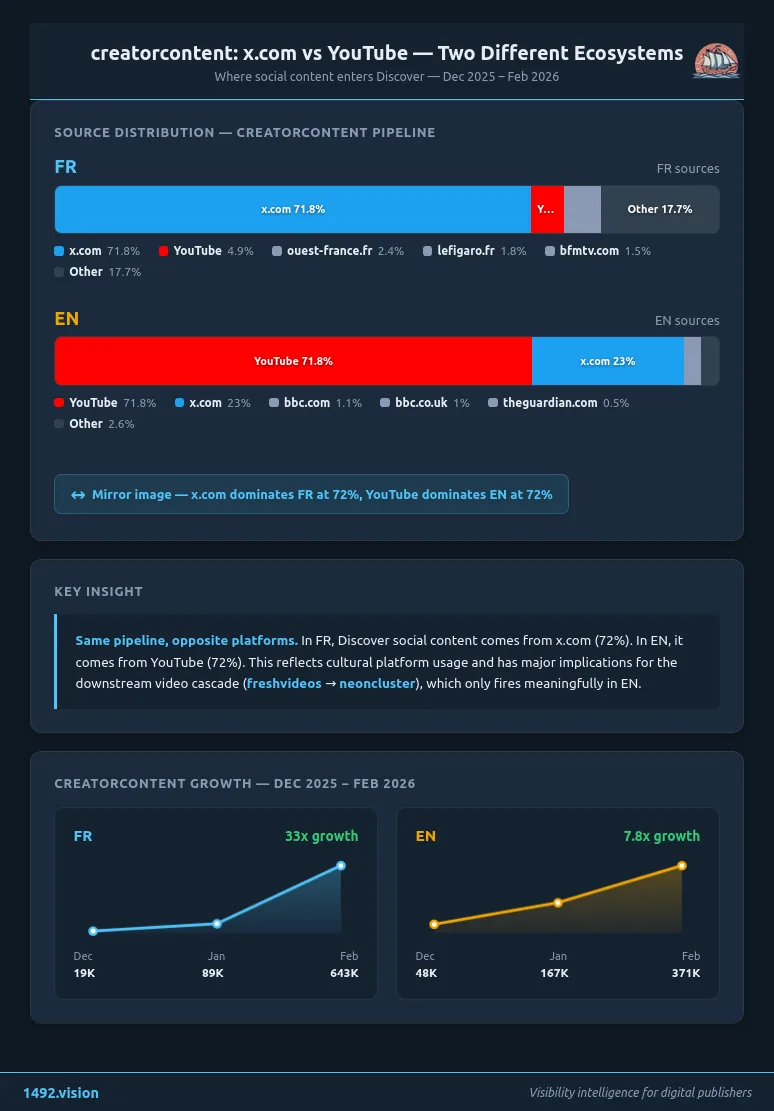 creatorcontent FR = 75% x.com. creatorcontent EN = 72.4% YouTube. The same pipeline, two opposite sources.
The implication is cultural as much as technical: in France, social content circulating on X (politics, sport, crime stories) feeds Discover. In English, it's YouTube (news, politics, entertainment). The same system, two cultural ecosystems.
What this changes: an FR content creator who wants to reach creatorcontent must be on X. An EN creator must be on YouTube. The entry platform into Discover differs by market.
Divergence 5 — neoncluster: the pipeline that only exists in English
FR: 36 hits. EN: 4.5% of volume, 13% reach, 100% YouTube.
This is the sharpest divergence. Neoncluster — the YouTube broadcast pipeline — is the third pipeline by reach in EN (13%). In FR, it doesn't exist. 36 hits over 3 months is statistical noise.
Why? Neoncluster is the third stage of the video cascade. It amplifies the best YouTube content filtered by freshvideos. In FR, the cascade doesn't work: creatorcontent is fed by x.com (not YouTube), freshvideos is half textual. The conditions for YouTube broadcast aren't met.
Neoncluster's growth in EN is staggering: 18x in 3 months. It's the fastest-growing pipeline in Discover, across all markets. Google is investing massively in YouTube/Discover integration — but only in English, for now.
What this changes: for an EN YouTube creator (news, politics, science), neoncluster is the route to 13% broadcast. This route doesn't exist in French.
Divergence 6 — feedads: the advertising gap
FR: 24% reach. EN: 58.4%. A 2.4x gap.
The English feed is massively more monetized than the French one. More than half of EN devices see each ad.
| Metric | FR | EN | Ratio |
|---|---|---|---|
| Reach | 24% | 58.4% | 2.4x |
| Volume | 3% | 11.1% | 3.7x |
| YouTube in ads | — | 53.7% | — |
| Growth | 2.7x | 4.1x | EN accelerates faster |
YouTube is the source of 53.7% of EN ads — video advertising dominates. In FR, ads are mostly text links (hotels, fashion, SME e-commerce).
The advertising ecosystem is completely closed in both markets — 99.8% exclusive URLs. It doesn't interfere with the editorial feed. But its weight in the user experience is radically different: an EN user sees 2.4x more ads than an FR user.
What this changes: for an EN publisher, competition for attention in the feed is fiercer — editorial cards are diluted by more aggressive advertising. For an FR publisher, the feed is more "editorial."
Divergence 7 — Shopping: product content lives longer in France
FR: 3.7-day lifespan. EN: 2.5 days. French product content recycles more.
The shoppinginspiration pipeline has similar reach in both markets (FR 19.7%, EN 13.1%). The silo is the same — low co-occurrence with other pipelines. But lifespan diverges: French product content stays 48% longer in the feed.
Sources differ too:
- FR: generalist tech — Frandroid (11.7%), Le Parisien (9.3%), Les Numériques (6.9%)
- EN: specialist reviewers — TechRadar (9.9%), What Hi-Fi (5.9%), Tom's Hardware (5.6%)
The hypothesis: the EN product review market is more competitive — more fresh content pushes articles out faster. In FR, the tech/review content pool is smaller, so each article circulates longer.
What this changes: an FR tech publisher benefits from a longer shopping visibility window. An EN publisher must publish more frequently to maintain presence.
Divergence 8 — Multi-labeling: the French feed crosses more pipelines
FR: 58% of URLs in 2+ pipelines, max 14. EN: 37% in 2+, max 12.
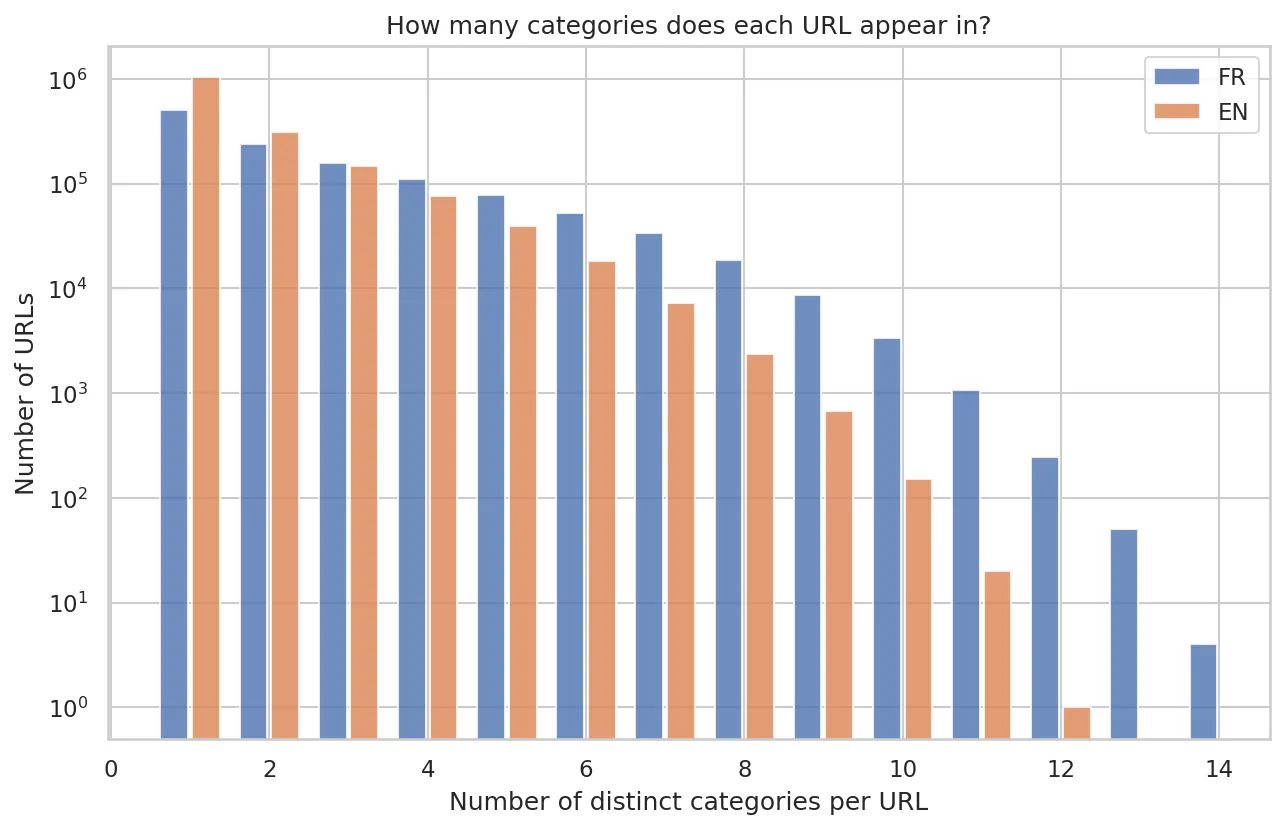 FR (blue) vs EN (orange). The FR tail is longer — some articles reach 14 pipelines. In EN, the maximum is 12. Multi-pipeline is a more French phenomenon.
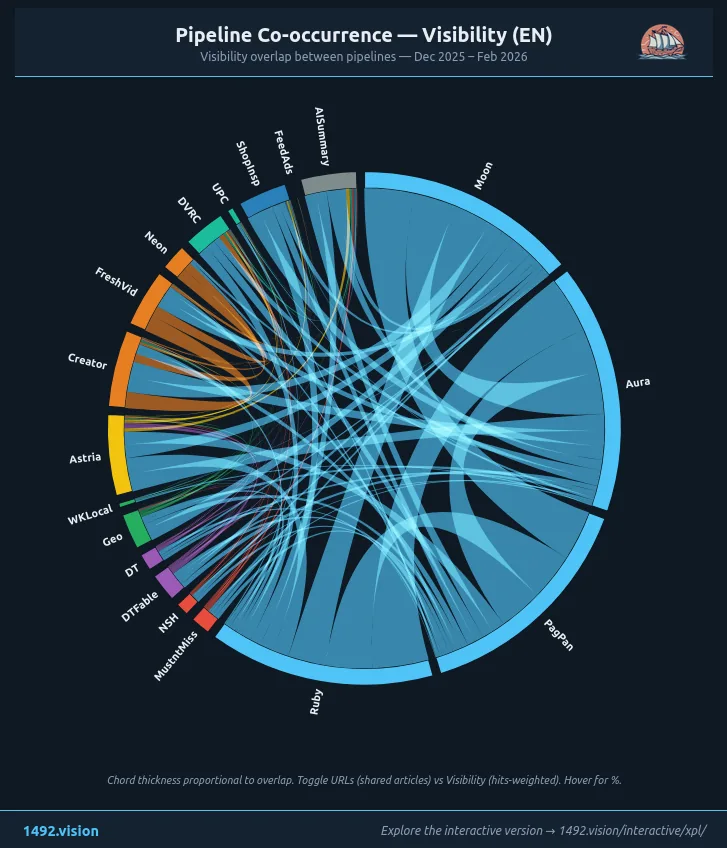 Which EN pipelines share the same URLs? The video cascade (creatorcontent-freshvideos-neoncluster) forms a co-occurrence block unique to EN. EN multi-labeling is more structured by cascades; FR is more diffuse across editorial pipelines.
Multi-labeling is structurally more common in French. The reason: the FR feed is dominated by editorial pipelines (content, aura, moonstone, paginationpanoptic, relatedcontentruby, deeptrendsfable, mustntmiss) that share many URLs — a Le Monde article can traverse 6–8 of these pipelines.
In EN, the video cascade (creatorcontent → freshvideos → neoncluster) is a multi-labeling vector by design — but it only concerns YouTube content. EN text URLs traverse fewer pipelines than FR text URLs.
| Distribution | FR | EN |
|---|---|---|
| 1 pipeline | 42% | 63% |
| 2 pipelines | 20% | 19% |
| 3 pipelines | 13% | 9% |
| 4+ pipelines | 25% | 9% |
What this changes: the multi-pipeline strategy — publishing content that traverses the maximum number of pipelines — has more leverage in FR. In EN, the YouTube video strategy gives "free" multi-labeling (3 pipelines via the cascade).
Divergence 9 — The EPL exclusion: an EN-only phenomenon
The Premier League is systematically under-represented in 7+ EN pipelines. In FR: no equivalent exclusion.
The terms Premier League, football, Arsenal, Liverpool, Chelsea show a coherent negative signal in aura, deeptrendsfable, deeptrends, geotargetingstories, astria, freshvideos, and other EN pipelines.
Unaffected sports: NFL, NBA, Olympics, rugby, cricket, Formula 1. The exclusion is specific to the EPL.
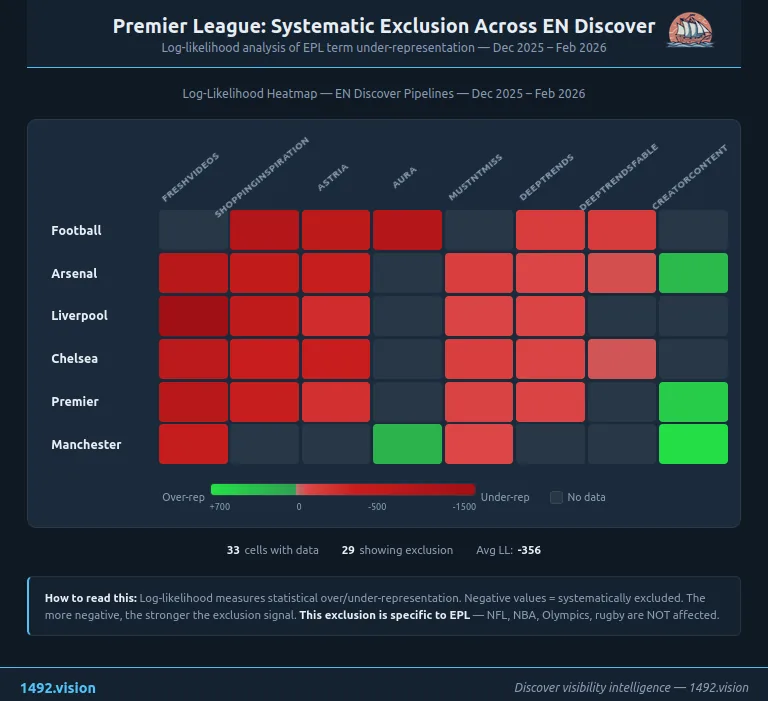 Systematic under-representation of EPL terms in 7+ EN pipelines. Specific to the Premier League — other sports are unaffected.
In French, no equivalent sports exclusion exists. Football (Ligue 1, Champions League) circulates normally through trend, local, and diversification pipelines. The EPL is a case specific to the English market — likely tied to broadcasting rights.
What this changes: an EN sports publisher covering primarily the EPL has a structural ceiling in diversification pipelines. To maximize visibility, diversify toward other sports or other angles (transfers, business of sport, tactical analysis vs raw results).
Divergence 10 — Growth: different explosions
FR: creatorcontent 33x. EN: neoncluster 18x. Both markets are evolving fast — but not in the same direction.
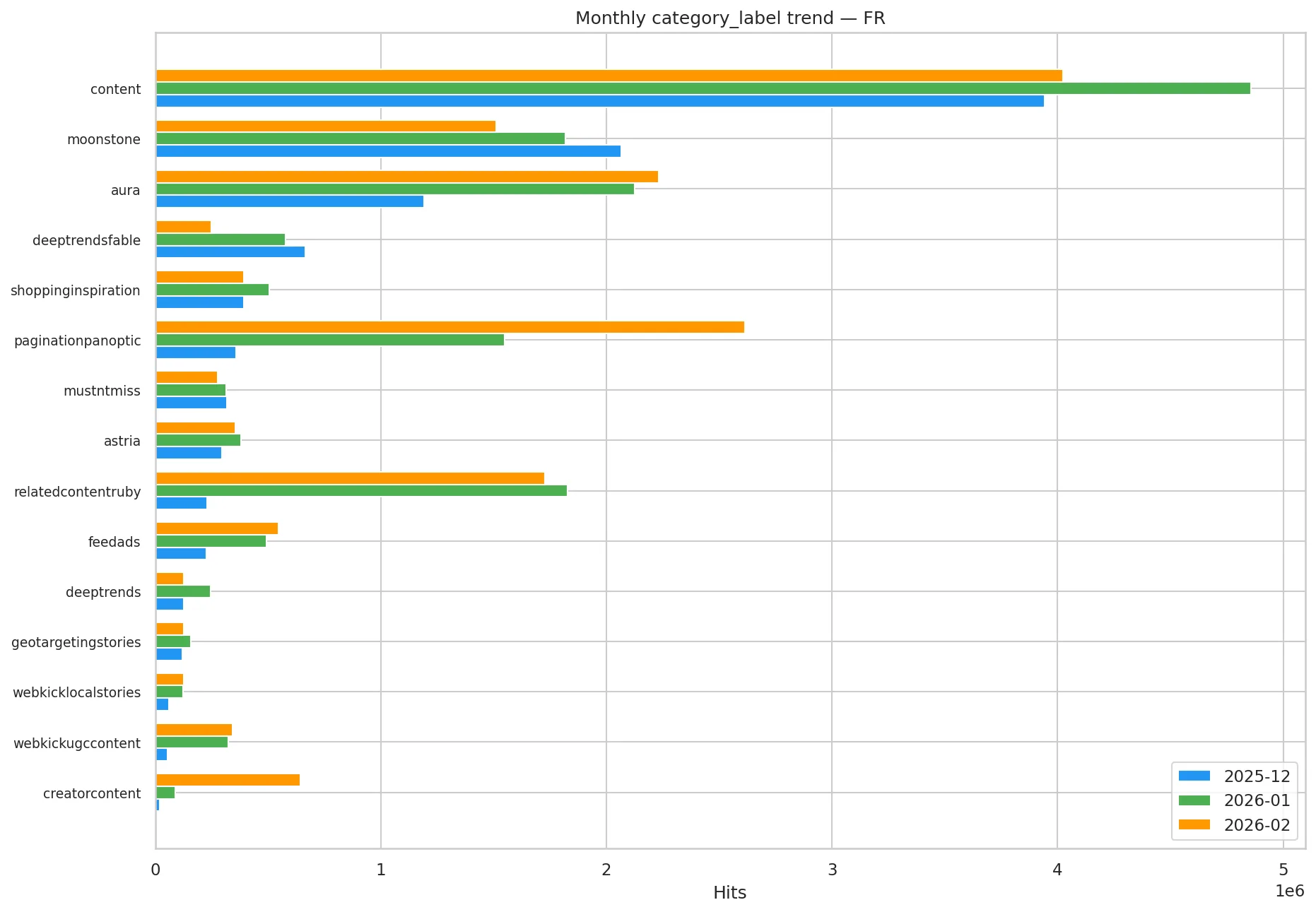 FR: creatorcontent explodes at 33x. paginationpanoptic at 7x. feedads at 2.7x. userpersonascontent in decline (-73%).
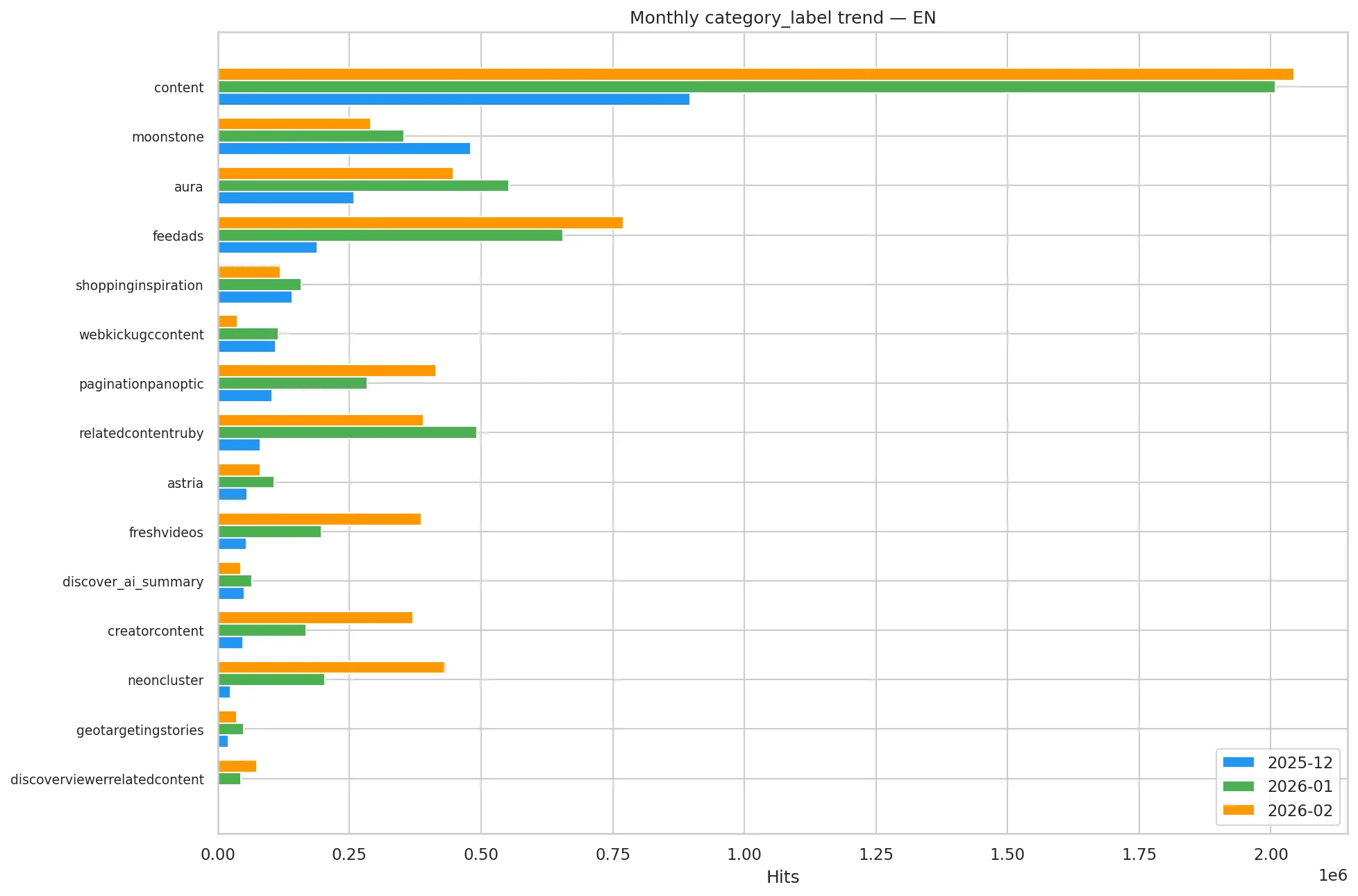 EN: neoncluster at 18x. creatorcontent and freshvideos at ~8x. feedads at 4.1x. userpersonascontent at 0.4x.
Growth directions tell Google's strategy:
| Direction | FR | EN |
|---|---|---|
| Social | creatorcontent 33x (x.com) | creatorcontent 7.8x (YouTube) |
| Video broadcast | Absent | neoncluster 18x |
| Advertising | feedads 2.7x | feedads 4.1x |
| Scroll infra | pagpan 7x | pagpan 4x |
| Personalization | userpersonascontent -73% | userpersonascontent 0.4x |
| Trends | deeptrends contracting | deeptrends 0.5x |
Both markets converge on one point: the gradual abandonment of userpersonascontent (the persona system) and deeptrends. Google seems to be migrating toward other personalization and persistence mechanisms.
They diverge on video: EN is accelerating massively toward YouTube broadcast (neoncluster 18x). FR is accelerating toward x.com social intake (creatorcontent 33x). Two different trajectories.
What this changes: tomorrow's Discover feed won't be today's. Continuous monitoring is necessary — the pipelines exploding in February 2026 didn't exist in December 2025.
The domain landscape: two worlds
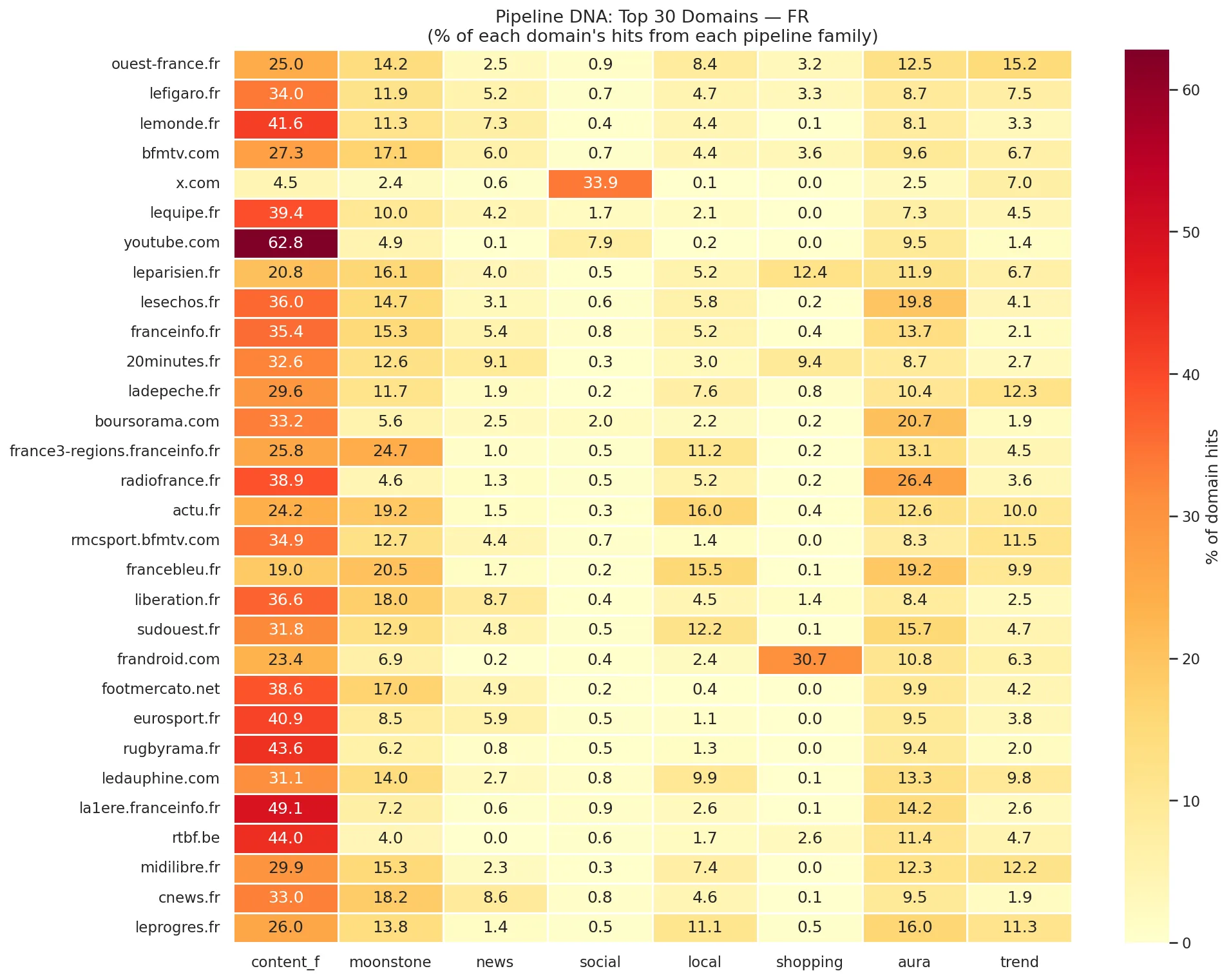 FR: traditional publishers dominate. Ouest-France shows the widest multi-pipeline spread. Social and video columns are nearly empty.
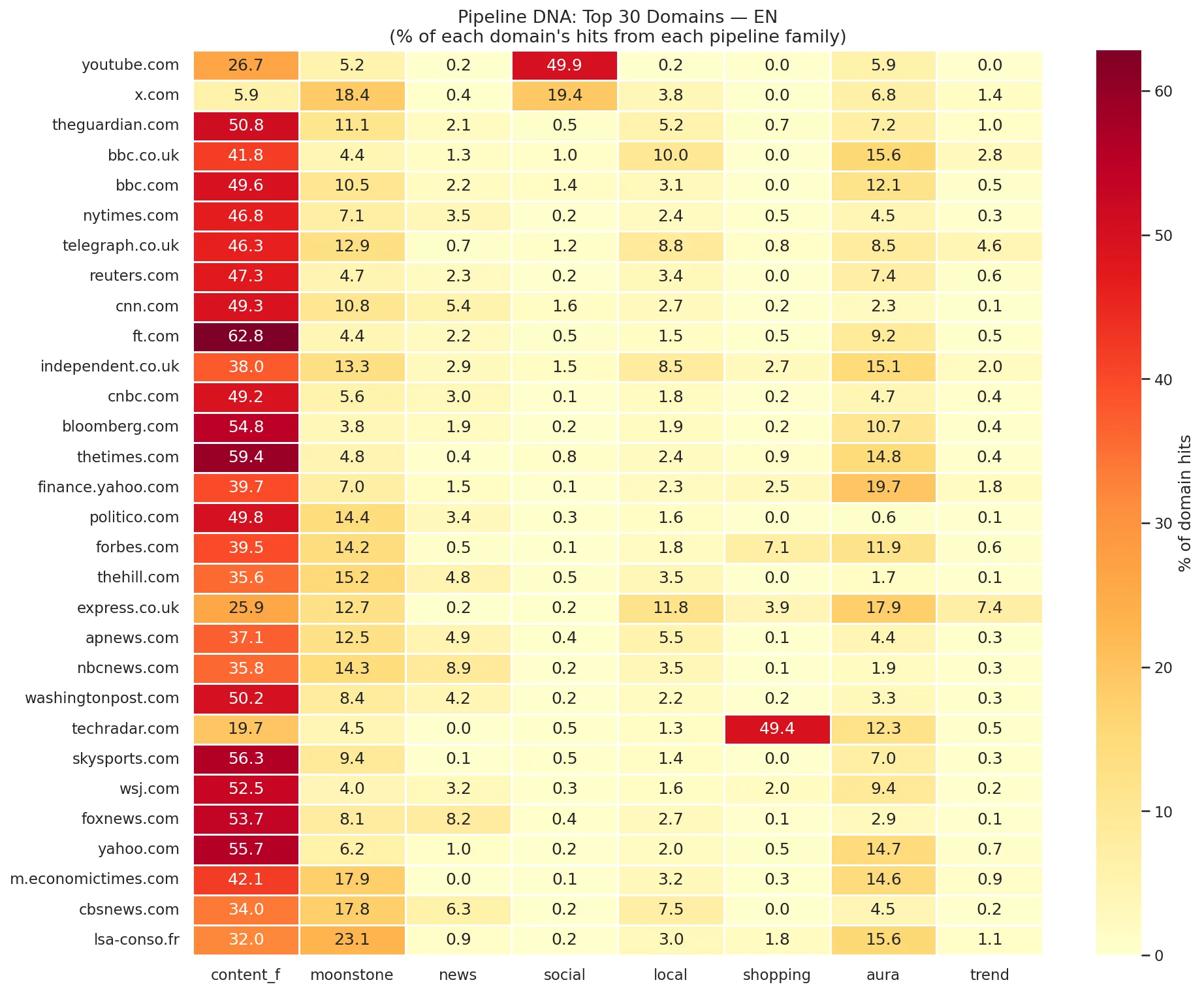 EN: YouTube dominates the social/video column (49.9%). Quality UK press (Guardian, BBC) shows rich editorial spread. YouTube advertising dominates feedads.
The heatmap comparison speaks for itself:
- FR: traditional press everywhere, x.com in a single column (social), YouTube marginal, video columns nearly empty
- EN: YouTube omnipresent (content, social, video, ads), quality UK press diversified, x.com in social and trends
The "multi-pipeline" model doesn't execute the same way:
- In FR, it's the dual local/national anchor that multiplies pipelines (Ouest-France model)
- In EN, it's the broad editorial spread that multiplies pipelines (Guardian model)
Strategic implications
An FR publisher expanding to the EN market
- Don't transpose your FR playbook. Moonstone will be 2x less powerful. YouTube video is an entire channel you don't have in FR.
- Invest in video. The creatorcontent → freshvideos → neoncluster cascade is the route to 13% reach. This route doesn't exist in FR — it must be built from scratch.
- Prepare for AIO. Mustntmiss EN is already at 29% AIO. Quality publishers selected for AIO have a measurable visibility advantage.
- Expect more ads. The EN feed is 2.4x more monetized — your editorial cards will be diluted.
An EN publisher targeting the FR market
- Moonstone is king. 19.3% reach — no EN pipeline has this editorial broadcast power. Engagement content has 2x more leverage in FR.
- Text dominates. Video is marginal in the FR feed. Focus on the article.
- x.com, not YouTube. The social content feeding Discover in FR comes from x.com. Your YouTube Discover strategy doesn't transfer.
- AIO doesn't exist (yet). No AIO advantage in FR. No penalty either.
A global publisher (both markets)
- Two strategies, not one. Direct transposition FR→EN or EN→FR is a mistake. Pipelines, sources, and balances are structurally different.
- Multi-pipeline works differently. FR: 58% of URLs in 2+ pipelines via editorial pipelines. EN: 37% via video cascade + editorial. Two mechanisms, two optimizations.
- Monitoring is key. Both markets evolve fast and in different directions. What's true in February 2026 may not be in June. The competitive advantage is seeing the change before others.
Convergence or divergence?
The question everyone asks: will the two markets converge?
Convergence signals:
- creatorcontent is exploding in both markets (33x FR, 7.8x EN) — social is entering Discover everywhere
- userpersonascontent is declining everywhere — same migration direction
- AIO is EN-only today, but the historical pattern suggests EN features eventually arrive in FR, even if the neighboring rights issue makes this more complex here.
Divergence signals:
- The moonstone gap (2x) appears structural, not cyclical
- The social source (x.com vs YouTube) reflects different digital cultures — unlikely to converge
- The EPL exclusion is a legal/commercial phenomenon, not technical — it will persist as long as rights are at stake
- neoncluster has no reason to activate in FR as long as YouTube doesn't dominate French social
Our hypothesis: the markets will partially converge — AIO will arrive in FR, video will gain importance — but structural divergences (moonstone gap, social source, mono/multi-pipeline) will persist. Discover will remain two distinct products sharing the same infrastructure.
And that's precisely why continuous monitoring has value. Not to predict the future — to see it coming.
Explore further
- The full FR analysis: 20 pipelines, French data, pipeline by pipeline
- The full EN analysis: 20 pipelines, English data, video cascade, AIO, EPL
- The interactive explorer: navigate the 20 pipelines, compare FR and EN
- The newsletter: weekly analyses with data, charts, and recommendations
- Your domain: 1492.vision will soon give you your own domain's pipeline fingerprint
The feed evolves. The cards too. Like any good navigator, it's by keeping an eye on the horizon that you anticipate the currents.
Data: 42 million Discover cards, December 2025 to February 2026. Analysis: 1492.vision. Internal mechanisms are presented as our interpretations based on observed data and available public research.
Authors
Posted on 2026-03-28
More reliable, sourced reporting on Discover? Add us to your sources!
Add to sources Add to sources