Inside Google Discover: How 20 Pipelines Shape the French Feed
Three months of data, 42 million cards. Here's what no one had measured about Google Discover's internal architecture in France.
What you'll discover
Our data reveals a system far more structured than the SEO community imagined. Here are the ten key findings — each links to its detailed section:
- 20+ distinct pipelines — Discover is not one algorithm, it's a layered system with specialized roles (broadcast, breaking news, trends, local, social, commercial)
- moonstone: 19.3% reach — each selected URL is shown to nearly 1 in 5 devices. Twice the baseline pipeline
- mustntmiss: ~2x priority boost — the editorial importance pipeline. Le Monde dominates
- shoppinginspiration: 3.7-day lifespan — 8x longer than a news article, with 19.7% reach. But siloed
- deeptrendsfable → deeptrends — a sequential 2-stage trend detector, 27% pass-through rate, +21h between stages
- webkicklocalstories: 67% exclusive URLs — a dedicated channel for regional press, invisible to the rest of the system
- creatorcontent: 33x explosion in 3 months — x.com dominates at 73% in FR, not YouTube
- 58% of URLs in 2+ pipelines — multi-pipeline is the norm, not the exception
- A living system — ~10 abandoned pipelines, ~8 new ones observed. The architecture evolves constantly
- Position in the feed — pipelines don't just select content, they also control where it appears in the feed
Methodology
Our analysis is based on observing real Discover feeds, collected across hundreds of devices over three months (December 2025 – February 2026). In total: 42 million cards analyzed.
For each Discover card, we traced the pipeline responsible for its selection. This data, never exploited at this scale, is what allows us to decompose Discover into its components. Metehan Yesilyurt listed some of these pipelines by analyzing the Google SDK; the data reveals more precisely what they are and, more importantly, how to leverage them.
For each pipeline, we compute:
- Reach — percentage of devices that see each URL per day. A proxy for broadcast power.
- Speed — median age of articles at the time of appearance. A proxy for freshness.
- Exclusivity — percentage of URLs unique to the pipeline, absent from others. A proxy for independence.
- Volume — share of total feed, expressed as a percentage.
Metrics are normalized by observation density to avoid biases related to our panel size.
Before diving into the full analysis, explore the 20 pipelines visually: Open the interactive explorer →
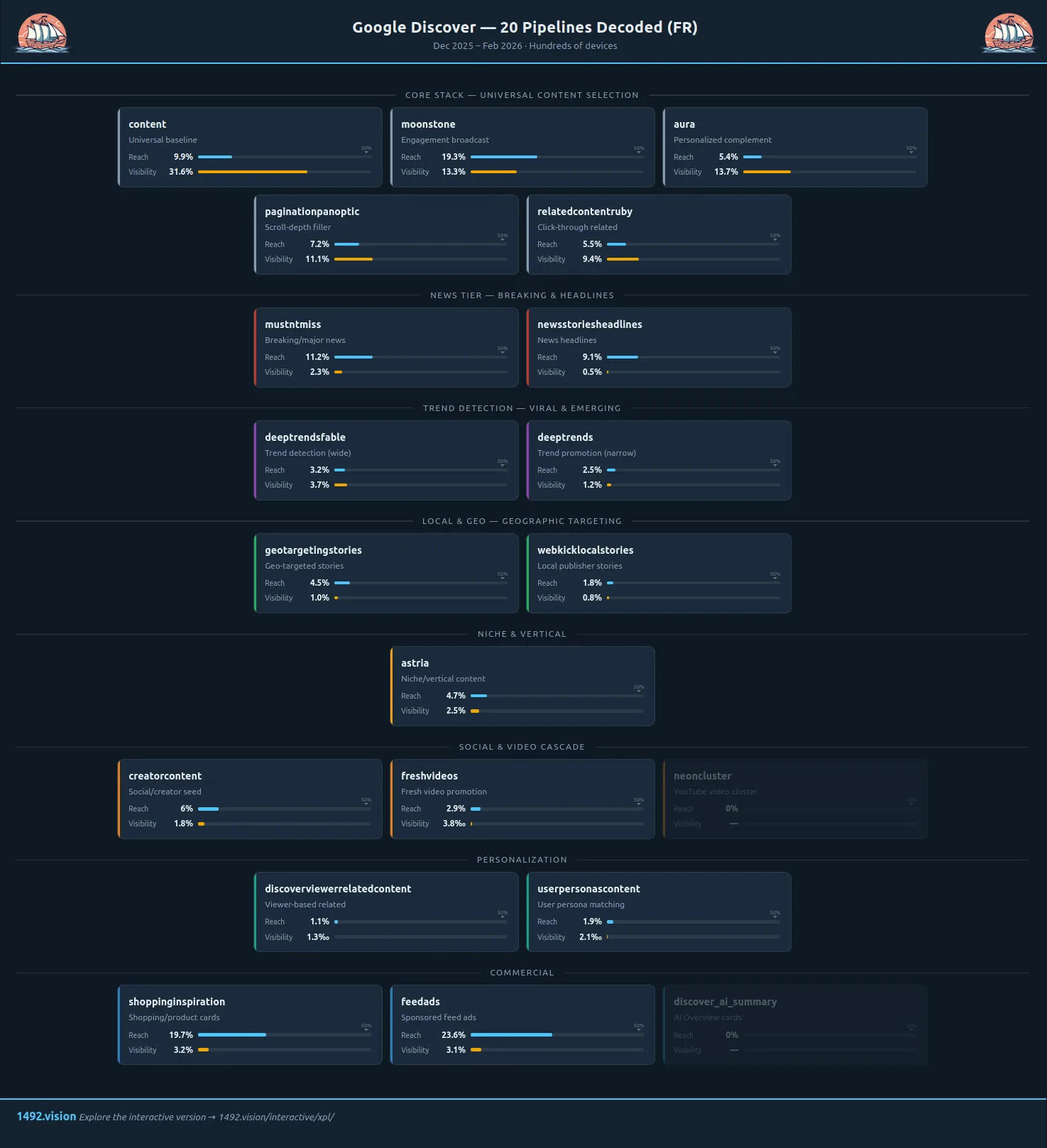 Screenshot of the interactive explorer — FR view. Live version →
The architecture: a layered system
The common belief: Discover uses a recommendation algorithm that selects content. The reality from our data: Discover is a system structured into six functional layers, each with its own logic, speed, and audience.
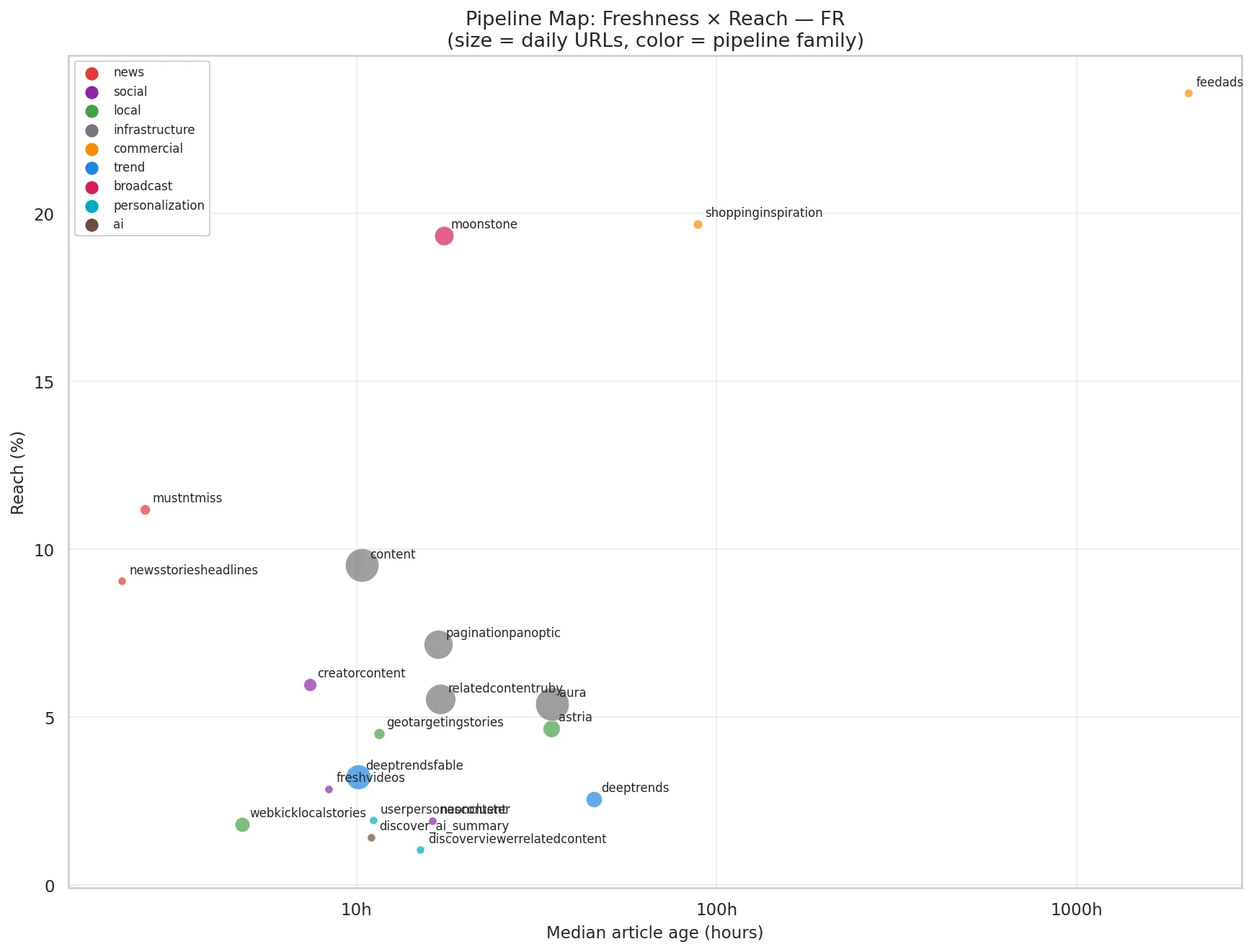 Each pipeline positioned by speed (X-axis, log) and reach (Y-axis). Size = daily URLs, color = functional family. Breaking in the top left, broadcasts in the center, long-tail in the bottom right.
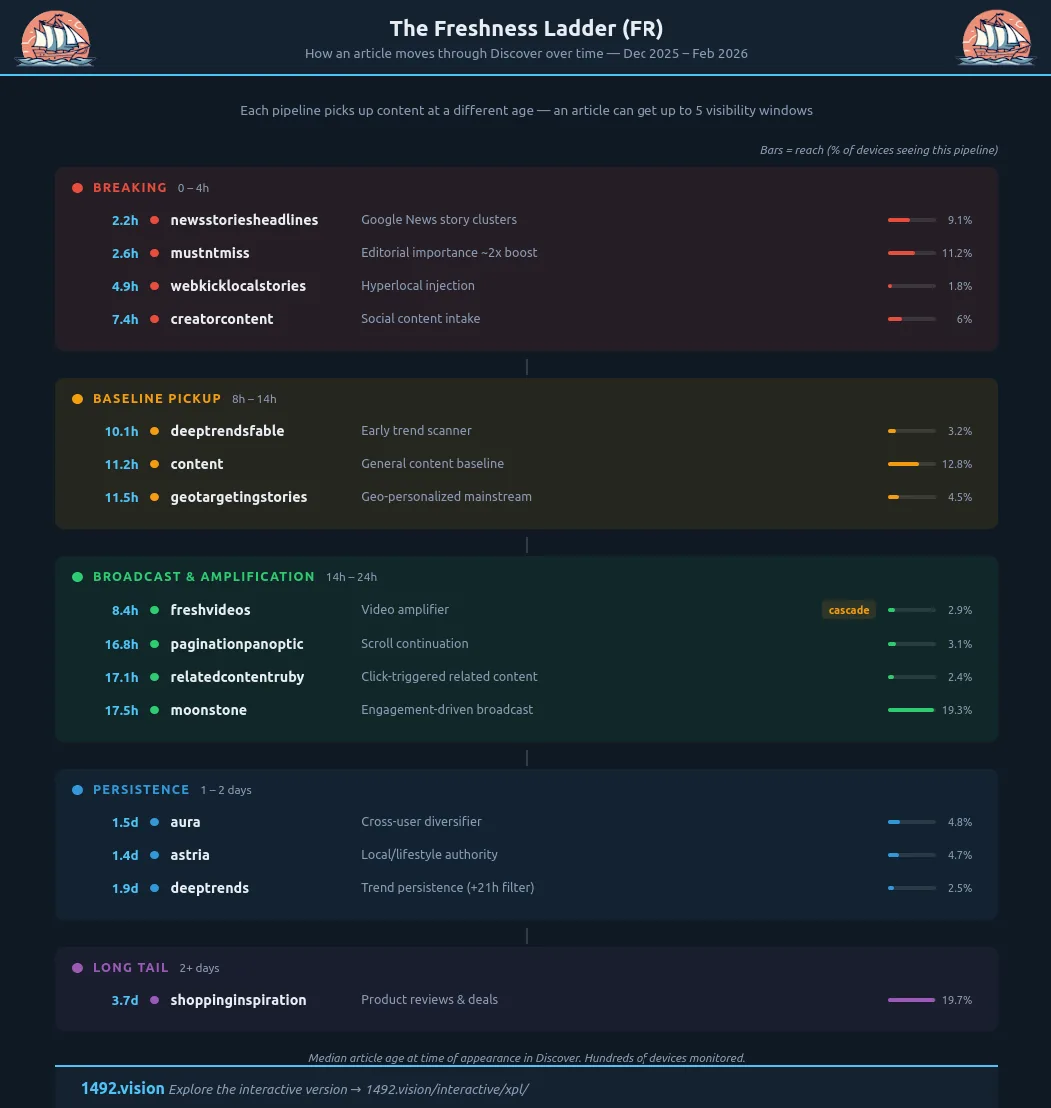 The lifecycle of an article in Discover FR: from breaking (nsh 2.2h, mustntmiss 2.6h) to long-tail (shopping 3.7 days). Each pipeline has its time window.
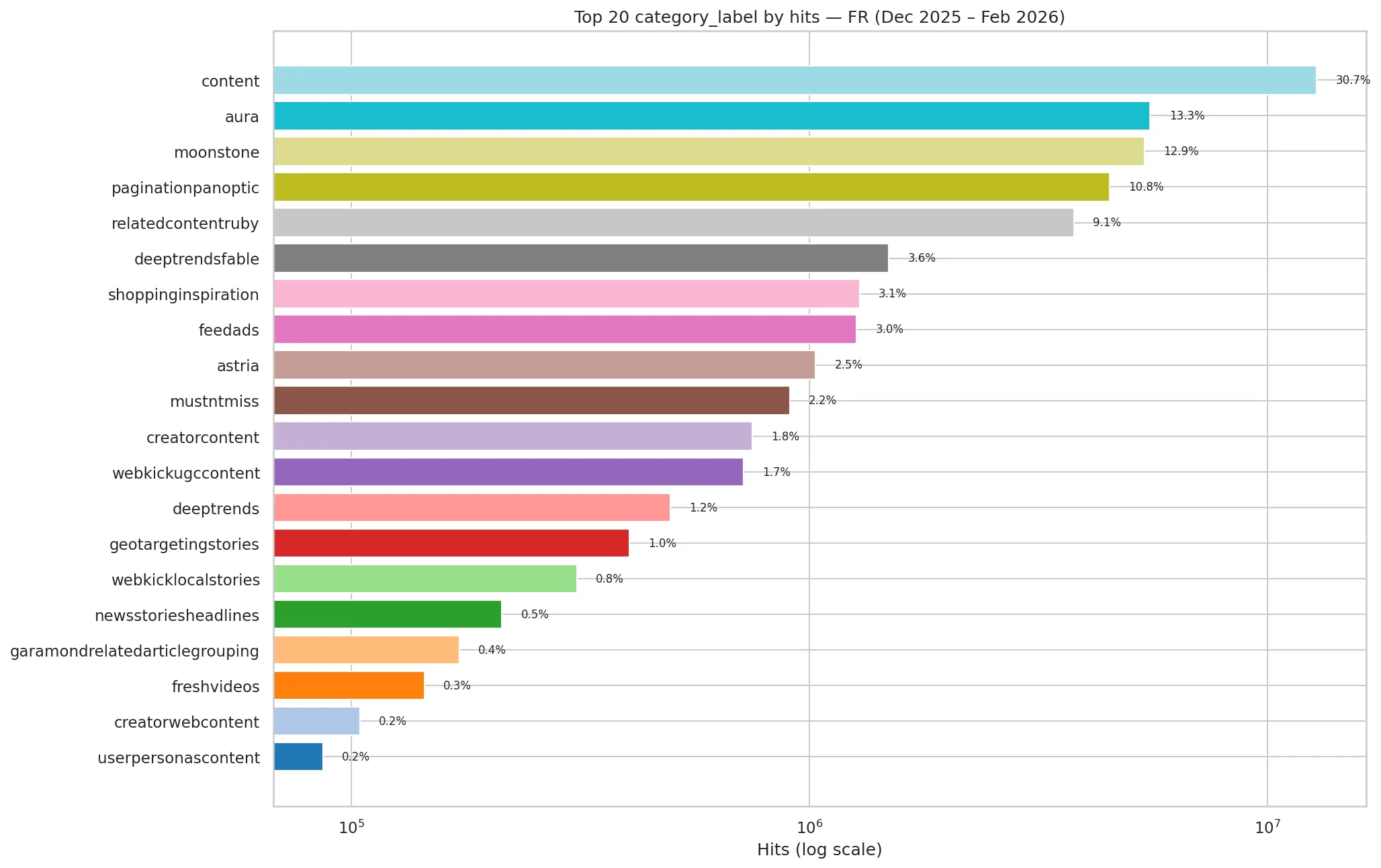 The 20 FR pipelines ranked by total volume (December 2025 – February 2026). content dominates at 30.7%, followed by aura (13%) and moonstone (12.9%).
Layer 1 — The editorial foundation
Five pipelines form the base of Discover. Together, they account for the majority of volume. It's a recycling loop: content enters through content, gets amplified by moonstone if engagement follows, diversifies via aura, and extends through paginationpanoptic (scroll) and relatedcontentruby (click).
- content — the generalist baseline. 9.9% reach, 30.7% of FR volume.
- moonstone — the engagement broadcast. 19.3% reach — 2x content.
- aura — the long-tail diversifier. Science, tech, finance. 1.5-day median age.
- paginationpanoptic — the scroll infrastructure. 7.1% reach.
- relatedcontentruby — related content triggered by a click. 5.5% reach.
Layer 2 — Breaking news and urgency
Two pipelines handle breaking news and editorial importance. They're fast — 2 to 3 hours median age — and independent of each other (5% overlap).
- mustntmiss — editorial importance. ~2x priority boost. Le Monde dominates.
- newsstoriesheadlines — breaking news. Google News clusters. 46% exclusive URLs.
Layer 3 — Trends
A sequential two-stage pipeline: deeptrendsfable detects, deeptrends persists. 27% pass-through rate, 21-hour delay. x.com is a trend source in FR.
Layer 4 — Local and geo
Three approaches to local, very different:
- geotargetingstories — mainstream content filtered by geolocation
- webkicklocalstories — pure hyperlocal, 67% exclusivity, regional press
- astria — local authority and lifestyle, with a 1.5-day delay
Layer 5 — Social and video
The most recent and most explosive layer. In FR, x.com dominates (73% of creatorcontent), not YouTube. The creatorcontent → freshvideos → neoncluster cascade works primarily in English.
Layer 6 — Commercial
Two ecosystems separate from the rest:
- shoppinginspiration — product broadcast. 19.7% reach, 3.7-day lifespan.
- feedads — advertising. 24.0% reach, campaigns lasting months.
The hidden dimension: position in the feed
Our data reveals a dimension that pipelines control beyond selection: placement in the feed.
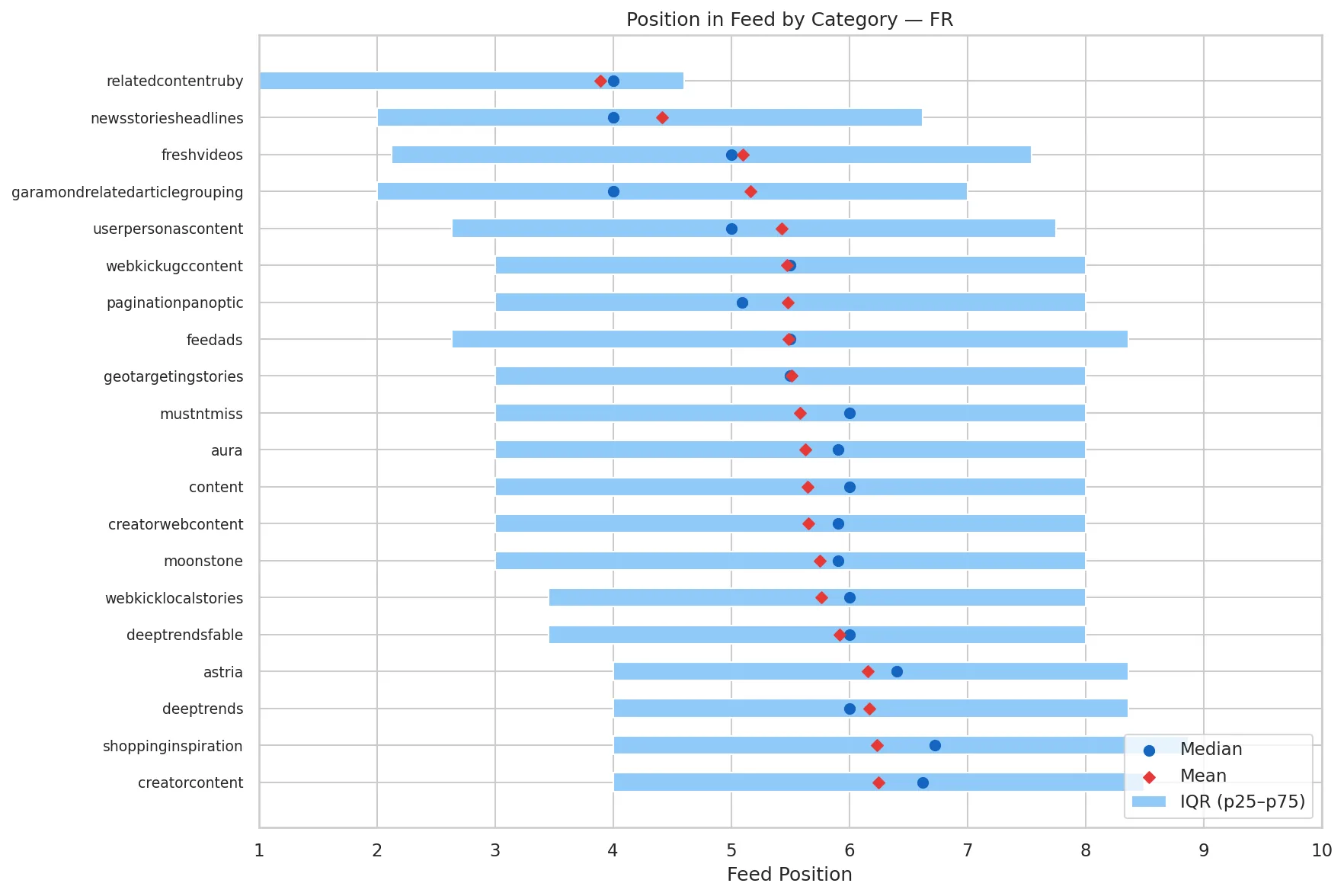 Median position and interquartile range of each pipeline in the Discover feed. Breaking news and related content occupy positions 2–4 (top of feed). Engagement and shopping sit at positions 6–8 (deeper).
Breaking news (newsstoriesheadlines) and related content (relatedcontentruby) get premium placement — positions 2 to 4. Engagement (moonstone) and products (shoppinginspiration) end up deeper — positions 6 to 8. This is not random: it's an architectural choice. Urgent pipelines capture immediate attention, browse pipelines reward scrolling.
Pipeline by pipeline — FR data
For each pipeline, an identical structured profile. This is the core of this reference — the detail you won't find anywhere else.
content — the generalist baseline
- FR reach: 9.9%
- Volume: 30.7% of FR feed — the largest pipeline
- Median age: 11 hours
- Top FR domains: YouTube (10.6%), Le Monde (8.7%), Le Figaro (7.5%), L'Equipe (7.3%), Ouest-France (6.1%), BFM TV (5.4%)
- Distinguishing signal: the common trunk. 80% overlap with mustntmiss, 65% with aura. Everything flows through content — it's the system's entry point.
The content pipeline is Discover's main highway. Almost all articles pass through it. The question isn't getting there — it's getting out to reach the specialized pipelines that amplify reach.
moonstone — the engagement broadcast
- FR reach: 19.3% — 2x the reach of content
- Volume: 12.9% of FR feed
- Median age: 17.6 hours (0.73 days)
- Top FR domains: Ouest-France (9.0%), BFM TV (8.8%), Le Figaro (6.8%), Le Monde (6.2%), L'Equipe (4.8%)
- Co-occurrence with content: 85%
- Distinguishing signal: restricted URL pool (~4.5x fewer than content), massive reach. Selection based on engagement signals.
Moonstone is Discover's broadcast machine in France. It takes a tight selection of URLs and shows them to 2x more devices than content. It's the deliberate broadcast strategy: few articles, large audience.
What's over-represented? Horoscope (3.5x), betting/games (3.3x), entertainment, weather, celebrity news. The profile is clear: moonstone selects what generates clicks.
And yet. Ouest-France — a regional daily — dominates moonstone. Not an engagement pure player. The secret: local crime stories with a national angle, weather, regional celebrity news. Content that combines local roots with national resonance.
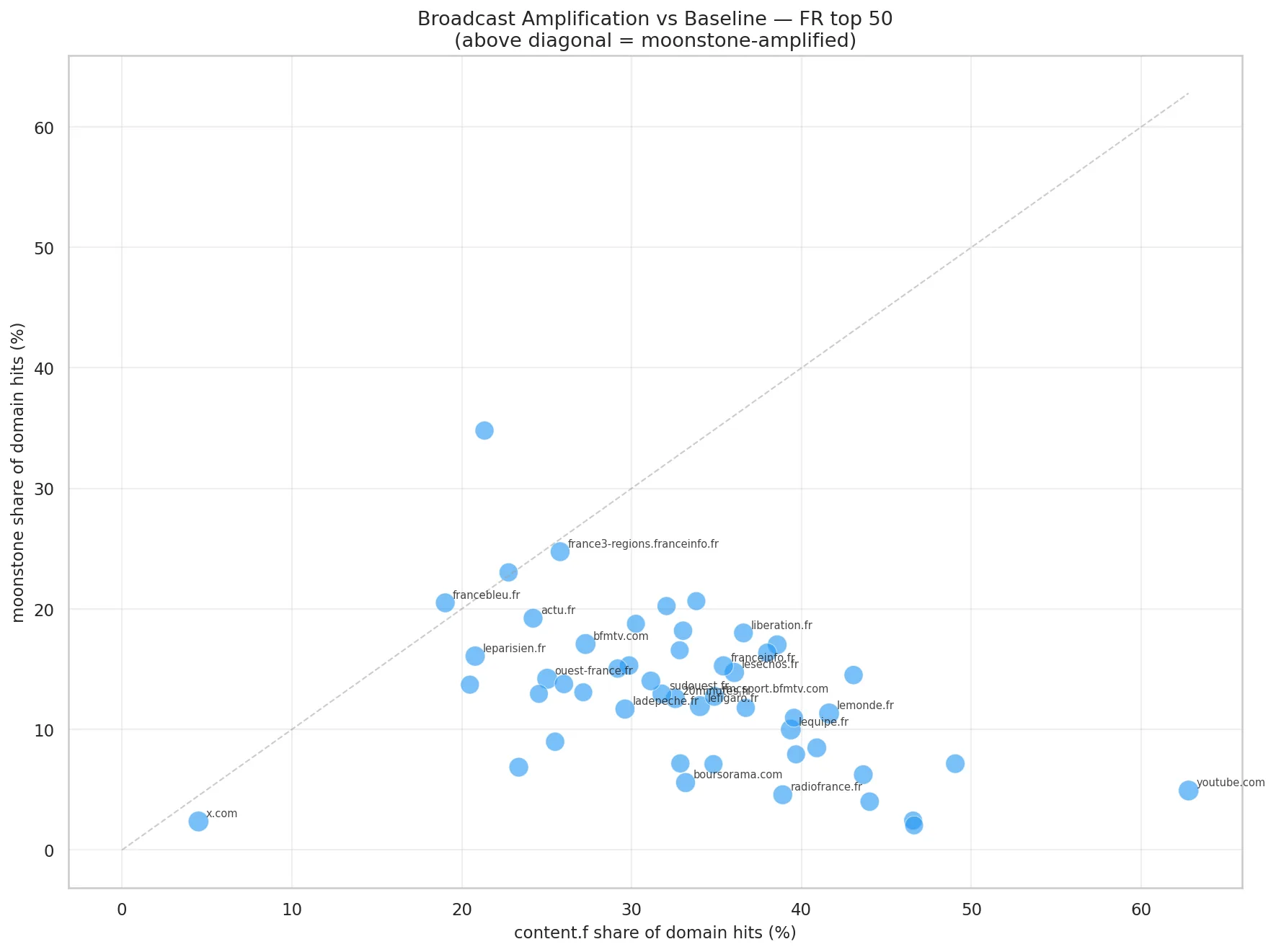 Each domain positioned by its content share (X) and moonstone share (Y). Ouest-France and BFM TV lean toward moonstone (engagement); Le Monde and L'Equipe lean toward content (authority). x.com and YouTube are outliers — they don't use these pipelines.
aura — the long-tail diversifier
- FR reach: 5.4%
- Volume: 13.9% of FR feed — second largest pipeline by volume
- Median age: 1.46 days — 3x older than content
- Top FR domains: broad distribution, no marked concentration
- Co-occurrence with content: 65%
- Distinguishing signal: over-representation of science/tech, business, finance. Longer content (+16% vs content). Our hypothesis: cross-user sourcing — what interests readers similar to you.
Aura is the anti-moonstone. Where moonstone concentrates audience on a few popular articles, aura diversifies: ~3.5x more URLs than moonstone, for more modest reach. It's the pipeline that helps you discover content you wouldn't have searched for.
The over-represented signals — business (1.5x), consumer electronics (1.52x), cycling (1.42x), rugby (1.33x) — paint a profile of intellectual curiosity and niches. An interesting observation: Trump is specifically under-represented in aura, while being omnipresent in moonstone. Aura filters out the noise to surface the signal.
paginationpanoptic — the scroll infrastructure
- FR reach: 7.1%
- Volume: 11.5% of FR feed
- Median age: 0.69 days
- Top FR domains: L'Equipe (11.0% — #1), Le Monde (9.6%), Le Figaro (8.9%), BFM TV (7.0%), Ouest-France (6.7%)
- Co-occurrence with content: 82.6% — the highest of all pipelines
- Distinguishing signal: pure infrastructure. Triggers when the user scrolls past the first screen. L'Equipe at #1 makes sense: sports fans scroll deep.
relatedcontentruby — related content, triggered by click
- FR reach: 5.5%
- Volume: 9.8% of FR feed
- Median age: 0.71 days
- Top FR domains: BFM TV (8.5%), Ouest-France (7.8%), Le Figaro (7.7%), L'Equipe (6.0%), Boursorama (5.1%)
- Co-occurrence with content: 73%
- Distinguishing signal: triggered by user click — not passive. When you click an article, ruby serves related content on the next refresh. Boursorama at #5 is unique — a finance signal found in no other pipeline.
The seed→expansion mechanism is visible in the data: a click on a political article generates political suggestions on the next refresh, with progressive broadening of the thematic scope.
mustntmiss — editorial importance
- FR reach: 11.2%
- Volume: 2.3% of FR feed — low volume, high reach
- Median age: 2.6 hours (with a 1–3 day tail)
- Top FR domains: Le Monde (11.3% — #1), Le Figaro (10.2%), BFM TV (10.1%), L'Equipe (8.0%), 20 Minutes (6.3%)
- Co-occurrence with content: 80%
- Distinguishing signal: ~2x priority boost in the ranking system. High-importance topics — economics (2.98x), politics (2.45x), international (2.23x) — are over-represented. Lifestyle (recipes, gardening) is excluded.
The fact that Le Monde dominates mustntmiss — and not BFM TV, despite leading in raw volume — is revealing. This pipeline rewards editorial authority on important topics, not production volume.
Our scoring analysis suggests a priority multiplier of about 2x for articles selected by mustntmiss. In practice: a mustntmiss article is twice as likely to appear at the top of the feed as an equivalent article in content alone.
newsstoriesheadlines — breaking news
- FR reach: 9.1%
- Volume: 0.6% of FR feed — very low volume, but high reach and extreme freshness
- Median age: 2.2 hours
- Top FR domains: Le Monde (18.8% — remarkable concentration), BFM TV (9.3%), Libération (6.4%), Le Figaro (6.3%), France Info (5.9%). Notable Swiss presence: 24heures.ch, 20min.ch
- Co-occurrence with content: only 54% — 46% exclusive URLs
- Distinguishing signal: Google News story clusters. International (5.2x) and political (4.3x) topics dominate. Sport — particularly football — is massively under-represented (50x).
Newsstoriesheadlines is the most independent pipeline in the system. Nearly half its content appears nowhere else in Discover. This is explained by its mechanism: it connects to Google News story clusters, a system distinct from the main Discover feed.
Le Monde captures nearly a fifth of the volume on its own — a remarkable concentration reflecting its status as the French-language breaking news reference.
deeptrendsfable — the trend scanner
- FR reach: 3.2%
- Volume: 3.8% of FR feed
- Median age: 0.42 days (10 hours)
- Top FR domains: Ouest-France (20.4%), x.com (9.2% — #2), Le Figaro (8.2%), BFM TV (7.3%), La Dépêche (5.4%)
- Co-occurrence with content: 65%
- Distinguishing signal: the only major pipeline (after content) with significant x.com presence. Short content (290-character median — x.com posts bring down the average). Over-representation of travel (4.8x), tourism (3.5x), electronics (1.5x).
The presence of x.com as the second source is a strong French specificity. Deeptrendsfable doesn't just detect trends in the press — it also scans what's circulating on the social network.
The name "FaBLE" likely refers to long-term interest embeddings on the user side (public references in Chromium code suggest this). The hypothesis: the pipeline cross-references emerging trends with each user's stable interests — which explains the thematic variety observed.
deeptrends — trend persistence
- FR reach: 2.5%
- Volume: 1.3% of FR feed — ~3x less than deeptrendsfable (the filter is strict)
- Median age: 1.9 days — 15.6% of articles are 3 to 7 days old
- Top FR domains: Ouest-France, Le Figaro, BFM TV (same profile as deeptrendsfable, filtered)
- Co-occurrence with content: 73%
- Distinguishing signal: the second stage of the trend detector. 88% of shared URLs appear first in deeptrendsfable, with a median delay of 21.5 hours. Pass-through rate: 27%. The remaining 73% are eliminated.
The sequential mechanism is clear: deeptrendsfable detects quickly (day 0), deeptrends persists if the topic holds (day 1–2). It's a temporal quality filter — ephemeral trends die at the first stage, lasting trends pass to the second.
geotargetingstories — geo-filtered mainstream
- FR reach: 4.5%
- Volume: 1.0% of FR feed
- Median age: 11.5 hours
- Top FR domains: balanced distribution — BFM TV, actu.fr, Ouest-France, Le Figaro, Le Monde (all between 5 and 7%)
- Co-occurrence with content: 72%
- Distinguishing signal: mainstream content filtered by user geolocation. Local news (1.74x), restaurants (1.57x), real estate (1.79x) are over-represented. This is not a hyperlocal pipeline — it's a geographic filter applied to the general feed.
webkicklocalstories — pure hyperlocal
- FR reach: 1.8% (the lowest)
- Volume: 0.8% of FR feed
- Median age: 4.8 hours
- Top FR domains: actu.fr (11.0%), Sud Ouest (9.7%), Ouest-France (8.6%), France Bleu (7.8%), Le Dauphiné (4.2%), Républicain Lorrain (4.1%), Le Progrès (3.9%)
- Co-occurrence with content: only 33% — 67% exclusive URLs
- Distinguishing signal: pure regional press. No national title in the top 10. Over-represented keywords map France's local geography: municipales, maire, commune, élections, and department names (Loire, Vosges, Rhône, Moselle).
Webkicklocalstories is a dedicated channel. Without it, two-thirds of its content simply wouldn't exist in Discover. Its reach is the lowest of all pipelines — 1.8% — but that's by design: content is geographically targeted, so only users in the relevant area see it.
For regional press, this is an existential pipeline. It's their direct access to the Discover feed, independent of the rest of the system.
astria — local authority and lifestyle
- FR reach: 4.6%
- Volume: 2.6% of FR feed
- Median age: 1.5 days
- Top FR domains: Ouest-France (16.1% — dominant), Le Figaro (8.1%), Le Monde (7.2%), BFM TV (5.3%), La Dépêche (4.7%)
- Co-occurrence with content: moderate
- Distinguishing signal: a "day two" pipeline. 66% of its articles are 1 to 3 days old. Astria waits before selecting. Atypical content profile: horse racing (quinté, Vincennes), astrology (Rob Brezsny), wine, cultural events. Anti-sport — football is excluded.
creatorcontent — the social intake
- FR reach: 6.0%
- Volume: 1.8% of FR feed — but exploding
- Median age: 7.5 hours
- Top FR domains: x.com (75.0%), YouTube (5.1%), Ouest-France (2.5%), Le Figaro (1.8%), BFM TV (1.6%)
- Co-occurrence with content: 45% — 55% exclusive content
- Distinguishing signal: in France, creatorcontent is essentially an "what's trending on X" pipeline. 75% from x.com. Content is short — 38-character median (tweet length). Sport accounts for 46.8% of volume — the highest of all pipelines. Growth: 33x in 3 months (December → February).
The creatorcontent explosion is the most striking finding of our observation period. In three months, this pipeline went from a marginal channel to one of the most dynamic in Discover France. And unlike English where YouTube dominates, it's the social network x.com that feeds the French feed.
freshvideos — the video amplifier
- FR reach: 2.9%
- Volume share: 0.3%
- Median age: 8.4 hours
- Top FR domains: YouTube (53% of the pipeline), TF1 (14.3%), x.com (12.4%), L'Equipe (11%), RTS.ch (6.6%)
- Distinguishing signal: appears +15 hours after creatorcontent for shared URLs. In FR, this is not a pure video pipeline — 47% articles (TF1, L'Equipe) alongside 53% video. The video cascade works primarily in English.
neoncluster — the YouTube broadcast
- FR reach: near zero (36 hits over 3 months)
- Distinguishing signal: 100% YouTube, 100% English. Absent from the French feed. In English, neoncluster reaches 13% — broadcast level — and forms the third stage of the video cascade. This pipeline does not exist in France.
discoverviewerrelatedcontent — viewing recommendation
- FR reach: 1.0%
- Distinguishing signal: triggered by a click on video content or an AIO card. Notable growth in English (50x), more modest in French.
userpersonascontent — user personas
- FR reach: 1.9%
- Volume share: 0.2%
- Median age: 0.46 days
- Top FR domains: Ouest-France (9.7%), BFM TV (9.5%), Le Figaro (6.4%), France 3 Régions (4.9%), Le Monde (4.6%)
- Distinguishing signal: geopolitical content in FR — trump, ukraine, iran, guerre, russie, armée are over-represented. The pipeline uses a "multiple personas" framework (Multiple User Representations / MUR) — each user has N interest profiles, and content is matched to the relevant one. In decline: -73% over our period.
shoppinginspiration — the product broadcast
- FR reach: 19.7% (the highest editorial reach)
- Volume share: 3.3%
- Median age: 3.7 days — 8x longer than content
- Top FR domains: Frandroid (11.7%), Le Parisien (9.3%), Les Numériques (6.9%), Ouest-France (6.3%), BFM TV (5.7%)
- Co-occurrence with content: 67% (33% exclusive)
- Distinguishing signal: shopping content (4.8x), automotive (16.6%), gaming (9.3%) dominate. Most importantly: shoppinginspiration is a silo. Very low co-occurrence with other pipelines. A Samsung Galaxy review stays in shopping. It doesn't cross into moonstone, mustntmiss, or deeptrendsfable.
The reach is impressive — 19.7%, the highest outside advertising — but the isolation is structural. For a tech/review publisher, the challenge isn't reaching shopping (they're already there), it's getting out. Adding an editorial angle — a trend analysis, market context — can open doors to aura and content.
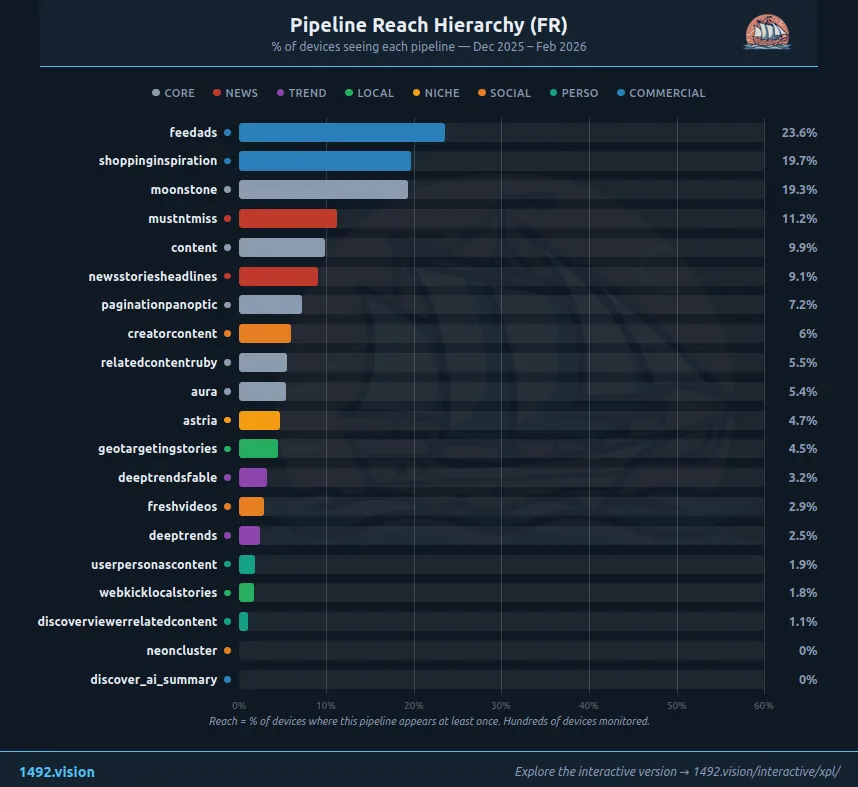 Reach of each FR pipeline (% of devices touched). moonstone leads at 19.3%, followed by shoppinginspiration at 19.7%. Reach is not proportional to volume.
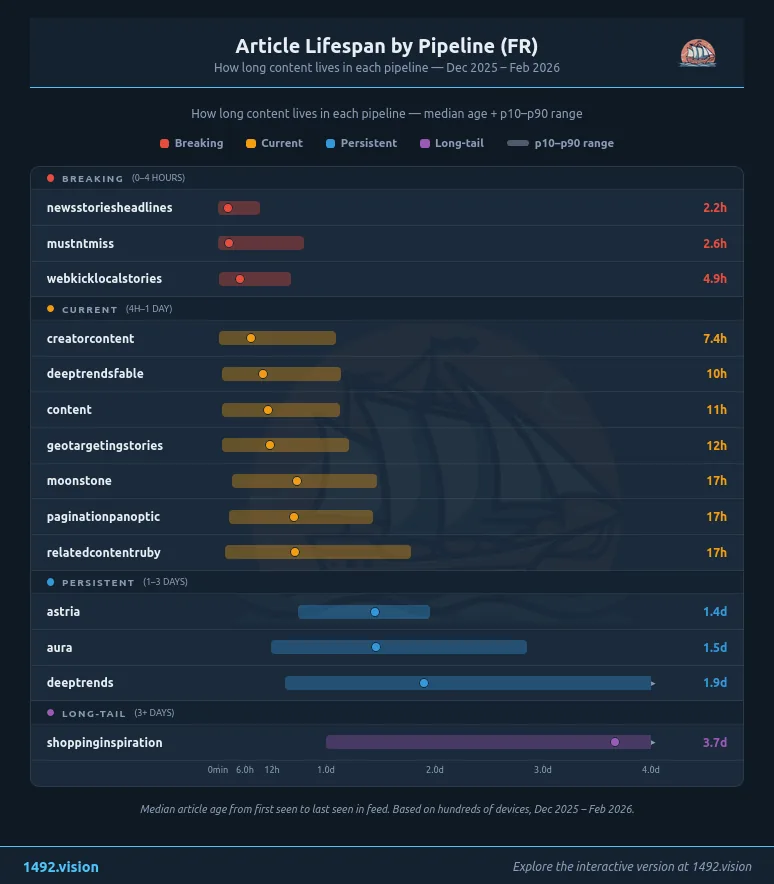 Median article age by pipeline. From newsstoriesheadlines (2.2h) to shoppinginspiration (3.7 days). Product content lives 8x longer than news.
feedads — advertising
- FR reach: 24.0% (the highest of all pipelines)
- Volume share: 3.0%
- Median age: 85.6 days — campaigns lasting months
- Distinguishing signal: 100% advertising, 99.8% exclusive URLs. Completely closed ecosystem. FR advertisers: hotels/travel (30%), fashion, SME e-commerce, services. YouTube video ads account for 6.7% of hits. Growth: 2.7x over the period.
Feedads is the most powerful pipeline in raw reach — a quarter of all devices see each ad. But it's hermetically sealed from the editorial feed. It's an ad impression channel, not a content channel.
discover_ai_summary — AI summaries
- FR reach: near zero — 72 hits over 3 months
- Distinguishing signal: in English, this pipeline selects quality content for an AI summary (AI Overview). Reuters, NYT, CNBC, FT, Guardian are the preferred sources. Finance (1.8x), space (3.4x), US sports (3x) are over-represented. In French: nothing. AIO has not arrived in France yet — something already known from SERPs.
The FR domain landscape
Who dominates which pipelines? Each publisher's fingerprint tells a strategy — whether deliberate or not.
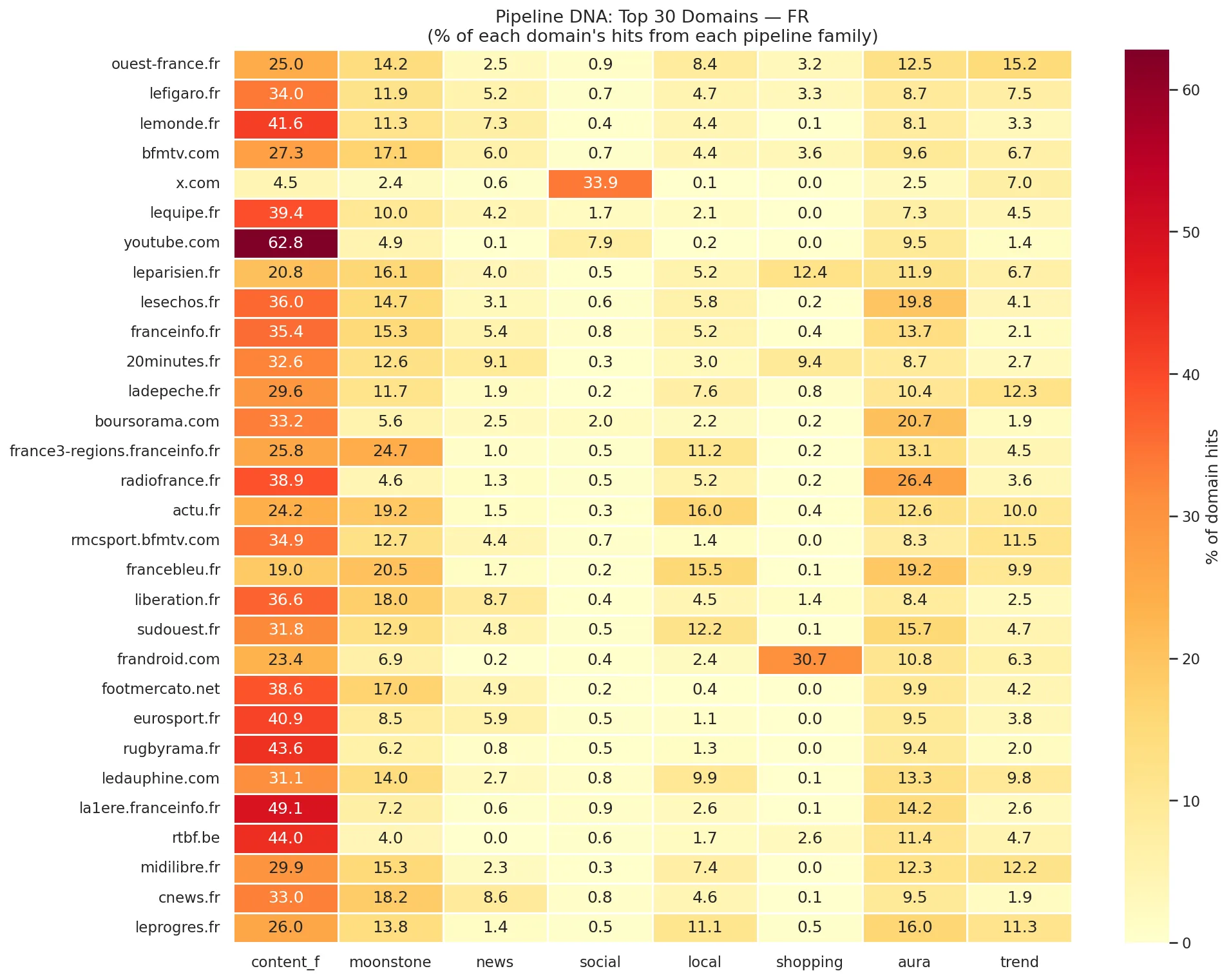 Each row = a domain, each column = a pipeline family, color = percentage of hits. Ouest-France shows a balanced spread; Le Monde is concentrated on content and mustntmiss; x.com dominates the social column.
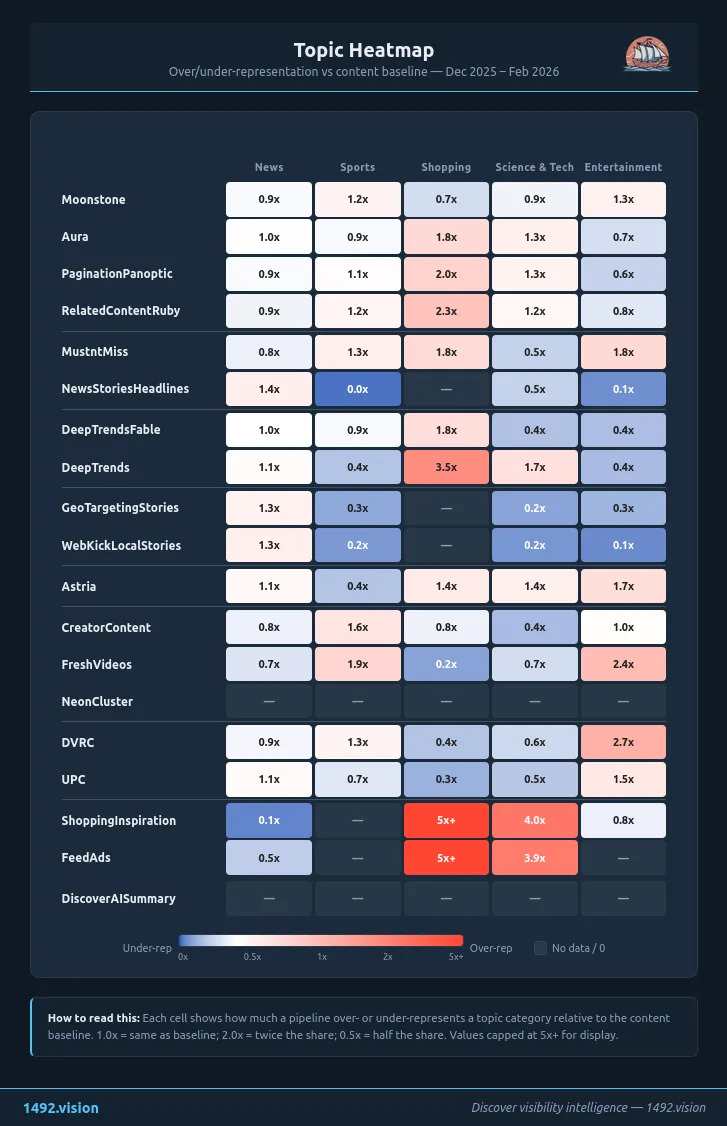 Topic representation by pipeline. Warm color = over-representation. moonstone concentrates horoscope/celebrity/entertainment; shopping concentrates on tech/auto; mustntmiss on economics/politics/international.
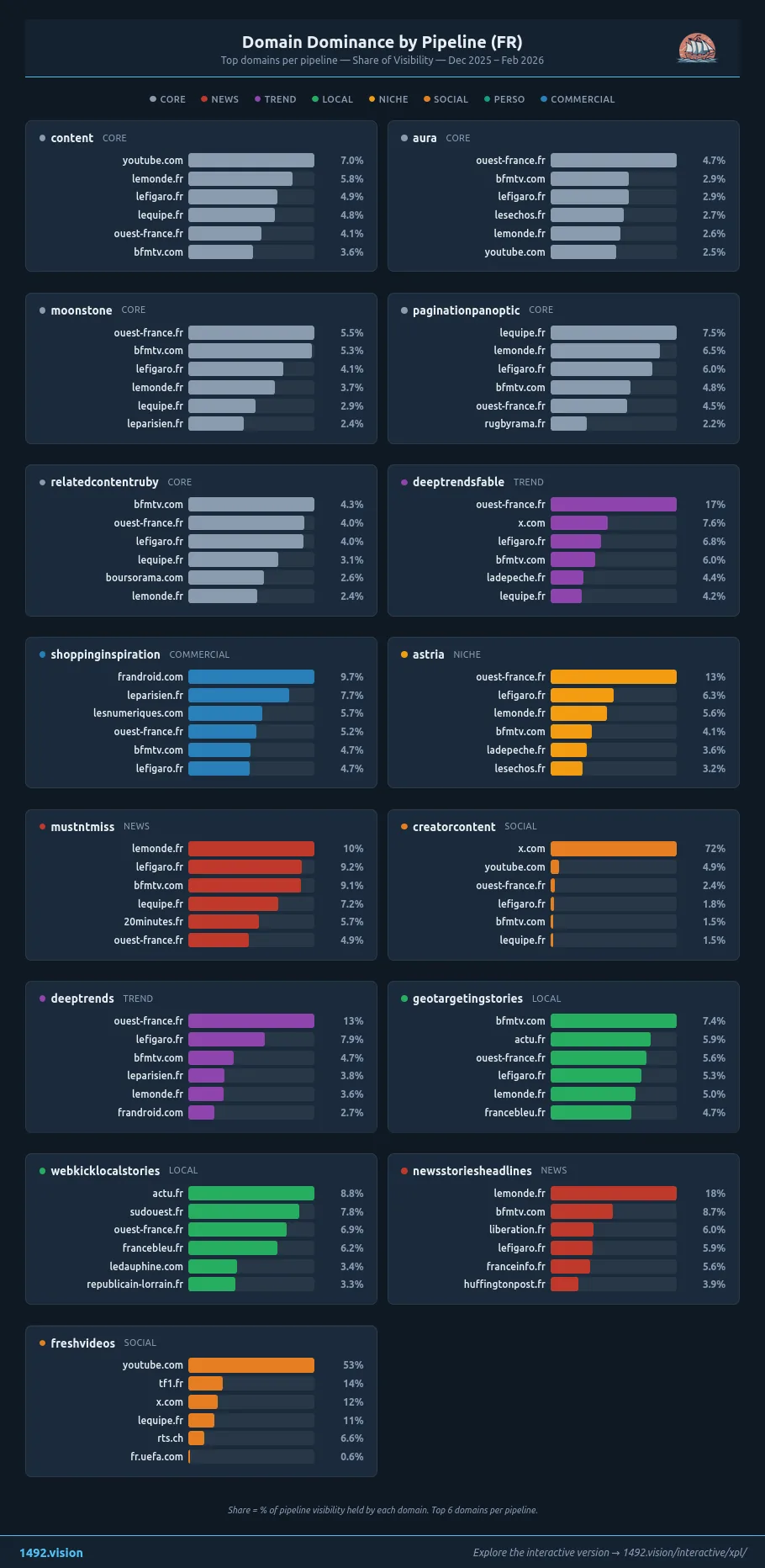 For each pipeline, the leading domains. content: youtube.com, Le Monde, Le Figaro. moonstone: Ouest-France, BFM TV, Le Parisien. mustntmiss: Le Monde, Le Figaro. shopping: Frandroid, Les Numériques.
Ouest-France — the multi-pipeline model. #1 in moonstone, dominant in webkicklocalstories, top-5 in astria, deeptrendsfable, geotargetingstories. Its secret: regional roots (which open local pipelines) combined with national coverage (which open editorial pipelines). Content 25%, moonstone 14%, local 8.4%, aura 12.5%, trends 15.2% — an exceptional spread.
Le Monde — authority. #1 in mustntmiss (11.3% of pipeline), strong in content and newsstoriesheadlines. Its fingerprint is concentrated: content 41.6%, the rest spread across urgency and authority pipelines. It's the profile of a publisher betting on editorial importance.
BFM TV — volume. Strong in content and moonstone, present everywhere in mid-rank. Absent from the mustntmiss top — a revealing signal about the system's perception of editorial importance.
x.com — the social network. 73% of creatorcontent. 33.9% of the social column. x.com is not a traditional publisher, but in FR, it's the dominant source for Discover's social pipeline. A fact most strategists overlook.
Boursorama — the finance signal. #4 in relatedcontentruby (5.1% of pipeline) — a unique signal found in no other pipeline. Finance has its own path in Discover, through user clicks.
Multi-pipeline: 58% of FR URLs in 2+ pipelines
This may be the most actionable finding in this study. The majority of French URLs in Discover are not confined to a single pipeline — they traverse the system.
- 42% of URLs appear in only one pipeline (usually content)
- 20% in two pipelines
- 13% in three
- 25% in four or more
- Outliers reach 12 to 14 pipelines simultaneously
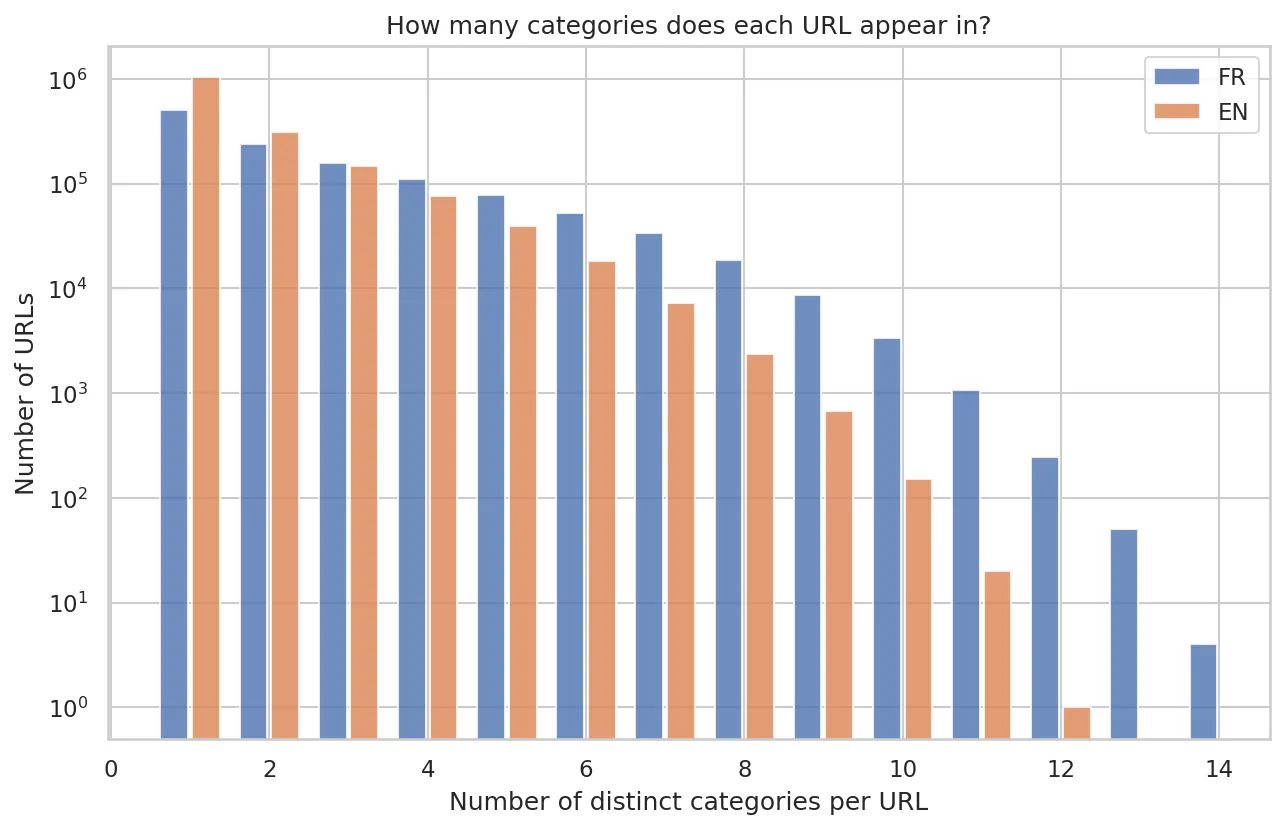 Number of distinct pipelines per URL (log scale). The drop is exponential — but the tail is long. Some FR articles reach 14 pipelines.
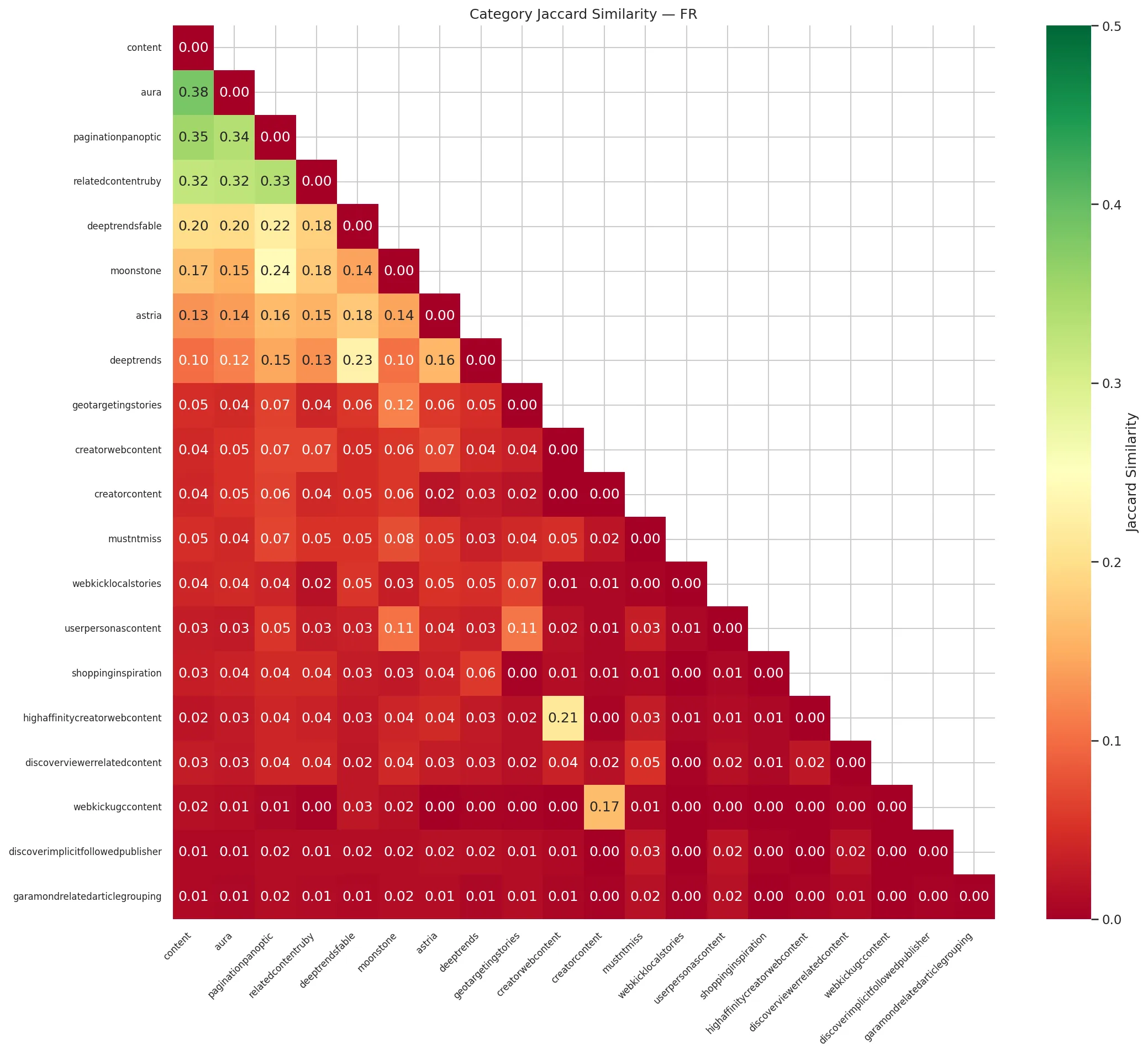 The content-aura (0.38), content-paginationpanoptic (0.35), content-ruby (0.32) pairs form a hot block — these pipelines share many URLs. Shopping, webkicklocalstories, and newsstoriesheadlines form cold rows — structural silos.
What favors multi-pipeline: a trending event (opens deeptrendsfable + mustntmiss + content + moonstone), strong editorial authority (Le Monde reaches 6–8 pipelines where a smaller site only touches 2–3), and the dual local/national anchor (the Ouest-France model).
What blocks it: pure product content (shopping silo), daily sports (confined to content + moonstone), pure lifestyle (ceiling at 2–3 pipelines), and old content (multi-pipeline is a first-48-hours phenomenon).
The full multi-pipeline analysis — with detailed mechanisms and publisher profile scorecard — will likely be the subject of a dedicated article on Réacteur.
A living system
What we show here is a snapshot. The Discover system evolves constantly — and our data bears the trace.
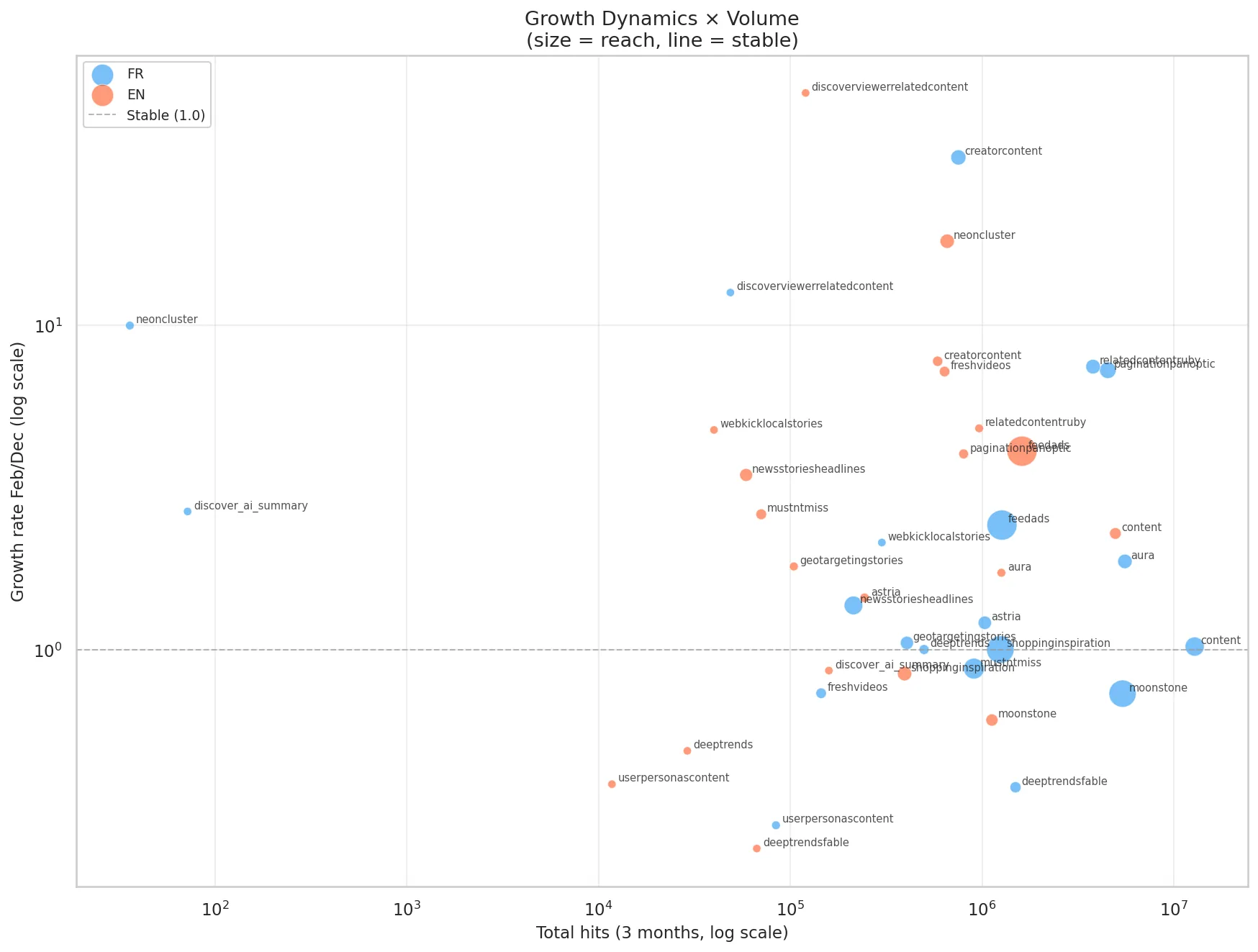 Growth dynamics (Y, log) vs total volume (X, log). Above the stability line = growth. creatorcontent FR at 33x and discoverviewerrelatedcontent are exploding above. deeptrends and userpersonascontent are declining. The system is alive.
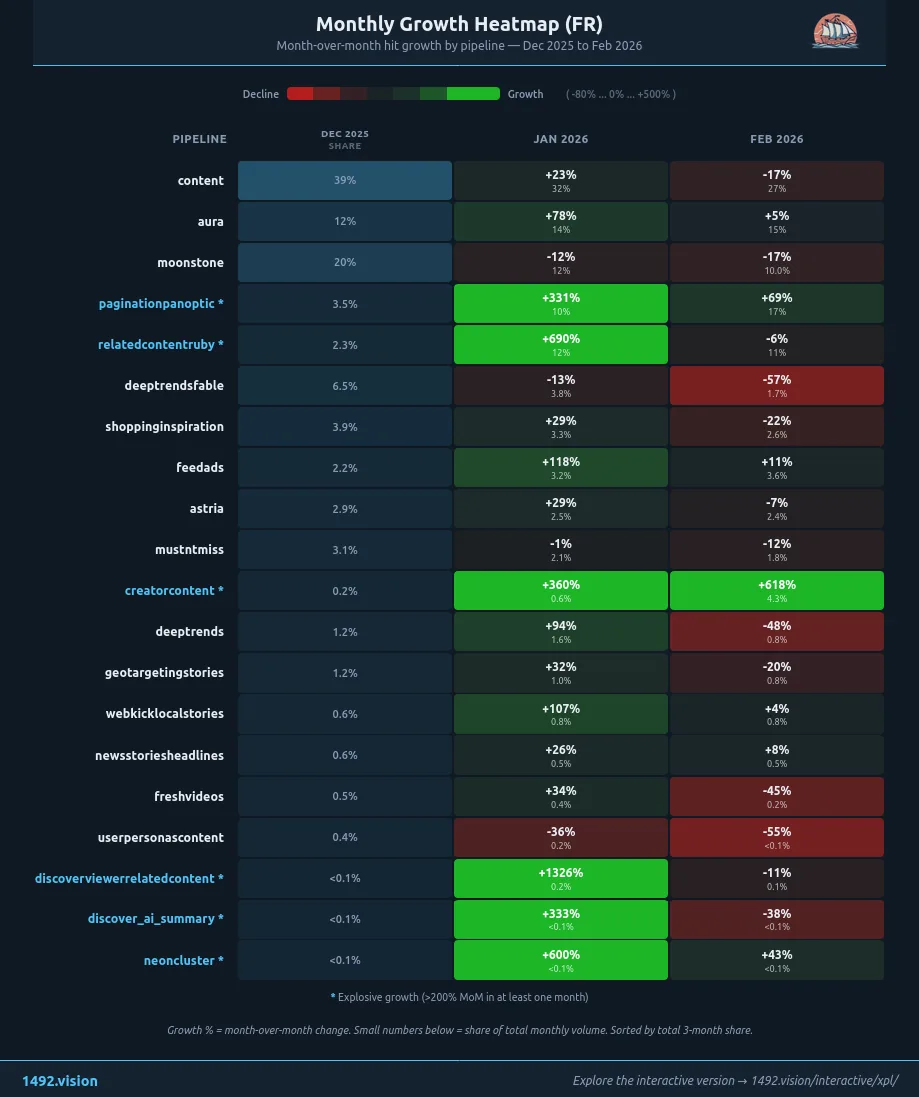 Monthly dynamics by pipeline (FR). Months in columns, color intensity represents growth rate. creatorcontent explodes from December to February; deeptrends and userpersonascontent contract.
Exploding pipelines:
- creatorcontent FR: 33x in 3 months
- paginationpanoptic: 7x expansion
- feedads: 2.7x advertising growth
Declining pipelines:
- userpersonascontent: -73% — the persona system seems to be retreating
- deeptrends: contracting
- mustntmiss FR: -17% (while it's exploding in English — an interesting divergence)
Abandoned pipelines:
An entire family — the queryrecommendations* (queryrecommendationsmoonstone, queryrecommendationsrelated, etc.) and clusterprofile* — has been abandoned. The name alone tells the story: the old system worked by queries and profile clusters. The new system works by embeddings and personas. It's a fundamental architectural shift.
Emerging pipelines: We observe ~8 new identifiers not yet integrated into our analysis — collaborative filtering, NL tuning, entertainment trailers, garamond (Google Showcase). The system continues to expand.
The direction is clear: from query-based to embeddings/personas, from textual content to social/video content, from passive selection to selection based on real-time engagement signals. And AIO, currently absent from France, likely won't stay that way.
What's next?
This map didn't exist before our study. It changes how we think about Discover — from "one algorithm, one lever" to "20 pipelines, 20 different levers."
Each publisher profile has natural pipelines — those your content reaches by default — and pipelines to conquer — those accessible with strategic adjustments. A national publisher reaches 8–12 pipelines. A tech/review site, 3–5. A pure lifestyle player, 2–3.
The question is no longer "am I in Discover?" but "how many pipelines am I visible in?"
Three paths to go further:
- Explore the data — our interactive explorer lets you navigate the 20 pipelines, compare metrics, see leading domains and typical headlines
- Follow the series — every week, our Substack newsletter dives into a group of pipelines with data, charts, and recommendations
- Analyze your domain — 1492.vision will soon give you your own domain's pipeline fingerprint, with per-pipeline metrics
The system evolves. This data is a snapshot from December 2025 to February 2026 — not a frozen truth. Hence the value of continuous monitoring. Like any good captain, it's by sailing that you make your best discoveries.
- The EN analysis: 20 pipelines, English data, video cascade, AIO, EPL
- The FR vs EN comparison: What sets each market apart
Data: 42 million Discover cards, December 2025 to February 2026. Analysis: 1492.vision. Internal mechanisms are presented as our interpretations based on observed data and available public research.
Authors
Posted on 2026-03-28
More reliable, sourced reporting on Discover? Add us to your sources!
Add to sources Add to sources