Google Discover and cold-start: how fresh articles can get tested in the feed
Damien Andell, 1492.vision
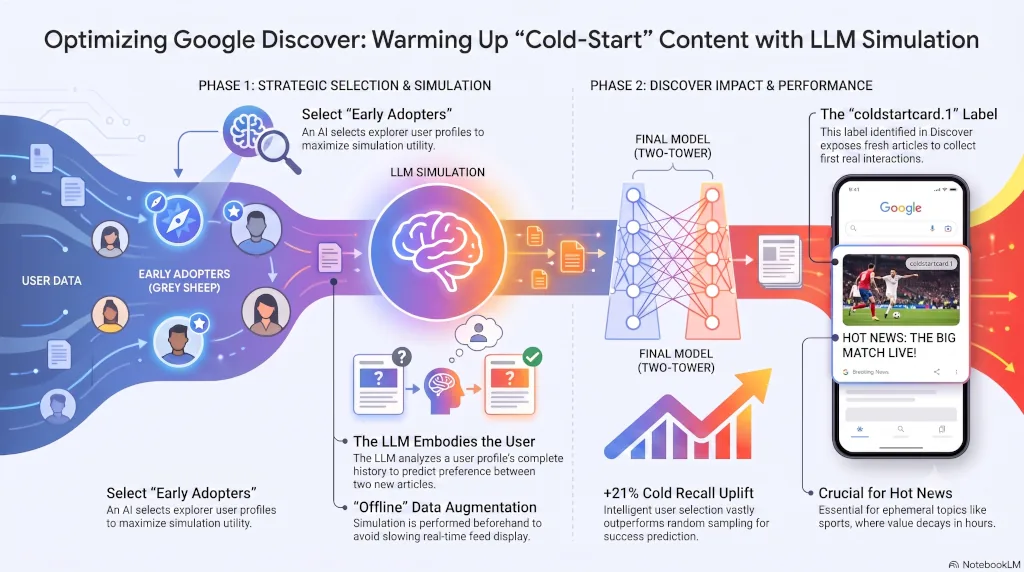
Interpretive diagram: the LLM / offline stage comes from recent research, not directly observed in Discover. Only the coldstartcard.f label (on the right) is actually observed in our data.
In Discover, a freshly published article shows up with a very simple problem: it can be relevant, timely, well-titled, well-illustrated… yet it has almost no user signal yet. No solid clicks, no reliable dwell time, no satisfaction signals, no distribution in the feed yet.
This is what we call a cold-start item: a new item the system has to recommend even though it does not yet have enough interactions to understand it properly.
In this article, we look at a very specific Discover label: coldstartcard.f, observed over a short window (April 21-22, 2026), attached to very fresh articles, mostly tied to the 2026 World Cup.
Key points:
coldstartcard.flooks like a Discover content-card category, observed for only ~48 h.- The associated cards point to hot news: 5 of 6 impressions are sports (2026 World Cup).
- These articles are "hot" editorially, but "cold" for the model (no interaction history).
- These cards sit in a trending and AI-summary context (the AIO layer), with the same feedback surfaces as the rest of the feed.
- The real cold-start challenge is not only the content: it is which profiles to show the article to first.
- A research paper co-authored by Google researchers (Google Inc. and Google DeepMind, with UC Davis) shows that an LLM can bootstrap this signal offline, before real interactions, without replacing the feed.
Methodology
This article combines two sources of observation.
First, a reading of the Discover feed from our 1492.vision monitoring data: internal labels, card structure, signals attached to blocks, sources, topics, and whether the same cards reappear.
Second, a comparison with a recent research paper on the cold-start item problem, co-authored by Google researchers (Google Inc. and Google DeepMind) and UC Davis. The goal is not to review that document as such, but to use the framework it provides to better understand what a card like coldstartcard.f might do, especially since it partly comes from Google.
Three clarifications:
- Cold-start: fresh content that still lacks usable user interactions.
- Discover distribution: what we observe in our monitoring base, not Search Console data or Google-internal data.
- The mechanisms described remain an interpretation of the observed data.
coldstartcard.fexists in the captures, but its exact role is not publicly documented by Google.
1) The problem: a fresh article has no user proof yet
Discover is not Search. In Search, the user expresses intent with a query. In Discover, the system has to anticipate: choose what to show before the user asks for anything. That makes cold-start much harder.
An article may have just been published on a very hot topic: World Cup, ticketing, opening match, box office, political announcement. But when it enters the feed, the model does not yet know who will click, who will read for a long time, who will ignore or hide it.
This is the most fragile moment in a Discover article's life:
- shown to the wrong profiles, it can get bad signals very early;
- shown to the right profiles, it kicks off broader distribution;
- tested too late, its window of interest closes before the system has understood its potential.
2) coldstartcard.f: a short label, but a very telling one
In the observed Discover data, one label stands out: coldstartcard.f. The name is unusually explicit.
This label is attached to a content card, that is, an article actually shown in the feed, not a mere technical marker.
The most interesting part is its lifespan: the label was observed between April 21 and 22, 2026, then it disappeared. That is typical of an experimental mechanism, a limited test, or a pipeline switched on for a very specific period.
The name is telling. Most Discover pipelines are named after the type of content they distribute or their editorial role, for example newsstoriesheadlines.f (news headlines), deeptrends.f (trends), freshvideos.f (fresh videos) or mustntmiss.f (editorial importance). coldstartcard, by contrast, is named after a recommendation problem: cold-start. This suggests it is not only there to display fresh content, but to handle a precise question: how do you start an item that does not yet have enough history?
3) The observed examples: mostly sports and hot news
The cards attached to coldstartcard.f did not point to cold content in the editorial sense. On the contrary: very fresh, very time-sensitive content, with decaying value.
The observed articles:
2026 World Cup schedule: Every match, date and key stage to know   (Times Union)
Chuck Schumer calls on FIFA to cover $150 NJ Transit fares…        (Fox News)
FIFA struggling to sell tickets for USMNT's World Cup opener…      (NYT / The Athletic)
'Mortal Kombat II' To KO Box Office With U.S. Opening Around $50M  (Deadline)
The concentration is clear: 5 of 6 impressions are sports, mainly the 2026 World Cup; the last one is a box-office projection.
Rigor note: the sample is very small, 6 impressions for 4 unique articles (the NYT / The Athletic article reappeared 3 times), over a 48 h window. We see a clear tendency, not a general law.
Sports is a perfect domain to observe cold-start: an event happens, interest rises fast, the window is short, signals must be captured immediately. An article about ticketing or the schedule of a World Cup cannot wait several days to find its audience: its value peaks while the topic is hot.
4) Hot for humans, cold for the model
This is the key point. An article can be very hot for readers, yet cold for the model.
For a human, "2026 World Cup / ticketing / USMNT / MetLife Stadium / FIFA" immediately signals a strong topic. But for a recommendation engine, a new article is still a new item: it has a title, a source, an image, entities, a category… yet it lacks the most important part for a personalized feed: interactions.
hot news ≠ hot item for the modelThe coldstartcard.f card seems to sit exactly in this space: the moment when Discover knows a piece of content may be important, but still has to collect enough signals to know who to distribute it to.
5) What surrounds the card is not specific to cold-start
An important point, to stay honest about what we observe: coldstartcard.f cards do not carry signals that would be exclusive to them. They sit in the standard feed environment.
Feedback surfaces are generic. Every Discover card, not just cold-start cards, embeds the same signal-collection system: article open, like, save, entity follow, "not interested", hide, attention time. This is the feedback infrastructure common to the whole feed, not a cold-start specificity.
AI summaries belong to another layer. The AI-generated summary mentions seen on some of these articles belong to Discover's AI Overview layer (the discover_ai_summary.f pipeline, and in English a large share of AIO cards also goes through mustntmiss.f). These summaries apply to many news articles, regardless of cold-start.
So what is notable is not a signal specific to coldstartcard.f, but the context: the observed articles were fresh, embedded in a hot-news cluster, sometimes accompanied by an AI summary, and, like any card, surrounded by feedback surfaces. And that is exactly the environment a system needs to warm up a cold item: expose it where it will quickly collect its first real signals.
6) The real challenge: choosing the right first profiles (and why sports)
When we talk about cold-start, we think about the content. But the real problem is also on the user side. The question is not only "is this article interesting?" but "which users should we show it to first in order to find out?"
Not all profiles give the same signal: some mostly consume popular content, others explore a lot, others click early on topics before they go mainstream, others have atypical but very useful behavior for detecting weak signals.
For a hot sports article, the right first audience is not necessarily "all football fans", but something more precise: USMNT fans, World Cup readers, profiles interested in ticketing or transport, users who react early to event-driven topics.
This is where sports is a special case. It combines hot news, highly segmented communities, short interest peaks, and high volatility. A beauty or cooking guide stays useful for weeks; an article about a ticket-sale opening has a window of a few hours. In this kind of domain, the most useful profiles are those who detect signals early: early adopters, explorer profiles, event-driven readers. They are not just consumers: they become trend sensors, and for a system like Discover, those sensors are valuable.
7) Offline vs online: two ways to warm up content
We can distinguish two complementary mechanisms.
The offline mechanism, the one described by the Google / UC Davis research. An LLM is used upstream to simulate preferences from user histories:
user history + 2 new items
↓
"which of these two would this profile prefer?"
↓
synthetic signal
↓
better-initialized embedding for the new item
The LLM is not used at the moment the card is displayed. It acts beforehand, offline, as a bootstrapping layer. So we are not talking about "LLM → recommends the article in the feed", but "LLM → helps the system create signal before serving". Then the classic engine does its job: retrieval, scoring, ranking, re-ranking, diversity, freshness, safety.
The online mechanism, what coldstartcard.f could represent:
new article
↓
cold-start card
↓
exposure to some profiles
↓
collect clicks, dwell, dismiss, feedback
↓
widen or stop distribution
In both cases, the goal is the same: reduce the time needed to understand who fresh content should be shown to. The difference is the source of the signal: synthetic / anticipated (offline) vs real, collected in the feed (online).
One element clearly strengthens the hypothesis: this type of LLM pipeline is not an idea foreign to Google. It is described in a research paper co-authored by Google researchers (Google Inc. and Google DeepMind), with UC Davis. In other words, Google is explicitly working on LLM augmentation for the cold-start item problem.
I remain cautious nonetheless: a research paper is not proof of deployment. The data does not show that Discover uses exactly this pipeline in production for these cards. But the convergence is strong: a coldstartcard.f label, ultra-fresh articles, a trending / AI context, and a cold-start problem that Google studies directly.
8) What it changes for publishers
We often think of Discover through: title, image, freshness, E-E-A-T, source, mobile performance, structured data. All of that still matters. But cold-start adds another question:
Does Google immediately understand which initial audience this article should be shown to?
A Discover-friendly article should help the system make that match, through very clear editorial signals: strong entities, explicit angle, unambiguous title, image consistent with the topic, clear time context, identifiable source, obvious category, link to an event or a trend.
For a World Cup article, the system has to understand quickly: is it sports? football? ticketing? transport? US fans? a specific team or stadium? The clearer the angle, the easier the article is to test with the right cluster. So the question is no longer only "how do you write a good article?" but also "how do you make it understandable for Discover's initial retrieval?"
9) What it is not
We should avoid shortcuts. coldstartcard.f does not mean Google automatically gives every new article a chance. It is not a traffic guarantee, not necessarily a mass pipeline, not proof that the LLM directly decides the displayed cards, and not proof that Discover uses in production exactly the mechanism described in the Google / UC Davis research paper.
The most reasonable reading:
coldstartcard.flooks like a trace of a testing or bootstrapping mechanism for certain fresh content, probably used to quickly collect real signals on low-history articles.
That already matters: it shows that Discover does not handle articles only by their past popularity. It also has to handle content that does not yet have a past.
Conclusion
Cold-start is probably one of the most underrated angles of Google Discover. Behind every fresh article, there is an invisible decision: who to show it to first, how long to test it, which signals to wait for, when to widen, when to stop.
Classic pipelines favor what already has signals: already-distributed articles, known sources, validated topics. But a feed cannot work only that way: it also has to discover, test recent articles, detect weak signals, and react quickly to events. For that, it needs cold-start mechanisms. coldstartcard.f looks like one of them.
And if LLMs enter this loop, their most likely role is not to "choose the article instead of Discover", but to help the system better bootstrap new items and select the first test profiles, to decide faster whether fresh content deserves to be widened.
Discover does not just wait for articles to become popular. It also has to organize their first chance.
Notes
- Cold-start item: a new item entering a recommendation system with little or no user interaction. In Discover, typically a freshly published article.
- Pipeline: a selection circuit that retrieves, scores, and serves certain cards in the feed. The
.flabels observed in the data sometimes make it possible to isolate these circuits. - Dwell time: time spent after opening or interacting with content; an important implicit signal for measuring real interest.
- Dismiss: the action by which a user indicates they do not want to see this content, this source, or this type of topic.
- LLM: Large Language Model. Mentioned here as a potential bootstrapping or offline-simulation layer, not as proof of a model used directly to display
coldstartcard.f.
Data: 1492.vision Discover feed monitoring (April 2026, April 21-22 window). Internal mechanisms are our interpretations based on observed data.
Research reference: "Selecting User Histories to Generate LLM Users for Cold-Start Item Recommendation", Subbaraman et al., Google (Google Inc. & Google DeepMind) and UC Davis, arXiv 2511.21989 (Nov. 2025).
Authors
Posted on 2026-07-03
More reliable, sourced reporting on Discover? Add us to your sources!
Add to sources Add to sources