Google Discover publisher profiles: 14 months of monitoring, 54 publishers, what nobody else has documented
Damien Andell & Sylvain Deauré, 1492.vision, May 2026
Since March 2025, Google has been quietly building a publisher profile ecosystem on Discover. Banners, pinned posts, configurable links, a Follow button: the profile.google.com pages have become a surface in their own right for publishers. Largely uncharted territory.
Nobody has mapped this evolution end to end. We did. Phase by phase, snapshot after snapshot, over 14 months of continuous observation. What you're about to read is the result of that work: a complete timeline, a claiming mechanism dissected, and the analysis of a 54-publisher cohort hand-picked by Google to test enhanced features.
All data comes from our proprietary monitoring infrastructure. We tell you what we know, and we're clear about what we don't know yet.
Timeline: 10 phases, from March 2025 to May 2026
The story of Discover profiles doesn't start with an official announcement. It starts with a series of weak signals we documented as they appeared.
Phase 1: the Follow button on Chrome (March 2025)
It all starts with Chrome's webFeeds mechanism. In the browser menu, a "Follow" button lets you subscribe to any site. Under the hood, Chrome fetches the domain's RSS feed and creates a dedicated Knowledge Graph entity for each domain and subdomain. These follows populate a "Following" tab on Discover, separate from regular interests. [1]
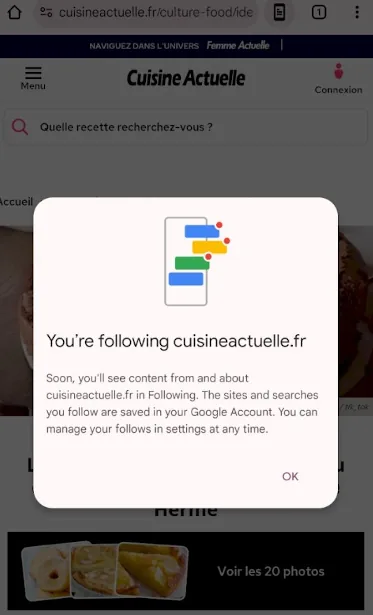
"You're following cuisineactuelle.fr": Chrome follows create a dedicated entity per domain
Phase 2: Follow returns on Discover (August 2025)
On August 21, 2025, a "Follow" button appears directly on Discover feed cards, next to the publisher's name. Key difference from Chrome Follow: this one doesn't create new entities. It uses existing Knowledge Graph entities. Leaner, more integrated. [2]
Phase 3: the profile.google.com pages (August 2025)
The same day, we discover that each Follow button is backed by a profile.google.com/cp/... URL. Each page aggregates the publisher's name, social media accounts (with follower counts), an "About" section (often pulled from Wikipedia), cross-platform latest posts, and a "Follow on Google" button.
It's a cross-platform publisher profile. Google aggregates your website, your Facebook, your YouTube, your Instagram, your X, all on a single page. [3] We published our initial findings in a dedicated Substack issue on August 30, 2025.
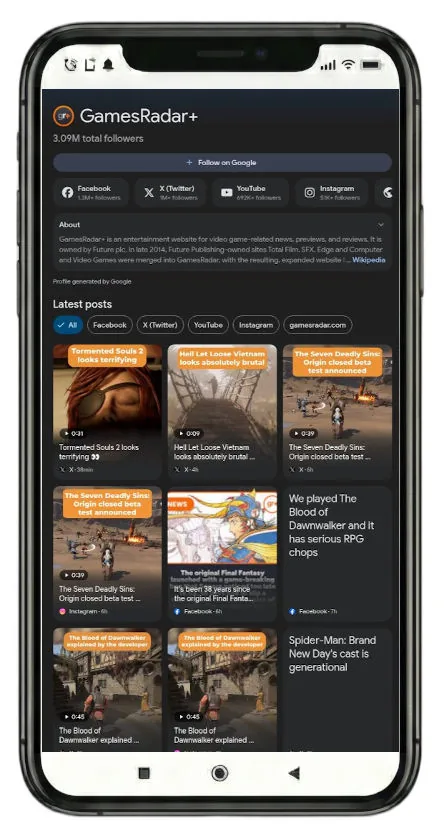
GamesRadar+ profile (3.09M followers): social links, per-platform followers, filterable latest posts
Phase 4: the Subscribe button (September 2025)
On September 13, we spot a new label in the source code: "Subscribe" / "Subscribed", driven by a server flag (DiscoverCardMenuRendering.convert_follow_to_subscribe). A UI rebrand of Follow, no API change. Google is testing terminology. [4]
Phase 5: Follow boosts the feed (September 2025)
Following a publisher via their profile page has a direct, observable impact on the user's Discover feed. Content from the followed publisher surfaces at the top. We document this publicly on September 22 with a concrete example: after following Laurent Bourrelly's profile page, his articles and videos appear first in the feed. [5] [6]
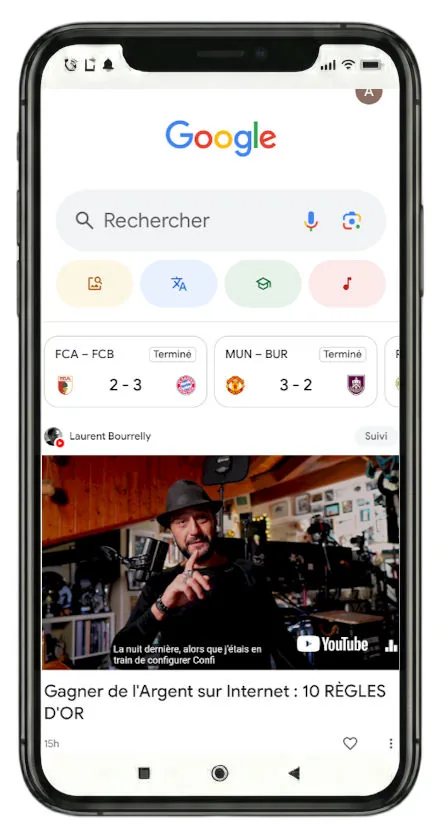
Laurent Bourrelly's content rises to the top of the Discover feed after following (label "Suivi")
Phase 6: Google publishes official documentation (November 2025)
On November 3, Google publishes a help page on "Discover feed source overviews." The document confirms that profiles are "automatically generated from public sources found on the internet" and provides a procedure for reporting errors (via the "..." menu or via a legal report for site owners). [7]
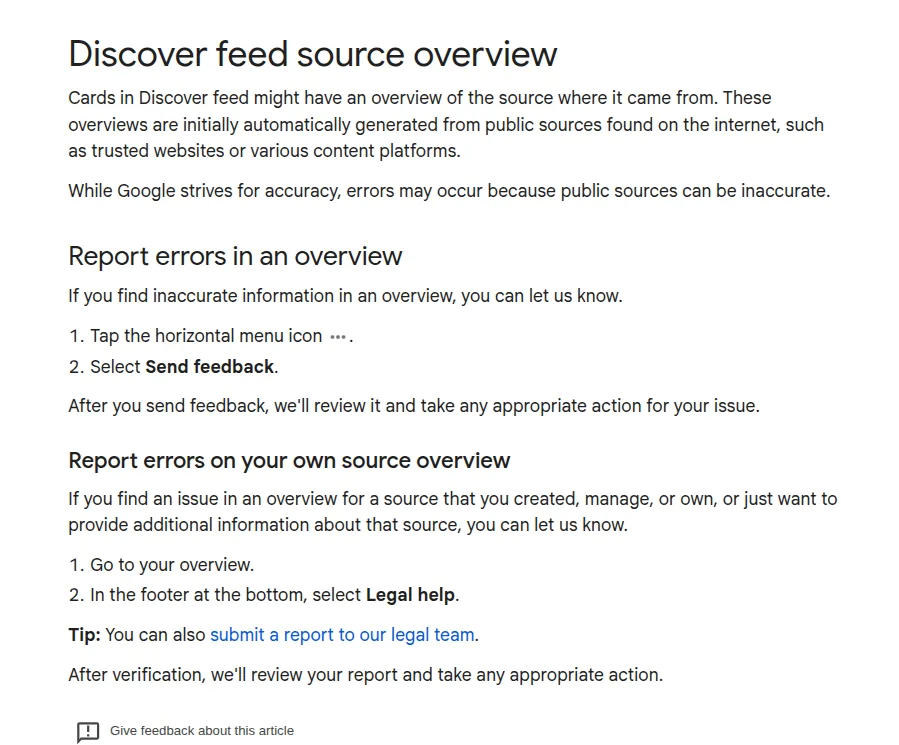
Official Google help page: "Cards in Discover feed might have an overview of the source where it came from"
Phase 7: X cards linked to profiles (June 2026)
Google Discover starts displaying cards that reproduce the text of X (Twitter) posts but redirect to the publisher's article rather than the X post. This mechanism only works if the URL in the post comes from the same publisher as the X account, a cross-validation via the Google profile. A strong signal of cross-platform integration. [8] [9]
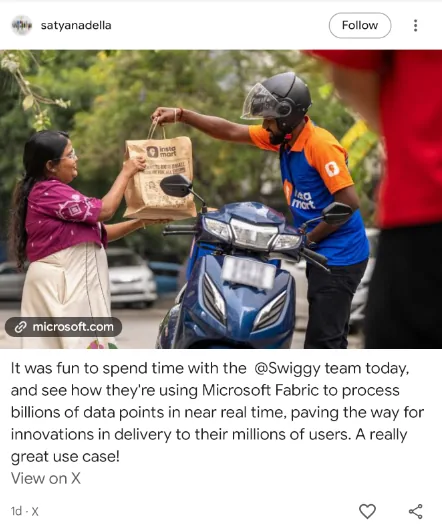
Discover card reprinting a Satya Nadella X post with "View on X", the click redirects to microsoft.com
Phase 8: major update, banners, Featured Posts, Links (March 2026)
March 9, 2026 is the turning point. Three new features appear simultaneously on select profiles:
- Header images: large-format banners at the top of the profile, similar to YouTube channel banners
- Pinned (initially called "Featured Posts"): pinned posts above "Latest posts"
- Links: a block of configurable links (site sections, weather, live streams, apps...)
In parallel, eligible publishers gain control over the display order of their tabs (Articles, social profiles) and their social/website links. Previously, the order was algorithmic: sorted by follower count, website always last. Now, the publisher decides. Newsweek places YouTube first and Articles second. Delish puts Website first, followed by Instagram. No longer an automatic ranking, it's an editorial choice.
First enhanced profiles observed: Newsweek, Wall Street Journal, Fox News, Delish, KTLA. [10] [11] [12]
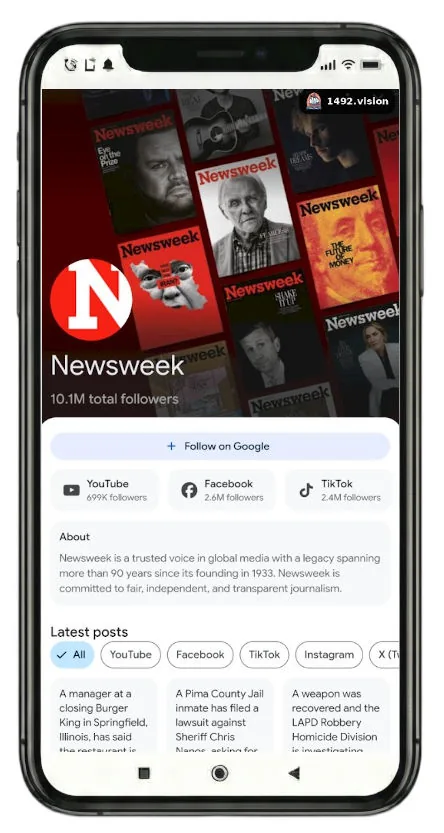
Newsweek (10.1M followers): first profile observed with the new large-format banner
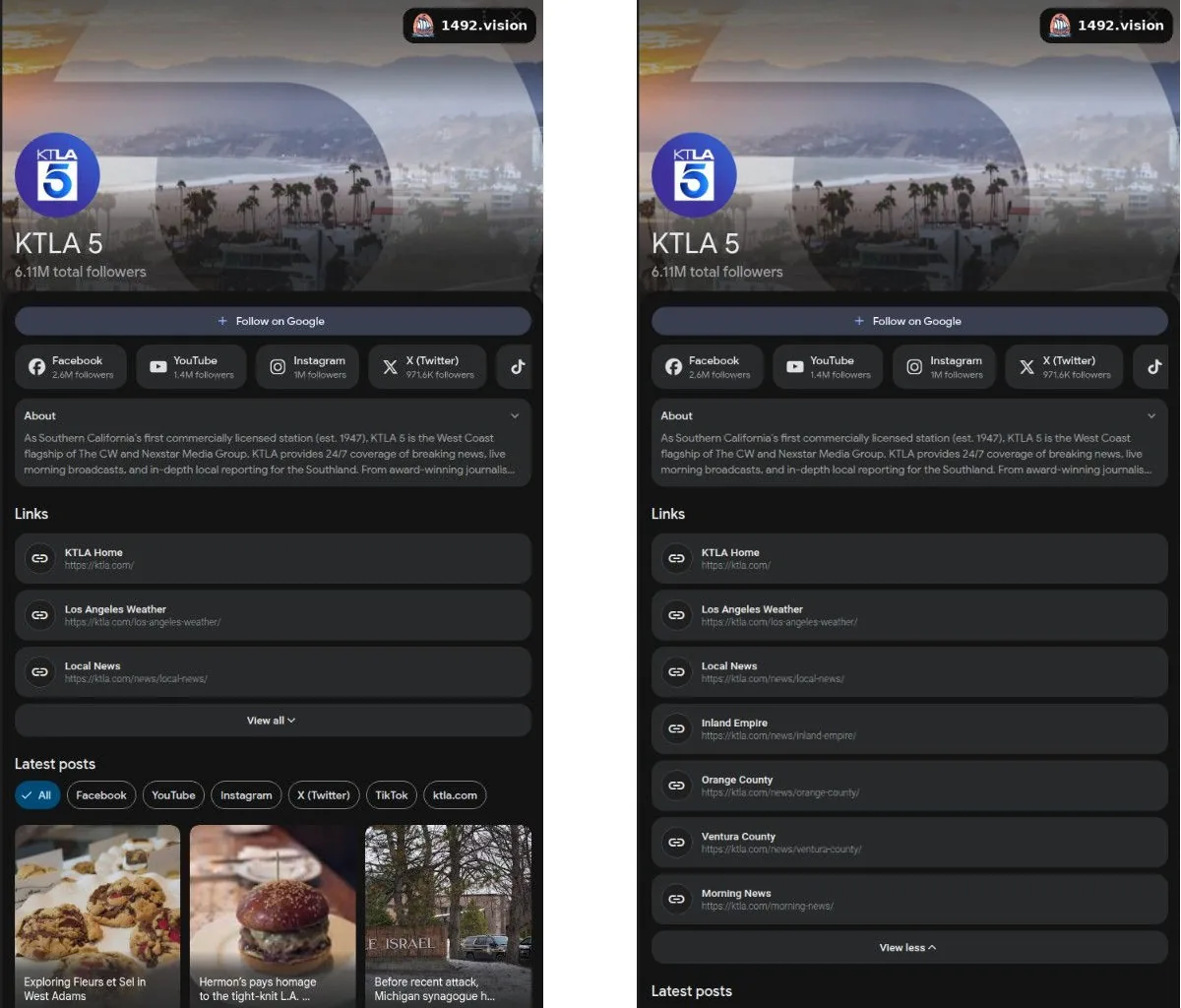
KTLA 5 (6.11M followers): banner, expanded Links block (KTLA Home, Weather, Local News, sub-regions)
Phase 9: Profile Features Monitor launch (March 2026)
On March 11, we launch our free monitoring tool. First snapshot: 46,926 publishers across 7 languages (EN, FR, DE, IT, ES, NL, PT). At that point, only 67 English-language publishers out of 19,380 have access to enhanced features. Zero deployments in French, German, Italian, Dutch, or Spanish. [13]
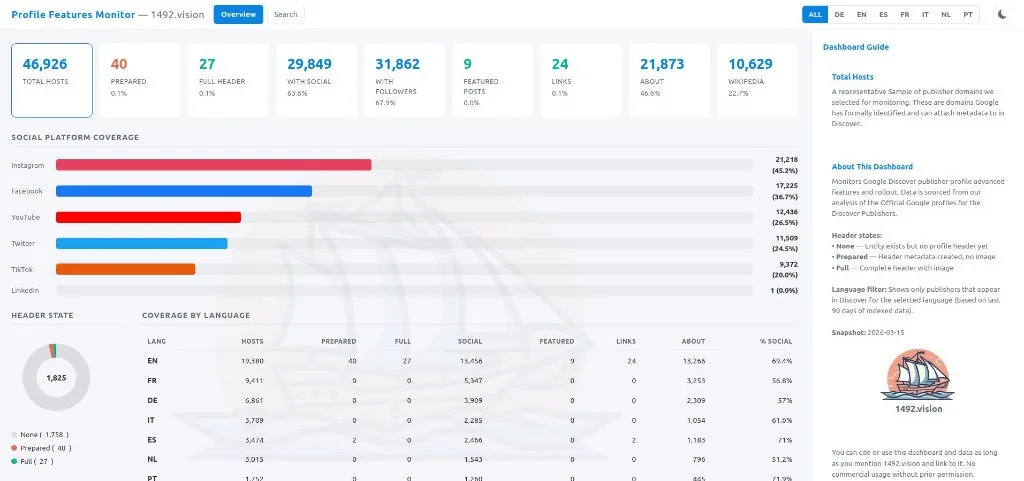
Profile Features Monitor: per-language stats, header states, feature coverage. Free for all accounts, including free tier.
Phase 10: the "Profile generated by Google" label disappears (April 2026)
On April 25, we observe that the "Profile generated by Google" label, visible at the bottom of all standard profiles, has disappeared on enhanced profiles. This is not a global change: it's a status marker. Claimed (partner) profiles no longer display the label. Auto-generated profiles (like CNN) still do. The coexistence of both versions confirms two distinct tiers. [14]
The claiming mechanism: two profile tiers
Analyzing page load data for profile pages reveals a two-level architecture.
Standard profile (auto-generated)
This is the default state for virtually all of the ~47,000 publishers we monitor. The profile is assembled automatically by Google from public sources. It displays the "Profile generated by Google" label and loads 4 data streams: base profile, social links, follow status, latest posts.
Partner profile (claimed)
A small number of publishers (54 identified in our cohort) have a claimed profile. The "Profile generated by Google" label disappears. The profile loads 6 data streams instead of 4, the two additional ones being WebLinks (configurable links) and FeaturedPosts (pinned posts).
The key technical difference: partner profile data is loaded with a unique claim token (a random string of roughly 10 characters, generated server-side). This token is injected into the HTML at page render time. It cannot be fabricated, guessed, or requested through any public interface. There is no button in Search Console, no known claiming form. The program appears to be invitation-only.
What claiming unlocks:
| Feature | Standard profile | Partner profile |
|---|---|---|
| Banner (header image) | No | Yes |
| Pinned (formerly Featured Posts) | No | Yes |
| Links block | No | Yes |
| Tab and social link ordering | Algorithmic (by followers) | Customizable |
| "Profile generated by Google" label | Visible | Absent |
| Data endpoints | 4 | 6 |
| Claim token | Absent | Present |
Our monitoring approach
To track this rollout, we built the Profile Features Monitor: a proprietary monitoring infrastructure that regularly captures the state of profiles for a large publisher sample.
Scope
- ~47,000 publishers tracked (the most visible on Discover, roughly the top 30% per language)
- 7 languages covered: English, French, German, Italian, Spanish, Dutch, Portuguese
- Regular snapshots enabling feature evolution tracking over time
- Data captured includes: header state (none, prepared, full), social links, Featured Posts, Links block, "About" text, Wikipedia source
Cohort identification
By cross-referencing successive snapshots, we identified 54 publishers persistently showing enhanced features (full banner or active Links block). These 54 form what we call the "sticky cohort": the group of publishers Google selected for the pilot program.
All are US-based. All publish in English. The selection is not random: we have no visibility into Google's criteria, but the cohort's composition is consistent with Google's public statements about supporting local journalism.
The cohort of 54: composition and adoption
Composition by tier
| Tier | Publishers | Description |
|---|---|---|
| National | 15 | National brands (Fox News, WSJ, Barron's, NY Post, Newsweek, NY Mag, Inquirer, Fox Weather...) |
| Regional Paper | 13 | Regional/metro newspapers, strong Hearst presence (SFGate, Boston Globe, CT dailies...) |
| Local TV | 14 | Local broadcast stations, heavy Fox/CBS affiliate concentration (KTLA, MyFox8, PIX11, WSMV...) |
| Lifestyle Brand | 6 | Lifestyle brands (Country Living, House Beautiful, Delish, The Dodo, Everyday Health, Mansion Global) |
| Specialty | 6 | Outliers (Pew Research, NYTimes/Athletic, Gothamist, THE CITY, Civil Beat, SecretNYC) |
The overrepresentation of local news (Local TV + Regional Paper = 27 out of 54, exactly 50% of the cohort) supports the hypothesis of a pilot focused on local news and community publishers.
Feature adoption by tier
| Tier | Publishers | Full banner | Links on | Featured Posts active | Configured links |
|---|---|---|---|---|---|
| National | 15 | 14 | 7 | 2 | 9 |
| Regional Paper | 13 | 6 | 10 | 1 | 18 |
| Local TV | 14 | 13 | 10 | 3 | 31 |
| Lifestyle Brand | 6 | 4 | 4 | 5 | 4 |
| Specialty | 6 | 4 | 2 | 2 | 3 |
Two patterns emerge immediately:
National publishers grabbed the banner and stopped there. 14 out of 15 uploaded a banner, but only 7 turned Links on, and the entire tier totals just 9 configured links (0.6 per publisher on average).
Local TV did the opposite. 13 out of 14 have a banner and 10 turned Links on with 31 configured links (2.2 per publisher). They're the power users of the configurable surface.
Lifestyle brands bet on Featured Posts: 5 out of 6 activated them (the highest rate of any tier), but their visibility trajectory remains flat.
What publishers did with these features
Banners: five visual archetypes
Of the 54 publishers, 41 uploaded a full banner (the remaining 13 are in "prepared" state, the capability is granted but no image has been uploaded). First observation: zero amateur banners. Every image is professional, custom-designed. Nobody uploaded a stretched logo or a default template.
Analyzing the 41 banners reveals five archetypes:
Archetype 1: brand-pattern (pure identity, no photography). The publisher's name is the banner. The Wall Street Journal uses a black background tiled with its serif wordmark in dark gray. Barron's, a geometric pattern in blue triangles. Pew Research, its partial sunburst logo on a black field. Maximum institutional prestige.
Archetype 2: editorial subject matter (content sample). The banner shows what the publisher covers. Delish displays a top-down food photograph. The Dodo, someone holding a puppy. Fox News, a photo of their actual control room with the FNC logo glowing in the back.
Archetype 3: local pride (landmark photography). Local outlets anchor their identity in a place. KTLA uses the Santa Monica coastline at sunset with a giant transparent "5" overlay. Atlanta News First, Atlanta's night skyline. Boston Globe, cherry blossoms by the water on the Esplanade. Times Union, frost crystals on glass, upstate New York winter.
Archetype 4: brand-statement (collage and manifesto). SecretNYC displays a torn-paper collage with the tagline "HYPER-LOCAL, SUPER SHAREABLE." New York Magazine, a composition of its print covers (NY Mag, The Cut, The Strategist) on a coral background.
Archetype 5: front-page archive. A single case, but striking. The New York Post displays a grid of 12 iconic front pages in black and white ("SACKED!", "RESPECT", "HAMBURGLAR"...). The tabloid's history is the banner.
Square format dominates (71% of banners), the rest being wide landscape. Tier predicts archetype: nationals gravitate toward brand-pattern, locals toward local pride, lifestyle brands toward editorial content.
Notable anomaly: The Athletic (NYTimes) shows a solid black square, 656x656 pixels. Deliberate minimalism or corrupted upload? The question remains open.
Links: a mini site-nav
Among the 65 configured links from 31 publishers, the dominant pattern is clear: site navigation. Publishers use the Links block as a mini site-nav within the Discover profile.
| Category | Links | Example |
|---|---|---|
| Section / sub-section | 43 | "Local News", "Inland Empire" (KTLA) |
| Live streaming | 7 | "Watch Live" (MyFox8) |
| Weather | 4 | "Los Angeles Weather" (KTLA) |
| App download | 3 | "Get the Delish App!" (Delish) |
| Subscription / donation | 3 | "Support Us" (Gothamist) |
| Contact / team | 3 | "Meet the Team" (MyFox8) |
| Other | 2 | "New York Post Covers" (NY Post) |
Fox affiliates (KTLA, MyFox8, PIX11, WSMV...) consistently apply the same playbook: Watch Live, Weather, Local News, sub-region, Contact. The same template, station after station.
Three outliers worth noting:
- PIX11 includes a link titled "How to make PIX11 a preferred source on Google": meta-marketing to push users to follow the station on Discover
- Gothamist channels donations to its parent foundation (WNYC) with a dedicated UTM tag
- Fox Nation uses its link to convert paid subscribers
The UTM tracking black hole
Of 65 configured links, only 3 use UTM tracking. Three.
| Publisher | Link | Campaign tag |
|---|---|---|
| Gothamist | "Support Us" | utm_campaign=discover-profile (surface-specific) |
| Inquirer | "Sign up for our free newsletters" | utm_campaign=edit_Google_Discover_Profile |
| Inquirer | "$1 for 6 months of Philly news" | utm_campaign=mktg_acq_ig_organic_bio_offer (recycled Instagram tag) |
Gothamist is the only publisher with a campaign tag explicitly named for the Discover profile. The Inquirer recycled an Instagram tag, meaning clicks from the Discover profile land in their Instagram analytics bucket. Broken attribution.
The other 62 links carry no analytics parameters. 95% of the cohort doesn't measure this surface. A complete attribution blind spot.
Pinned (formerly Featured Posts): the underused capability
52 of 54 publishers have the Pinned capability enabled (Google renamed "Featured Posts" to "Pinned" in the publisher interface). But only 13 have an active pinned post. The gap between granted capability and actual usage is striking.
Lifestyle brands are the most active on this feature (5 out of 6 use it). National publishers largely ignore it (2 out of 15).
About text: Wikipedia disappears, self-branding takes over
On a standard profile, the "About" section is auto-generated by Google, often from Wikipedia. On claimed profiles in the cohort, the picture changes: 38 of 54 publishers have a self-written description, with no Wikipedia attribution. Only 16 retain a Wikipedia-sourced description.
Tone analysis of these 38 hand-written texts reveals a clear pattern that tracks tiers:
| Tone | Publishers | Examples |
|---|---|---|
| Promotional ("trusted", "#1", "leading") | 9 | KTLA, MyFox8, Atlanta News First |
| Descriptive (factual) | 17 | Gothamist, jp.wsj.com, NY Mag |
| Mission-driven | 1 | Delish |
| Other / too short | 11 | Investors, Nation Fox News, SecretNYC |
Local TV writes promotional copy: "Your trusted source for breaking news, accurate weather forecasts and local sports across Greensboro..." (MyFox8). "As Southern California's first commercially licensed station (est. 1947), KTLA 5 is the West Coast flagship..." (KTLA).
Nationals and digital-native outlets write factual: "Gothamist is a website about New York City news, arts, events and food, brought to you by New York Public Radio." No superlatives, no promises.
Only one publisher goes mission-driven: Delish ("At Delish, you don't have to know how to cook, you just have to love to eat!").
Something to keep in mind for publishers preparing for this: when you claim your profile, it appears you can take over the "About" text. The temptation of promotional copy is real (local TV gave in), but the most visible publishers in the cohort opted for factual. Choose your register wisely.
Sister-site coordination
Analyzing media groups reveals very different operational strategies.
Hearst Connecticut is the only fully coordinated group. Its 5 papers (CT Insider, CT Post, NH Register, NewsTimes, The Hour) share a strictly identical configuration: "prepared" state, Links activated, 2 configured links each, all pointing to the same subscription.hearstmediact.com checkout with per-paper identifiers. A single Hearst CT digital team manages all 5 profiles. And yet, even they uploaded distinct banners per masthead: structural coordination doesn't eliminate local visual identity.
Dow Jones is the only group coordinated at the visual asset level. WSJ and jp.wsj.com share the same banner artwork (wordmark tile, perceptual hash distance of 14), cross-edition brand consistency.
Everywhere else, it's bespoke. Fox affiliates (KTLA, MyFox8, PIX11, WSMV) each have a completely different configuration despite being sister stations. Dotdash Meredith, same story. Profile management is local, not corporate.
Social platform priorities
On standard profiles, social link ordering is algorithmic: sorted by follower count, website last. On claimed profiles, the publisher chooses the order. The first listed platform is a deliberate priority signal, not a follower-count artifact.
| Tier | Facebook 1st | Instagram 1st | X 1st | YouTube 1st | TikTok 1st |
|---|---|---|---|---|---|
| National (15) | 5 | 3 | 3 | 2 | 2 |
| Regional Paper (13) | 7 | 2 | 4 | 0 | 0 |
| Local TV (14) | 12 | 0 | 0 | 1 | 1 |
| Lifestyle Brand (6) | 3 | 3 | 0 | 0 | 0 |
| Specialty (6) | 2 | 4 | 0 | 0 | 0 |
Local TV stations are overwhelmingly Facebook-first (86%). Their community audience is on Facebook, and they know it. Zero local TV stations list X/Twitter first, a striking choice for newsrooms that historically lived on that platform.
Nationals spread their bets (Facebook 33%, Instagram 20%, X 20%). Digital-native brands lean Instagram (67% among Specialty).
Historical evolution: what moved between snapshots
Comparing our snapshots #9 and #12 (19 days apart) shows the rollout is still active:
Banners:
- 37 publishers stable with a banner
- 4 new banners gained: jp.wsj.com, NY Post, SecretNYC, Everyday Health
- 0 banners lost
- 1 new cohort entry: jp.wsj.com
Links:
- 32 stable with Links activated
- 1 new activation: NY Post
- 0 deactivations
The feature isn't frozen. In 19 days, we observed 4 new banners and 1 new Links activation. Google and publishers continue expanding the scope within the cohort, and new entries appear (jp.wsj.com, the Japanese edition of the WSJ, is a recent addition).
The adoption paradox
To measure overall engagement, we built a composite adoption score on 6 points (+1 for: banner, Links activated, Featured Posts active, at least 1 configured link, at least 4 social platforms, UTM usage).
| Score | Publishers | % |
|---|---|---|
| 2 | 22 | 41% |
| 3 | 10 | 19% |
| 4 | 14 | 26% |
| 5 | 8 | 15% |
| 6 | 0 | 0% |
Nobody scored a perfect 6. The 6/6 doesn't exist in the cohort. UTM remains the rarest adopted bit. Top adopters (score 5): Fox Weather, Delish, The Dodo, PIX11, WSMV, WECT, Statesman, Nation Fox News.
Mean score by tier: Lifestyle 3.83, Local TV 3.57, National 2.93, Specialty 2.83, Regional Paper 2.77.
And here's the paradox: the publishers with the biggest audiences are the least engaged with the configurable surface. Nationals (WSJ, Fox News, Newsweek) grabbed the banner and touched nothing else. Local TV stations, with far smaller audiences, are the ones making the most of every available feature.
Feature adoption doesn't correlate with visibility trajectory either. Variance within the cohort is massive (from 0.23x to 4.27x on the recent/earlier period ratio), with no obvious correlation to adoption level. The profile is a storefront, not a traffic lever. No surprise there, but it needed verifying.
What we don't know
A few limitations to keep in mind:
- The cohort had all features for the entire observation window. We can't run a before/after test on the impact of the features themselves. (It would be very surprising to find any impact on publisher performance.)
- The selection of the 54 is Google's, not ours. We have no visibility into the invitation criteria.
- All findings are descriptive. Selection bias makes causal claims impossible from this dataset alone.
What you can do right now
The program is currently limited to the US and English. Other markets (FR, DE, IT, ES, NL) show zero deployments in our snapshots. But the infrastructure exists for the ~47,000 monitored publishers: the profiles exist, only the enhanced features are missing.
While waiting for the expansion:
- Audit your JSON-LD sameAs. This is one of the sources Google aggregates for the social links section on your profile. If your links are incomplete or outdated, your profile will reflect that. We'll be detailing these points soon.
- Prepare a professional banner. Square format dominates (71% of the cohort), minimum resolution 512px. The bar is high: zero amateur banners in Google's cohort. The tier you belong to predicts the expected style.
- Plan your link strategy. The data shows site navigation (key sections, weather, live content, apps) is the way to go. Local TV stations led the way.
- Think UTM from day one. Almost nobody does (3/65). First mover advantage on attribution.
- If you're a media group, decide: centralized or per-newsroom? Both models exist in the cohort. Hearst Connecticut is the case study for structural coordination. Everywhere else, it's local.
Full per-publisher data, historical snapshots, and real-time rollout tracking are available free for registered users on 1492.vision. We keep monitoring. Upcoming snapshots will tell us whether Google expands the program beyond the 54, and whether other language markets enter the picture.
Your turn to explore.
Tools and resources
- 1492.vision Profile Features Monitor: free monitoring of enhanced Discover profile deployments, available for all accounts (including free tier). Regular snapshots, per-publisher data, language and feature filters.
- Google Your Interests: manage your Discover follows. This is where you find the publishers you follow via the Follow button.
- A Wrap up on Search Engine Land : Google quietly gave 54 publishers control over their Discover profiles. Here’s what they did with it.
Authors
Posted on 2026-05-12
More reliable, sourced reporting on Discover? Add us to your sources!
Add to sources Add to sources